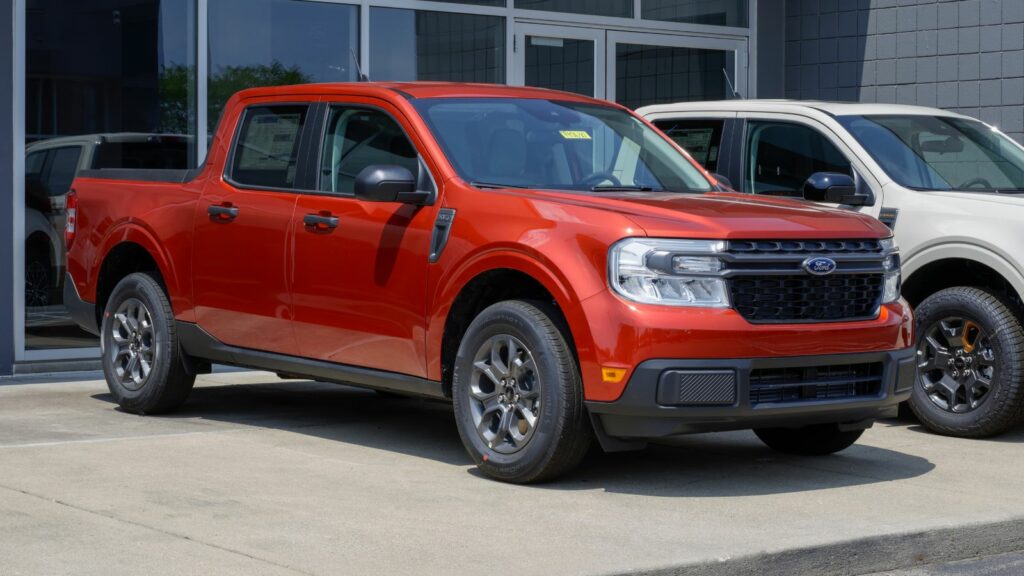
Ford’s third-quarter sales numbers tell two very different stories. Across the United States, Ford Motor Company sold 509,764 vehicles from July through September 2026, a 6.6% decline from the same period last year. Yet the Maverick compact pickup moved sharply in the opposite direction.
Ford sold 41,970 Mavericks during the quarter, an increase of just over 20% from 34,848 a year earlier. Even more striking was the performance of the Maverick Hybrid, which recorded a much larger increase and accounted for roughly two-thirds of the model’s quarterly sales.
The contrast reveals more than the success of one pickup. Ford is navigating discontinued models, expensive new vehicles, higher gasoline prices and changing demand for electrified powertrains. Maverick is emerging as one of the clearest examples of where buyers are still responding.
Maverick Is Becoming More Important to Ford
The Maverick’s third-quarter increase was substantial enough to change its position inside Ford’s overall sales mix. Deliveries climbed from 34,848 during the third quarter of 2025 to 41,970 this year, a gain of 7,122 trucks, or approximately 20.4%. Ford Motor Company, meanwhile, dropped from 545,522 vehicles to 509,764. In other words, Maverick was gaining thousands of buyers at the same time the company as a whole was losing more than 35,000 sales.
That divergence has made the compact truck a more meaningful part of Ford’s U.S. business. Maverick represented about 8.2% of Ford Motor Company’s third-quarter volume, compared with approximately 6.4% during the equivalent period last year. That does not suddenly make it Ford’s most important vehicle—F-Series remains vastly larger—but it demonstrates how quickly a comparatively young nameplate has established itself. A vehicle introduced for the 2022 model year is now providing meaningful support during a quarter when several older Ford products were disappearing or declining.
The Maverick Hybrid Is Doing Most of the Heavy Lifting
Maverick’s overall increase becomes even more interesting when its powertrain mix is examined. Ford sold a record 27,793 Maverick Hybrids during the third quarter, up 59.6% from a year earlier. That means approximately 66% of every Maverick sold during the quarter was a hybrid. The model’s growth therefore was not simply a broad increase spread evenly between gasoline and electrified versions. The hybrid was a major part of the story.
Its year-to-date performance reinforces that point. Ford reported 74,300 Maverick Hybrid sales through September, another record. That does not prove that fuel economy alone caused buyers to choose the truck. Availability, pricing, features and changing inventory can all affect sales results. It does show that an electrified pickup can appeal well beyond a niche audience when the technology is packaged into a relatively conventional vehicle. The Maverick does not ask owners to abandon gasoline stations or install home charging equipment. For many households, that makes hybridization feel like a smaller behavioural change than moving directly to a battery-electric truck.
Higher Gasoline Prices Have Made Efficiency Harder to Ignore
The timing of the Maverick Hybrid’s surge is notable because American drivers were paying substantially more for gasoline than they were a year earlier. Reuters reported that the national average for regular gasoline reached about $4.43 per gallon in September 2026, compared with $3.20 a year earlier. Ford executives also told Reuters that the company was seeing stronger demand for hybrid powertrains, including in its pickup lineup.
Higher fuel prices do not automatically explain the Maverick’s 20% gain, and individual purchasing decisions are rarely driven by one expense. They do, however, change the calculation for someone who drives thousands of miles each year. Ford rates a front-wheel-drive 2026 Maverick Hybrid at an EPA-estimated 42 mpg city, 35 mpg highway and 38 mpg combined. Those figures make fuel consumption a meaningful part of the truck’s value proposition. A commuter who also needs a pickup bed can therefore pursue better fuel economy without moving into a sedan or giving up the utility that prompted the truck purchase in the first place.
Maverick Sits Well Below the Average New-Vehicle Price
Maverick is also competing in an American vehicle market where affordability remains a serious constraint. Kelley Blue Book reported that the average new-vehicle transaction price reached $50,089 in August 2026, 1.9% higher than a year earlier. Even with some auto-loan rates easing, higher vehicle prices can leave shoppers facing difficult monthly-payment calculations, particularly when down payments and trade-in values do not close enough of the gap.
Ford’s current build-and-price tool lists the 2026 Maverick XL starting at $27,145 before a shopper adds options and applicable charges. Comparing a starting MSRP directly with an industry-wide transaction-price average is imperfect because the two figures measure different things, but the distance between them is still significant. The Maverick can move considerably higher as equipment is added, and not every truck on a dealer lot will be a base XL. Even so, Ford has a pickup whose entry point remains well below what buyers are typically spending on a new vehicle. In a market where $50,000 has become ordinary, that positioning is increasingly unusual.
Its Size Does Not Eliminate Everyday Truck Utility
The Maverick’s relatively low price would matter much less if its smaller dimensions made it impractical. Ford’s specifications show why the vehicle can work for buyers who need some truck capability without the size of a traditional full-size pickup. The 2026 Maverick seats up to five people and has a bed approximately 4 feet 5 inches long, with 33.3 cubic feet of cargo volume. That can be enough for bicycles, landscaping supplies, home-improvement materials or equipment that owners would rather not carry inside a crossover.
Towing capability also extends beyond purely urban duties, although the configuration matters. Ford rates the truck for 2,000 pounds of standard towing capability, while properly equipped versions with the available 4K Tow Package can tow as much as 4,000 pounds. Certain hybrid all-wheel-drive versions can be configured for that higher rating as well. None of that makes Maverick a substitute for a Super Duty when genuinely heavy towing is required. Its appeal is different: providing enough capability for many recreational and household jobs without forcing every buyer into a much larger, heavier and more expensive truck.
Escape and Corsair Explain Most of Ford’s 6.6% Drop
Ford’s companywide decline looks much less alarming once two outgoing models are separated from the calculation. The company is phasing out the Ford Escape and Lincoln Corsair, and their disappearing volume had an outsized effect on the third-quarter comparison. Together, Escape and Corsair sold roughly 38,849 vehicles during the third quarter of 2025 but only about 5,127 in the latest quarter—a reduction of 33,722 vehicles.
Ford Motor Company’s total year-over-year decline was 35,758 vehicles. That means the lost Escape and Corsair volume accounts for roughly 94% of the company’s net decline when the figures are compared mathematically. Removing those two models from both periods leaves Ford down only about 0.4%. Ford itself described adjusted volume as essentially unchanged and estimated that the broader U.S. industry declined about 1%. The distinction does not make the lost sales irrelevant; vehicles removed from a lineup still take revenue and showroom traffic with them. It does show that the 6.6% headline is partly a portfolio-transition story rather than evidence that every major Ford nameplate suddenly weakened.
Ford’s Truck Business Held Up Better Than the Overall Company
Maverick’s improvement also occurred inside a truck operation that performed considerably better than Ford Motor Company as a whole. Ford’s truck sales rose 0.5% year over year in the third quarter to 315,112 vehicles. That is hardly explosive growth, but it contrasts sharply with the companywide 6.6% decline. Trucks therefore remained a stabilizing force while Ford worked through changes elsewhere in the portfolio.
The much larger F-Series still dwarfs Maverick in total importance. Through September, Ford reported 561,508 F-Series sales, giving the company hundreds of thousands more deliveries than Maverick and reinforcing how dependent Ford remains on its traditional truck franchise. There were complications late in the quarter, including a short-term supplier issue affecting F-150 production. Ford said the problem had been resolved and expected the financial impact to remain within its existing full-year guidance. Maverick’s role should consequently be viewed as complementary rather than transformational. It is adding growth at the smaller end of Ford’s truck range while F-Series continues to carry vastly more overall volume.
The Full-Year Maverick Story Is Less Dramatic Than the Quarter
A 20.4% quarterly gain can easily create the impression that Maverick has been expanding at that pace throughout 2026. The year-to-date numbers show a more measured story. Ford sold 123,681 Mavericks through September, compared with 120,904 during the first nine months of 2025. That represents growth of approximately 2.3%—positive, but much smaller than the third-quarter increase highlighted in the headline.
Working backward from the published figures shows why. Maverick sold approximately 81,711 units during the first half of 2026, versus 86,056 in the first half of 2025. That means sales were down roughly 5% through June before the strong third quarter reversed the year-to-date decline. The summer therefore looks less like the continuation of uninterrupted growth and more like a meaningful acceleration after a softer start. That distinction will make the final quarter particularly important. If Maverick maintains its current momentum, 2026 could finish as another strong year. If sales cool again, the third quarter may look more like a temporary surge than the beginning of a new growth trajectory.
Maverick Shows the Opportunity—and the Challenge—Facing Ford
The most significant lesson from Maverick’s quarter may be that customers still respond when capability, efficiency and price intersect in a convincing package. Ford has a compact pickup starting far below the average new-vehicle transaction price, a hybrid capable of an EPA-estimated 42 mpg in city driving in its front-wheel-drive configuration, and enough bed and towing capability to handle tasks many households encounter regularly. Those attributes do not guarantee continued growth, but they help explain why Maverick occupies an unusual position in today’s market.
Ford still has a broader challenge. The company is replacing volume lost as Escape and Corsair disappear, managing an F-Series franchise that remains enormously important, and competing for buyers who are increasingly sensitive to both fuel and purchase costs. One successful compact pickup cannot solve every one of those issues. What Maverick does provide is a useful signal. Its strongest growth is coming from a hybrid version at a time when affordability and fuel expense are especially visible to consumers. If Ford can reproduce that combination elsewhere in its lineup, Maverick’s performance could matter well beyond the 41,970 trucks sold this quarter.
