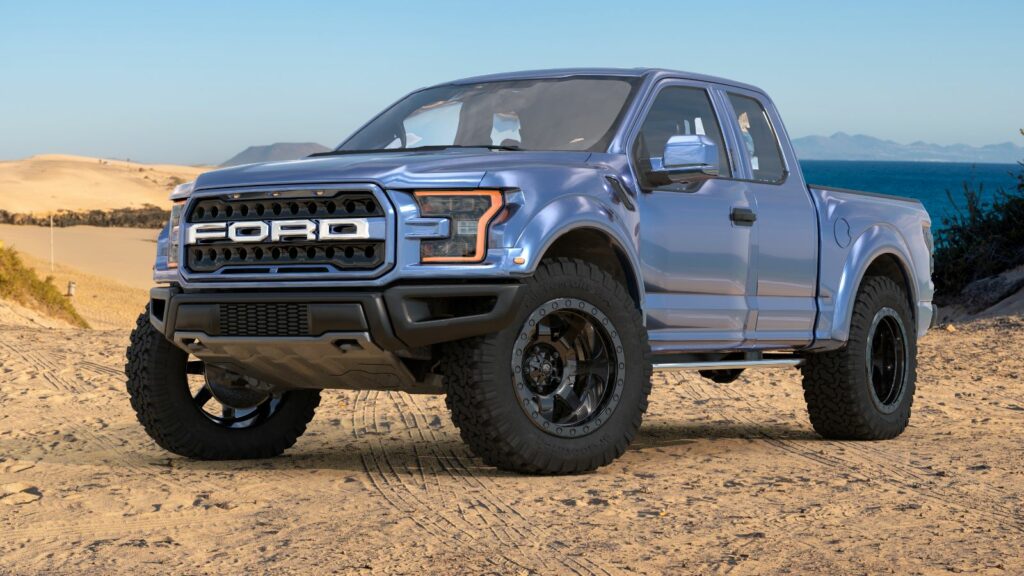
Ford is reshuffling one of the F-150’s familiar off-road configurations at an unusually sensitive moment for the North American truck business. For 2027, the dedicated STX FX4 equipment group disappears, but the FX4 hardware itself survives as a stand-alone package. That would ordinarily be a routine model-year adjustment. Instead, it arrives just as trucks have moved to the centre of an escalating Canada-U.S. trade dispute.
The two developments are separate: the F-150 is a light-duty pickup, while the late-stage tariff fight has focused on medium- and heavy-duty vehicles, including Canadian-built Ford Super Duty trucks. Yet their timing illustrates how decisions involving packages, engines, factories and tariffs are converging across a market where Ford’s F-Series has been Canada’s best-selling pickup line for six decades.
FX4 Is Staying, but the STX FX4 Equipment Group Is Not
Ford’s most visible 2027 change involves the way an F-150 STX buyer reaches the FX4 specification. The dedicated STX FX4 equipment group, known as 201A, has been deleted. For 2026, that group combined the STX 200A content with off-road hardware and appearance upgrades. Ford Authority reported a U.S. price of $3,885 for the 2026 201A group. Canadian Ford inventory listings confirm that 201A has been offered on 2026 STX trucks north of the border.
That does not mean Ford has abandoned FX4 on the STX. For 2027, FX4 becomes a freestanding option rather than its own higher equipment group. It is an important distinction for shoppers: the badge and capability package remain, but the buying path changes. Ford is effectively separating the off-road equipment from a broader bundle of STX features, giving the company more freedom to structure the trim lineup without maintaining another full equipment group.
The Hardware That Defines FX4 Mostly Survives the Reshuffle
The 2027 FX4 package retains the pieces that give the designation its practical meaning. Reported equipment includes an electronic-locking rear axle, off-road-tuned front shocks, monotube rear shocks, skid plates protecting key components, Hill Descent Control and Rock Crawl Mode. Axle ratios vary with engine choice. The package also carries the familiar FX4 exterior identification and a tray-style floor liner where applicable.
What disappears with 201A is the assumption that all the old STX FX4 bundle’s content travels together. The 2026 group also included items such as 18-inch black-painted aluminum wheels, all-terrain tires, black running boards and dual exhaust with black tips. Some equipment can now depend on other packages or selections. For a Canadian buyer comparing a remaining 2026 STX FX4 on a dealer lot with a factory-ordered 2027 truck, matching the specification line by line will therefore matter more than simply looking for an FX4 decal on the box.
Ford Is Simplifying More Than One Corner of the 2027 F-150 Lineup
The FX4 move fits a wider restructuring of the 2027 F-150 order book. Ford Authority reports that the STX FX4 201A group is one of several equipment combinations being eliminated, alongside the XLT 303A group and a particular long-wheelbase Lariat 500A configuration. Other content remains obtainable through different packages or options, suggesting Ford is reducing the number of factory combinations rather than simply stripping equipment from the truck.
There is also a meaningful powertrain change. The 2.7-litre EcoBoost V6, long familiar as an F-150 engine, is being replaced in base applications by a 3.0-litre EcoBoost V6 for 2027. The 5.0-litre V8 becomes available more broadly, while the 3.5-litre EcoBoost and PowerBoost hybrid continue. Ford is even applying the package-reset idea higher in the range: the standard U.S.-market Raptor gets a lower headline price for 2027 after several previously standard comfort features move into an optional equipment group.
Canada’s Truck-Heavy Vehicle Market Makes Small F-150 Changes Matter
Few nameplates have the Canadian reach of F-Series. Ford says F-Series finished 2025 as Canada’s best-selling line of pickup trucks for the 60th consecutive year. That kind of longevity means an ordering change that might look like dealer minutiae can affect a substantial number of buyers, fleets and resale shoppers. Pickup specifications in Canada also have to cover unusually broad use cases, from urban commuting to construction, agriculture, towing and winter travel.
Statistics Canada’s broader market data help explain that prominence. Just under 2 million new motor vehicles were sold nationally in 2025, and the agency’s broad “truck” category accounted for 88% of sales. That category includes SUVs, vans, light and heavy trucks and buses, so it should not be confused with pickups alone. More narrowly, new pickup registrations increased 0.9% in 2025. The market has clearly shifted away from traditional passenger cars and toward utility-oriented vehicles, making configuration decisions on a high-volume pickup particularly visible.
The Tariff Dispute Is About a Different Weight Class
The timing creates an easy misconception that deserves separating carefully. An F-150 STX is a light-duty pickup. Statistics Canada generally classifies light trucks and commercial vans through Class 3, with gross vehicle weight ratings up to 14,000 pounds. Medium- and heavy-duty vehicles occupy Classes 4 through 8 above that threshold. The U.S. tariff regime introduced for medium- and heavy-duty vehicles is therefore a different policy issue from Ford’s 2027 F-150 package reshuffle.
That distinction became politically significant during the Canada-U.S. negotiations that ended without an agreement on August 21. Reuters reported that Canada wanted favourable tariff treatment being discussed for light-duty vehicles extended to medium- and heavy-duty trucks. Washington resisted. Prime Minister Mark Carney specifically pointed to Canadian-made Ford F-350, F-450 and F-550 models as examples of vehicles that could be put at a competitive disadvantage. In other words, FX4 provides the timely Ford connection, but Super Duty is where the trade stakes intensified.
Oakville Has Turned Super Duty Into an Industrial Policy Issue
The truck argument carries unusual weight because Ford is preparing Oakville, Ontario, for large-scale Super Duty production. A federal contribution agreement signed in March 2026 is worth $464.5 million and supports refurbishment of the Oakville Assembly Complex as well as a new onsite stamping operation. The government record says the project is intended to support annual production of as many as 100,000 Super Duty vehicles and approximately 1,800 jobs at the plant.
That investment changes the political meaning of a truck tariff. A few years ago, a fight over medium- and heavy-duty imports could have seemed more remote from Canada’s best-known passenger-vehicle factories. Now one of Ontario’s major assembly facilities is being specifically rebuilt around Ford’s largest pickups. The factory plan also represents a major strategic pivot for Oakville after Ford moved away from its earlier electric-vehicle manufacturing plan there. Tariff treatment of large pickups is consequently tied directly to investment, employment and future production volumes in southern Ontario.
A Potential Auto Compromise Ran Into the Heavy-Truck Question
Only days before negotiations collapsed, a partial auto compromise appeared possible. Reuters reported that negotiators were discussing reducing the U.S. tariff on Canadian-built cars and light trucks from 25% to 15%, with Canadian industry representatives seeking an even lower 10% rate. The structure under discussion could also have reduced the effective burden further by recognizing U.S.-made content inside Canadian-assembled vehicles.
The heavy-truck question became one of the main late-stage sticking points. Canada sought comparable treatment for medium- and heavy-duty models, according to Reuters, while the United States resisted extending the proposed terms. Carney later described the exclusion as a major problem because of models slated for Canadian production. When the broader talks failed, the U.S. proceeded with new 50% tariffs on roughly US$20 billion of Canadian exports in other targeted categories. Canada responded by announcing dollar-for-dollar countertariffs scheduled to begin September 8. The auto compromise, including the truck dispute, was left unresolved.
Integrated Supply Chains Make a Vehicle Tariff More Complicated Than Its Headline Rate
North American vehicle production rarely fits neatly inside one national border. Canadian government briefing material notes that Canadian-assembled vehicles contain roughly 50% U.S. content on average. Under the existing U.S. automotive tariff structure, that U.S. content can materially reduce the effective duty on qualifying Canadian vehicles. The same integration helps explain why governments and manufacturers focus so intensely on rules governing content, parts and vehicle classification rather than only the headline percentage.
The medium- and heavy-duty regime introduced in November 2025 follows a related principle. U.S. tariffs of 25% apply to non-U.S. content in qualifying medium- and heavy-duty vehicles, subject to specific treatment and approvals, while non-compliant parts can also face duties. For an Oakville-built Super Duty, competitiveness can therefore depend on where components originate, how a model is classified and what exemptions survive negotiations. A pickup can cross borders in component form several times before arriving at a dealership, making tariff policy an operating-cost issue throughout the supply chain.
Ford’s Product Flexibility Matters More When the Market Is Uncertain
There is no evidence that Ford eliminated the STX FX4 201A group because of the Canada-U.S. tariff dispute, and treating the events as cause and effect would overstate what is known. Model-year package revisions are normal, and the 2027 F-150 changes extend well beyond FX4. Still, reducing rigid equipment-group combinations gives an automaker additional flexibility over what gets bundled, priced and produced as demand, costs and component availability change.
That flexibility is increasingly useful in a market shaped by tariffs and changing consumer budgets. Ford’s 2027 Raptor strategy offers another example: a lower advertised starting price comes with several features shifted into an optional package, allowing buyers to decide whether they want to pay for them. The STX FX4 change works differently, but it follows the same broad logic of separating capability or comfort content from a fixed high-level bundle. For shoppers, the result is potentially more choice, accompanied by more homework.
Canadian Buyers Now Have Two Sets of Numbers to Watch
For individual truck shoppers, the immediate questions are relatively straightforward: what Ford Canada ultimately charges for a 2027 STX equipped with FX4, which combinations appear in the Canadian order system, and how closely the resulting truck matches a 2026 STX FX4 201A. As of August 23, reporting on the new package had not established final Canadian pricing. Remaining 2026 inventory may therefore remain an important comparison point for buyers who want the older bundled configuration.
For the industry, the numbers are far larger. The Oakville project targets as many as 100,000 Super Duty trucks annually and around 1,800 plant jobs, while Canada and the United States are now dealing with a renewed tariff confrontation after negotiations were suspended. Canada’s announced countermeasures are scheduled for September 8, and Reuters reported no immediate new round of U.S.-Canada talks was planned after the collapse. The FX4 badge will survive 2027. The harder question is what trade environment Canadian-built Ford trucks will be entering.
