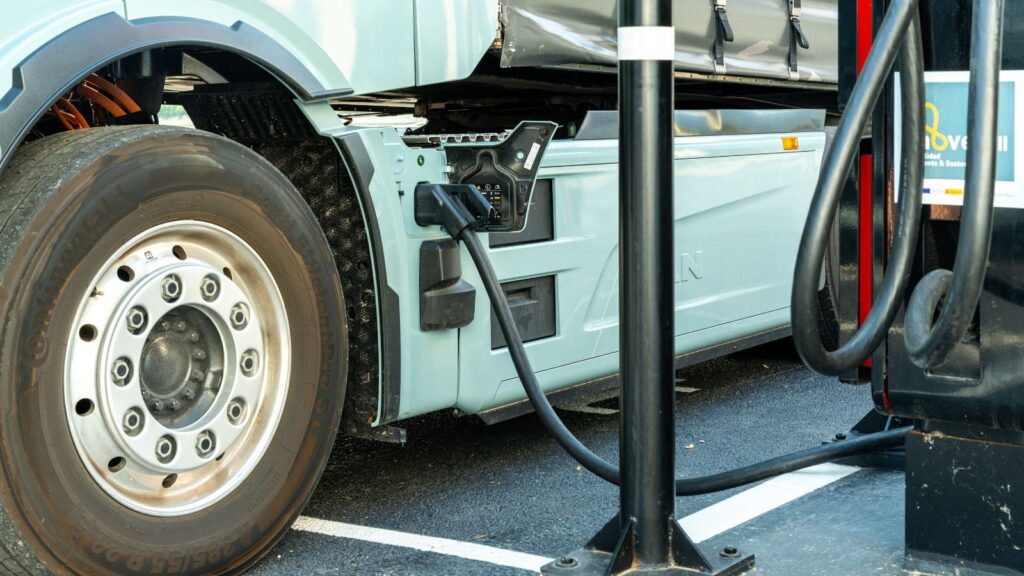
At Hannover’s IAA Transportation, one of the biggest questions hanging over electric freight is no longer whether a battery-powered truck can move a heavy load. The harder question is whether it can stop, recharge and return to work without destroying the tight schedules that make long-haul trucking profitable.
Megawatt charging is moving directly into that fight. Live demonstrations at IAA Transportation 2026 are showing heavy electric trucks taking on large amounts of energy within the same breaks professional drivers already have to take. The technology does not erase every advantage diesel enjoys, from mature fueling infrastructure to lower purchase prices in many markets. But it attacks one of the most stubborn objections to battery-electric freight: the fear that charging will leave an expensive truck and driver sitting still for too long.
Megawatt Charging Moves From Test Bench to Show Floor
The significance of the IAA demonstrations is less about producing an eye-catching power number and more about proving that different trucks and charging equipment can work together in a setting built around commercial operations. Daimler Truck, MAN Truck & Bus and Scania joined charging-network operator Milence for the megawatt demonstrations surrounding the Hanover show. IAA said participating vehicle batteries could reach 80 percent or, depending on the vehicle and starting state of charge, a full charge within the 30-to-45-minute windows being demonstrated.
Public demonstrations continued on September 15 at the IAA Driving Experience area, turning a technology that had spent years in standards work, prototypes and controlled trials into something fleet managers could watch operate. Milence is also using the event to test interoperability between different truck brands and charging equipment. That matters because a freight operator cannot build schedules around a charging system that only works reliably with one particular combination of vehicle and dispenser. Diesel became dominant partly because fueling became routine. Electric freight needs the same predictability.
The Real Benchmark Is a Driver’s 45-Minute Break
A megawatt charger does not need to make an electric truck refill as quickly as a diesel pump to change the economics of freight. It needs to prevent charging from becoming additional downtime. European driving rules make that target unusually clear: after 4½ hours behind the wheel, a professional driver generally must take a break of at least 45 minutes. If enough energy can be transferred during that mandatory stop, charging can become part of the schedule instead of an interruption to it.
That is why manufacturers keep framing MCS around rest periods rather than record-setting peak power alone. MAN says the combination of its eTGX and megawatt charging can support daily distances above 1,000 kilometres without extending working time beyond what would be required for a diesel truck. Real routes will vary with payload, weather, terrain, traffic and charger availability, but the operational logic is powerful. A truck that charges while its driver must already be stationary eliminates one of the largest productivity penalties historically associated with battery-electric long-haul transport.
A Common Megawatt Plug Reduces a Major Fleet Risk
High-power charging becomes much more valuable when operators know the same connector can serve trucks from competing manufacturers. The Megawatt Charging System was designed around that requirement. CharIN’s technical framework calls for a single conductive connection capable of operating at up to 1,250 volts and 3,000 amps, giving the architecture a theoretical ceiling of 3.75 megawatts. That is far beyond the charging power used by most passenger cars and reflects the enormous batteries and tight turnaround times involved in heavy freight.
Standardization took another important step in 2026 with publication of IEC TS 63379, covering connectors, vehicle inlets and cable assemblies for conductive DC megawatt charging. For fleets, that work is not an obscure engineering detail. A fragmented charging market could leave an operator dependent on proprietary stations, complicate cross-border freight and make expensive infrastructure obsolete. A common system instead creates the possibility that a Scania, MAN or another compatible truck can enter the same freight hub, connect and leave without the operator redesigning the facility around individual brands.
MCS-Capable Trucks Are Starting to Reach Customers
The vehicle side of the equation is moving beyond prototypes as well. MAN began series production in 2026 of eTGX and eTGS trucks equipped for MCS, with the manufacturer specifying charging power of up to 750 kW on the initial system. Deliveries are being spread across several European markets. That is important because charging networks make little commercial sense without trucks capable of using them, while fleet operators are reluctant to order expensive electric tractors if suitable high-power infrastructure remains years away.
Scania is pushing the same operational equation from another direction: more battery capacity combined with faster charging. Its latest long-distance configuration can be specified with batteries mounted both in the chassis and behind the cab, with the company quoting maximum range of up to roughly 720 kilometres in the appropriate configuration. MCS is central to keeping that larger energy capacity usable during a working day. The emerging pattern is clear: manufacturers are no longer treating range and charging speed as separate engineering competitions. They are designing them together around actual freight schedules.
The Shift From 400 kW to Megawatt Power Will Be Gradual
Not every electric truck arriving now will immediately depend on a megawatt charger. Daimler Truck’s latest eActros Lowliner variants illustrate the transition. The vehicles retain CCS2 charging at up to 400 kW, with Daimler quoting roughly 46 minutes for a two-battery version and around 70 minutes for a three-battery version to move from 10 to 80 percent under specified conditions. That is already useful for depot and regional operations, but it can remain awkward for tightly scheduled long-distance work.
Daimler plans to add MCS capability to these versions during the second half of 2027, targeting charging times below 30 minutes. The progression shows why conventional high-power CCS will not suddenly disappear when megawatt charging expands. Fleets use trucks for very different jobs. A vehicle returning to a warehouse every night may rarely require MCS, while a tractor repeatedly crossing national borders may depend on it. The likely charging ecosystem therefore includes slower overnight depot charging, 350-to-400-kW opportunity charging and megawatt stops reserved for routes where every minute of productive time matters.
Europe Still Needs Far More Truck-Suitable Chargers
The technology demonstrated in Hanover is arriving before a complete European network exists to support it. The International Energy Agency estimates that Europe currently has more than 4,000 publicly accessible charging points suitable for heavy-duty vehicles, with only part of that total dedicated exclusively to trucks. More than two-thirds of the truck-exclusive units identified by the IEA operate between 350 kW and 1 MW, while the number above one megawatt remains comparatively small.
The direction of regulation is nevertheless clear. Under the EU’s Alternative Fuels Infrastructure Regulation, heavy-duty charging pools are supposed to expand progressively along the Trans-European Transport Network. By 2030, the core network is generally expected to have heavy-duty charging pools no more than 60 kilometres apart in each direction, while the comprehensive network uses a 100-kilometre target. Industry estimates go further: ACEA has calculated that meeting Europe’s truck-decarbonization goals could require roughly 50,000 public heavy-duty charging points by 2030, including around 35,000 MCS-capable units. Building trucks is increasingly the easier half of the challenge.
A Megawatt Charger Is Also a Grid-Infrastructure Project
Installing a one-megawatt dispenser is not comparable to adding another fuel pump. A busy truck site with several high-power connections can create multi-megawatt electricity demand, bringing transformers, utility connections, site design and load management into the freight-planning discussion. The IEA notes that grid upgrades for large depots can take anywhere from one to several years, depending on the connection involved. Poorly managed charging can also create high peaks that make projects more expensive than necessary.
That explains why Milence’s IAA setup is demonstrating more than a cable and a truck. Battery energy storage and intelligent energy management are part of the display, specifically as tools for sites where available grid capacity is constrained. Broader European modelling points in the same direction. A Siemens study commissioned with industry groups estimated that smarter EV load management could reduce required distribution-grid investment by billions of euros through 2030. Megawatt charging therefore turns logistics companies into energy planners. Choosing when trucks charge may become almost as important as choosing where they travel.
The Cost Battle Is Becoming More Complicated Than Purchase Price
Electric heavy trucks still face an obvious disadvantage in the showroom. The IEA estimates they can cost roughly two to three times as much to purchase as diesel equivalents in some markets. Yet truck operators rarely make decisions from sticker price alone. Energy, maintenance, financing, road tolls, charging infrastructure, residual value and annual kilometres all shape total cost of ownership. The IEA expects electric-truck TCO in Europe to approach diesel parity by 2030, although the result will vary sharply between countries and operating profiles.
Some policy environments are already changing that calculation. ICCT modelling for Germany found battery-electric trucks could achieve lower five-year ownership costs than diesels under the country’s current road-toll structure, including an estimated advantage for long-haul applications. That result depends heavily on assumptions about electricity prices and policy. It also explains why charging speed matters financially: the economic case weakens when trucks spend too much time idle. MCS is therefore not merely a technical upgrade. It is an attempt to turn cheaper electric propulsion into usable commercial productivity.
Tesla and BYD Are Making the Race More International
IAA is also demonstrating that European manufacturers are no longer competing only with one another. Tesla is preparing the Semi for Europe, with a regional version advertised at up to about 550 kilometres of range at a 40-tonne gross vehicle weight. Reuters reported that Tesla says the truck can recover roughly 60 percent of its range in 30 minutes using its high-power charging system. After years of delays, the Semi’s European push brings another major brand into the battle over long-distance electric freight.
BYD is arriving with an even more aggressive charging claim. Its ETT 44 shown at IAA uses a 651-kWh Blade Battery and a 1.5-megawatt charging system. BYD says the truck can move from 20 to 80 percent charge in roughly 20 minutes under suitable conditions, while offering an estimated maximum range of about 600 kilometres. The company plans to launch its first heavy-duty truck in Europe in 2027 and has also discussed eventually producing trucks locally. Competition is increasingly about complete ecosystems: truck, battery, charger, energy management, financing and service.
Diesel Still Has Scale, but Its Time Advantage Is Under Attack
For all the technological progress in Hanover, diesel remains overwhelmingly dominant in European trucking. ACEA reported that diesel models represented 92.1 percent of new EU truck registrations during the first half of 2026. Electrically chargeable trucks grew quickly, but their share reached only 4.8 percent. Those numbers illustrate the enormous difference between proving that an electric truck can do the work and persuading thousands of fleet operators to restructure depots, financing, routes and energy supply around it.
European truckmakers themselves are warning that the transition is not moving quickly enough, with manufacturers pressing policymakers over charging infrastructure, grid connections, energy costs and the economics of zero-emission vehicles. Megawatt charging cannot solve all of those problems. What it can do is remove one of diesel’s most important practical defenses: the belief that only liquid fuel can restore enough operating range during a normal working stop. If reliable MCS corridors spread beyond demonstrations and into everyday freight networks, the diesel advantage will increasingly be measured in infrastructure and economics rather than charging time alone.
