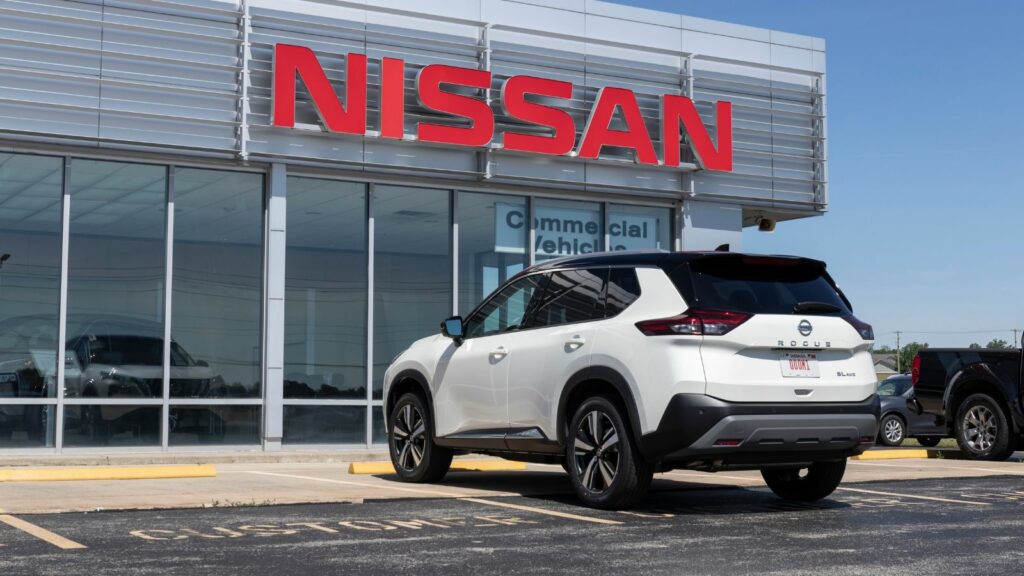
North America’s compact-SUV market is changing faster than Nissan can afford to ignore. Hybrids have moved from a fuel-saving alternative to a major part of the showroom mix, helped by buyers who want lower fuel consumption without depending entirely on charging infrastructure. Nissan is responding by putting the Rogue—one of its most important North American vehicles—at the centre of its hybrid expansion.
The all-new 2027 Rogue Hybrid will introduce Nissan’s third-generation e-POWER technology to U.S. and Canadian customers, with the company targeting a late-2026 arrival. It comes after Nissan launched a Rogue Plug-in Hybrid earlier in 2026 and repeatedly signalled that faster hybrid deployment is central to its North American strategy. The timing matters: Toyota and Honda already have established hybrid SUVs attracting buyers in large numbers.
Nissan’s Hybrid Push Has Become Much More Urgent
Nissan has been moving toward a hybrid Rogue for years, but the pressure to get one into North American showrooms has intensified. The company previously told investors that it intended to expand hybrid technology rapidly in the United States, initially through the Rogue Plug-in Hybrid and then through an e-POWER version. Nissan now says the all-new 2027 Rogue Hybrid is expected to reach U.S. dealers in late 2026, bringing its third-generation e-POWER system to America for the first time. Canada is scheduled to receive the redesigned Rogue Hybrid as well.
That makes 2026 a pivotal transition year for the nameplate. Nissan began selling its Rogue Plug-in Hybrid earlier in the year, giving dealers an electrified option while the more strategically important e-POWER model was being prepared. The company is not abandoning gasoline overnight; the current 2026.5 Rogue remains available with its 1.5-litre VC-Turbo engine. Instead, Nissan is rapidly broadening the powertrain menu. For a household replacing a conventional compact SUV, that means the Rogue lineup is evolving from essentially one propulsion strategy into gas, plug-in hybrid and no-plug hybrid choices.
Hybrid Demand Is No Longer a Niche Part of the Market
The market Nissan is entering looks very different from the one automakers were planning around only a few years ago. Hybrids accounted for roughly 19% of U.S. retail vehicle sales in August 2026, according to industry data reported by Reuters. High fuel prices have strengthened interest, but the shift is broader than one month of gasoline volatility. Cox Automotive also reported continued strong demand for hybrid vehicles during August, even as the overall new-car market dealt with inflation, high interest rates and trade uncertainty.
Canada is showing a similar pattern. Statistics Canada reported that registrations of new hybrid electric vehicles jumped 39.5% in the second quarter of 2026 compared with the same period a year earlier—the strongest growth rate among the fuel categories it tracked. That does not mean gasoline-only SUVs are disappearing. It does show that an increasing share of shoppers has another realistic choice. For a family that still wants to refuel in minutes during a long highway trip but would rather burn less gasoline during weekday commuting, a conventional hybrid increasingly sits in a practical middle ground between an internal-combustion SUV and a battery-electric model.
e-POWER Gives the Rogue a Different Kind of Hybrid System
The Rogue Hybrid will not simply copy the mechanical formula used by every established rival. Nissan’s e-POWER system is technically a series hybrid: electric motors drive the wheels, while a gasoline engine primarily acts as an onboard generator. There is no requirement to connect the vehicle to a charger. The driver fills the tank much like a conventional Rogue, but acceleration comes from electric motors rather than having the gasoline engine mechanically provide the primary wheel-driving force. Nissan says the North American Rogue Hybrid will use dual electric motors and standard Intelligent All-Wheel Drive.
That arrangement is designed to give e-POWER some of the immediate response and smoothness associated with a battery EV without the charging routine. Nissan is also including e-Pedal functionality, allowing greater control of acceleration and deceleration through the accelerator pedal in many driving situations. The technology is not untested: Nissan says nearly two million e-POWER-equipped vehicles have been sold globally since the system’s 2016 introduction. Its third-generation design uses a more integrated “5-in-1” electric unit and a purpose-built generator engine. Nissan has reported significant efficiency improvements from the latest system in its European Qashqai, particularly during faster highway driving.
Rogue Is Too Important to Nissan for the Hybrid Gap to Continue
The Rogue is more than another model receiving a new engine option. Nissan classifies Rogue as one of its global “core” vehicles—the products expected to provide scale, customer loyalty and business stability. That role is particularly important in the United States, which Nissan now describes as a market where it wants to rebuild scale and profitability. Rogue is also assembled at Nissan’s Smyrna, Tennessee plant, giving the nameplate a central place in the company’s North American manufacturing footprint.
Recent performance illustrates why Nissan is putting so much attention on it. The company reported that U.S. Rogue sales increased 39% year over year during its fiscal 2026 first quarter. Nissan has simultaneously been restructuring through its Re recovery program, reducing costs, simplifying its global model lineup and trying to concentrate investment on vehicles with the strongest commercial potential. In that environment, leaving a high-volume crossover without a mainstream hybrid option becomes difficult to justify. A successful e-POWER Rogue could do more than improve fuel economy figures; it could help Nissan protect one of the products its turnaround depends upon.
Toyota and Honda Have Already Shown What Nissan Is Chasing
Nissan will not arrive in an empty segment. Toyota and Honda have spent years making hybrid versions of their popular compact crossovers familiar to mainstream buyers. Toyota went further with the newest RAV4, making its 2026 U.S. lineup exclusively electrified through hybrid and plug-in-hybrid powertrains. Toyota reported 118,016 U.S. RAV4 Hybrid sales during the first six months of 2026. In Canada, electrified vehicles accounted for 64.3% of Toyota Canada’s August sales, while the Canadian-built RAV4 Hybrid recorded another record month.
Honda is seeing the same appetite. American Honda reported a record August for hybrid sales in 2026, moving more than 36,000 hybrid vehicles during the month, with the CR-V Hybrid also recording its best August. Total CR-V sales surpassed 37,000 units that month. Those numbers matter because Rogue competes directly for many of the same suburban garages. A shopper comparing a CR-V, RAV4 and Rogue can already purchase mature hybrid versions of the first two. Nissan’s challenge is not simply proving that e-POWER works; it must persuade buyers that arriving later has produced something compelling enough to change an established shopping pattern.
The Plug-In Rogue Is Buying Nissan Valuable Time
Nissan has already placed an electrified Rogue in showrooms through the 2026 Rogue Plug-in Hybrid. It offers an EPA-estimated 38 miles of electric range and up to 420 miles of total gasoline-and-electric range, along with all-wheel drive and seating for seven. Its combined output is rated at 248 horsepower and 332 lb-ft of torque. Nissan lists the U.S. starting price at $45,990 before destination charges, placing it well above the $29,490 starting price of the 2026.5 gasoline Rogue.
The plug-in model also illustrates how Nissan is using partnerships to fill product gaps faster. Mitsubishi Motors produces the Rogue Plug-in Hybrid at its Okazaki plant in Japan as an OEM model for Nissan, reflecting the two companies’ alliance and Mitsubishi’s long experience with plug-in-hybrid SUVs. That approach allowed Nissan to enter the segment before its own next-generation e-POWER Rogue was ready. For buyers able to charge at home and make most daily trips within its electric range, the PHEV can substantially reduce gasoline use. The upcoming e-POWER model targets a different customer: someone wanting hybrid efficiency and electric-motor driving characteristics without changing refuelling habits.
Price May Determine Whether e-POWER Becomes a Breakthrough
The biggest unanswered question is how Nissan will price the Rogue Hybrid. As of mid-September 2026, Nissan’s public information confirms a late-2026 arrival, dual-motor e-POWER, standard all-wheel drive and the redesigned fourth-generation Rogue, but final U.S. pricing and official EPA fuel-economy ratings have not yet been published. Those figures will determine whether e-POWER becomes a high-volume powertrain or remains a more expensive alternative chosen primarily by technology-focused buyers.
The competitive benchmarks leave little room for error. Toyota’s 2026 RAV4 Hybrid began at $31,900 in the United States, while Honda listed the 2026 CR-V Sport Hybrid from $35,630. Nissan’s current gasoline Rogue starts at $29,490, whereas its Rogue Plug-in Hybrid begins at $45,990. A no-plug Rogue Hybrid priced much closer to the conventional model would give Nissan access to a substantially broader group of shoppers. That could be especially important as fuel-conscious buyers increasingly expect electrification to be offered in mainstream SUVs rather than treated as a premium specialty. For Nissan, the e-POWER Rogue is arriving at exactly the moment that expectation is becoming difficult to ignore.
