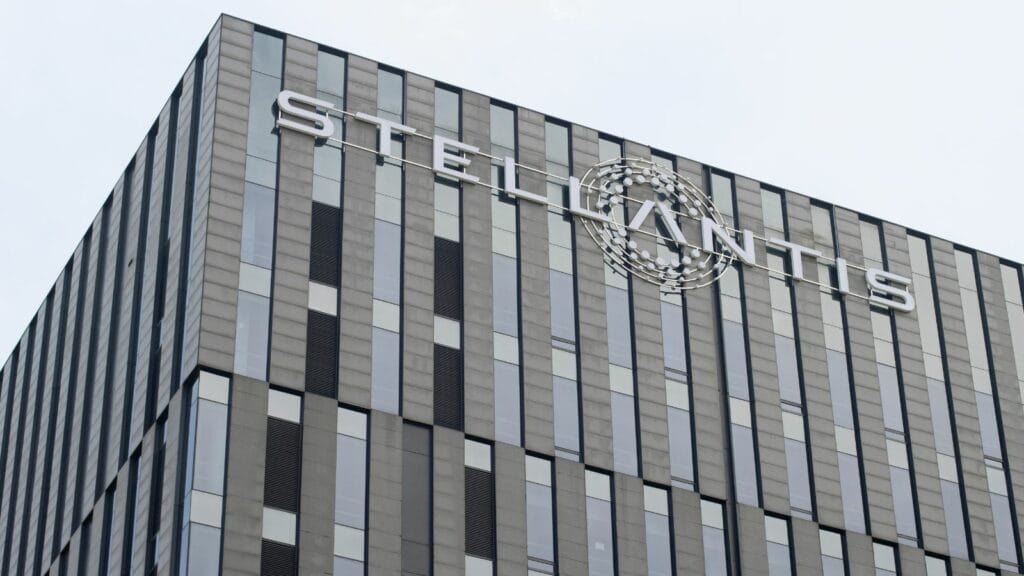
Stellantis is facing growing pressure from investors and Canadian officials as two major European financial institutions downgrade the automaker’s stock while shares tumble to new lows. On November 17, 2026, Oddo BHF and Landesbank Baden-Württemberg both lowered their recommendations, raising fresh concerns about the company’s ability to restore profitability and generate cash.
The downgrades come during an increasingly contentious dispute over Stellantis’s Brampton, Ontario, assembly plant, which the company has agreed to sell to Canadian defence manufacturer Roshel. With more than 2,000 workers facing an uncertain future and Ottawa threatening financial penalties over unfulfilled commitments, the controversy has become another test of Stellantis’s long-term strategy. The central question is whether the automaker can rebuild investor confidence while managing mounting financial, political and industrial pressures.
Oddo BHF Warns Stellantis Could Face Further Declines
French financial services group Oddo BHF delivered one of the most significant warnings on November 17, downgrading Stellantis from neutral to underperform. The firm also slashed its price target from €4.50 to €3.00, a reduction of approximately 33%. The revised target suggested that the company’s shares could face additional downward pressure despite already suffering substantial losses. The downgrade reflected growing doubts about Stellantis’s ability to deliver the financial recovery that investors had previously expected.
Analysts led by Michael Foundoukidis lowered their estimates for 2027 and 2028, pointing to rising raw material and electronic component costs. Oddo BHF estimated approximately €2.2 billion in additional gross cost pressures during 2027, potentially absorbing much of the benefit from planned efficiency improvements. The firm projected an adjusted operating margin of just 1.6% in 2027, compared with a 2.3% Visible Alpha consensus estimate. It also forecast negative free cash flow of approximately €2.2 billion that year. These are analyst projections rather than company guidance, but they illustrate why the bank believes Stellantis’s recovery could take longer than previously anticipated.
Landesbank Baden-Württemberg Cuts Its Recommendation and Price Target
Germany’s Landesbank Baden-Württemberg, commonly known as LBBW, added to the negative outlook by downgrading Stellantis from buy to hold. The bank simultaneously reduced its price target from €6.40 to €3.50, a decrease of approximately 45%. The substantial revision was another setback for an automaker attempting to convince investors that its restructuring efforts will eventually restore profitability and shareholder value.
The distinction between the two downgrades is important. While Oddo BHF issued an underperform recommendation and a €3.00 target, LBBW’s hold rating was less negative, with a target slightly above the share price reported during Tuesday’s trading. Nevertheless, the scale of LBBW’s reduction demonstrated how much its valuation outlook had changed. The bank’s detailed reasoning was not fully disclosed in the publicly available reports, so the downgrade should not be attributed specifically to the Brampton dispute. Together, the two decisions showed that investor concerns extended well beyond one Canadian factory. Stellantis was also contending with questions about its profitability, manufacturing strategy, operating costs and ability to produce sustainable financial improvements.
Stellantis Shares Fall to Their Lowest Levels in Five Years
The stock market reaction added urgency to the downgrades. On November 17, Stellantis shares trading in Paris touched €3.28, establishing a new five-year low and falling below the €3.36 level reached the previous day. During Tuesday’s session, the stock was trading around €3.30, down approximately 2.5%. The decline extended a difficult period in which the company’s shares had lost approximately 16.9% over one week and 28.4% over three months, according to intraday market reporting.
The broader picture was even more troubling. By mid-November, Stellantis had lost approximately 62% of its stock-market value per share since the beginning of 2026, underscoring the scale of the decline. Although some financial commentary described the latest trading levels as historic lows, the independently reported five-year low is the more precise description. The selloff also cannot be attributed exclusively to the Brampton controversy. Weak profitability, cash consumption, production adjustments and uncertainty surrounding future vehicle programs have all contributed to questions about the company’s outlook. For investors, the latest price movement was another indication that Stellantis still has considerable work ahead to restore confidence.
Rising Manufacturing Costs Threaten Stellantis’s Recovery Strategy
A central concern behind the financial downgrades is whether Stellantis can reduce expenses quickly enough to offset rising manufacturing costs. The company has introduced a restructuring strategy called FaSTLAne 2030, targeting €6 billion in annualized cost reductions by 2028 compared with 2025. Its longer-term objectives include reaching a 7% adjusted operating margin by 2030 and generating positive industrial free cash flow beginning in 2027. Management reported in October that it expected to implement at least 40% of the planned €6 billion in annualized savings by the end of 2026.
However, external cost pressures are complicating those ambitions. During an automotive industry gathering in Milan on November 12, Stellantis CEO Antonio Filosa warned that raw materials, memory chips, printed circuit boards and semiconductors could become significantly more expensive in 2027 and potentially 2028. A company spokesperson later clarified that Filosa’s reference to billions of euros concerned the company’s overall annual cost base, rather than a precise forecast of additional inflation expenses. Stellantis has also estimated approximately €1 billion in tariff costs for 2026. These pressures help explain why analysts are questioning whether efficiency improvements will translate into a meaningful recovery in profit margins.
Stellantis’s Latest Financial Results Reveal a Difficult Turnaround
Stellantis’s third-quarter financial results illustrate why investors remain cautious despite signs of operational improvement. In October, the automaker reported €37.6 billion in quarterly revenue, an increase of approximately 1% from the same period in 2025. Its net loss narrowed considerably to €453 million, compared with approximately €4.5 billion a year earlier. Adjusted operating income reached €256 million, producing a margin of just 0.7%. Although that represented improvement from the previous year’s 0.2% margin, profitability remained thin for a company operating such an extensive global manufacturing network.
Cash generation remains an especially important concern. Stellantis reported negative industrial free cash flow of approximately €4 billion during the quarter, compared with negative €4.3 billion a year earlier. The company also reported €42.7 billion in industrial available liquidity at the end of September, demonstrating that its weakened share price should not be confused with an immediate inability to meet its financial obligations. Nevertheless, North American revenue declined 3% year-over-year, partly because of planned production downtime. Management continues to expect positive industrial free cash flow in 2027, but investors are increasingly focused on how quickly that forecast can become a demonstrated financial result.
The Brampton Plant Dispute Has Become a Major Political Flashpoint
The dispute surrounding Stellantis’s Brampton assembly plant began long before the latest analyst downgrades. Vehicle production stopped in late 2023 as the company prepared to retool the facility, with work beginning in early 2024. The plant had been expected to manufacture the Jeep Compass, providing a future for thousands of automotive workers. However, Stellantis suspended its plans in 2025 and subsequently shifted the planned production to Belvidere, Illinois, as Trump’s tariffs created new challenges for Canadian vehicle manufacturing.
The change became part of Stellantis’s much larger American expansion strategy. In October 2025, the company announced plans to invest US$13 billion across its U.S. operations over four years, including more than US$600 million to restart its Belvidere plant and support approximately 3,300 jobs. Production there was expected to begin in 2027. For Brampton employees, however, the announcement meant that a vehicle program they had been anticipating would instead be built across the border. During a November 16 debate in Ontario’s legislature, opposition leader Marit Stiles described speaking with a worker named Rocco who had recently been involved in retooling the factory. His experience illustrated the uncertainty confronting workers who had prepared for a restart that never materialized.
Stellantis’s Agreement With Roshel Creates New Uncertainty for Workers
On November 9, Stellantis announced that it had signed an asset purchase agreement to sell the Brampton assembly plant and associated equipment to Canadian defence technology company Roshel. The purchase price was not disclosed. Although several public statements described the facility as already sold, Stellantis’s formal securities filing establishes that the transaction is expected to close by the end of 2026, subject to conditions including government and regulatory requirements. The agreement also provides for potential cooperation between the companies on vehicle technologies and defence-related services.
Roshel has outlined plans to transform the property into an advanced automotive and defence manufacturing centre, potentially creating more than 2,000 jobs as production expands. The company has promised priority hiring consideration for laid-off workers, but that is not the same as guaranteeing the return of every former Stellantis employee under their previous employment arrangements. More than 2,200 workers have been affected by the prolonged shutdown. Unifor has strongly opposed the sale, arguing that defence manufacturing cannot automatically replace the established automotive assembly operations and supplier relationships. Stellantis, meanwhile, says it remains committed to negotiating a fair resolution with the union. The unresolved issue is not simply whether manufacturing returns to the property, but what employment and production would actually look like.
Ottawa’s Default Notice Puts Federal Funding at Risk
For Ottawa, Brampton is no longer simply an industrial-policy disagreement. On November 12, Industry Minister Mélanie Joly issued Stellantis a notice alleging breaches of its 2022 federal funding agreement. The government argued that the automaker had abandoned planned Jeep Compass production without identifying a replacement vehicle program, leaving the factory without its promised manufacturing future. Stellantis was given 30 days to demonstrate corrective action or face potential default proceedings, repayment demands and legal action. The notice increased the financial and political stakes at a time when Stellantis was already under pressure to improve cash flow.
The amounts involved require an important distinction. Ottawa committed up to C$529 million in 2022 to support manufacturing investments at both Brampton and Windsor, while Ontario pledged C$513 million. These were funding commitments covering multiple facilities, not proof that the entire amounts had been paid to Brampton. Stellantis has offered to return approximately C$24 million received for the Brampton retooling project. However, Joly has indicated that the company’s potential obligations could extend beyond that amount under the broader agreement. Whether the dispute results in a negotiated settlement, a revised production commitment or litigation remains unresolved.
Ontario Searches for a Lifeline as Ford Withholds a Funding Promise
Federal and provincial officials have also explored an alternative to a prolonged legal dispute. On November 13, Joly and Ontario Economic Development Minister Vic Fedeli discussed an aggressive package intended to persuade Stellantis to reconsider its decision and preserve Brampton’s automotive future. Fedeli suggested keeping the factory ready for another vehicle program rather than allowing the opportunity for conventional assembly operations to disappear. A broader C$2.5-billion automotive support initiative was identified as a possible source of assistance, although no specific award of that amount to Stellantis was announced.
Premier Doug Ford subsequently made clear that Ontario had not committed additional taxpayer money to the automaker. On November 16, he said the province would consider support if Stellantis presented a credible plan to restore thousands of jobs, referring to approximately 3,000 to 4,000 positions. Provincial officials have also pointed to General Motors’ Oshawa operation, where vehicle assembly resumed in 2021 after an earlier shutdown, as evidence that idled factories can return to production. But Brampton faces a different set of circumstances, including a signed purchase agreement, unresolved labour negotiations and competing visions for the property’s future.
The Next Decisions Could Determine Both Stellantis’s Recovery and Brampton’s Future
The coming weeks will be critical for the workers, governments and investors involved. Ottawa’s 30-day deadline requires Stellantis to address the alleged funding breaches, while the proposed Roshel transaction is expected to close by the end of 2026 if its conditions are satisfied. Unifor’s negotiations with Stellantis remain unresolved after bargaining stalled in September. Canadian officials continue to pursue discussions about the plant’s future, but no agreement has been announced that would restore the original Jeep Compass production plan. For affected families, the difference between a potential future manufacturing job and a guaranteed return to work remains significant.
Financial markets will be watching a separate but closely related test. Stellantis has outlined substantial cost reductions and a target of positive industrial free cash flow in 2027, while analysts increasingly question how quickly profitability can recover. The Brampton controversy adds regulatory, political and reputational pressure, but there is no evidence that it alone caused the latest stock-market selloff. Restoring confidence will require more than resolving one plant dispute. Stellantis must demonstrate that its restructuring strategy can generate sustainable profits while providing a credible path forward for workers and communities affected by its manufacturing decisions.
