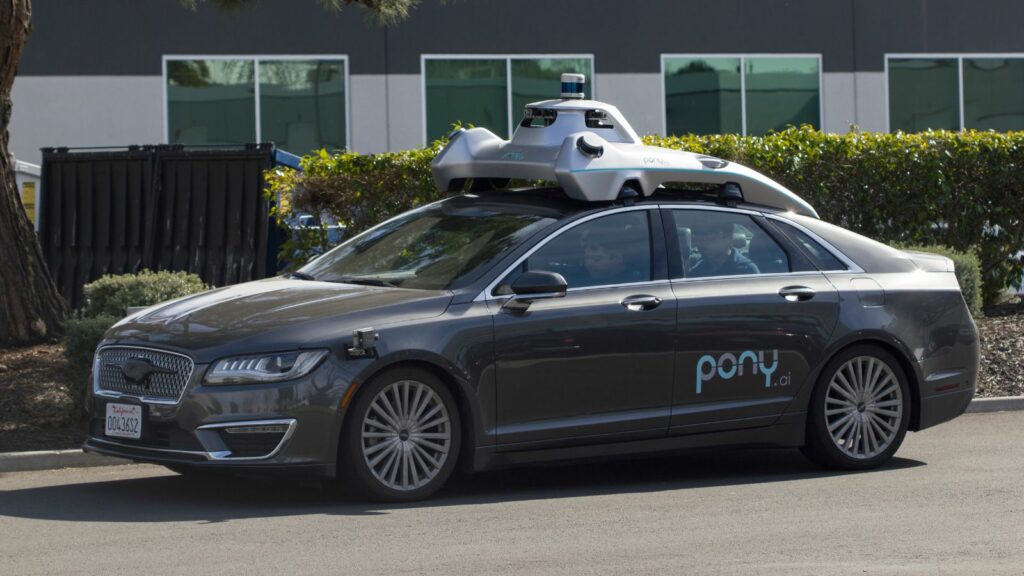
Europe’s robotaxi race is moving from small pilots toward fleets large enough to become part of everyday urban transport. Uber and China-based autonomous-driving company Pony.ai say they plan to deploy more than 2,000 Pony.ai robotaxis across five European cities, expanding a partnership that already has a commercial foothold in Zagreb, Croatia. Four additional cities have not yet been named, and the companies have not set a deadline for completing the rollout.
The plan matters because it combines Pony.ai’s Level 4 driving system with Uber’s huge ride-hailing marketplace and local fleet operators. It also arrives as Chinese and U.S. autonomous-driving companies intensify their push into Europe, where regulators have created a legal framework for automated vehicles but individual markets still control how those vehicles operate on public roads.
The Plan Is Much Bigger Than a Single-City Pilot
Uber and Pony.ai’s expanded agreement calls for more than 2,000 robotaxis across five European cities. Zagreb is the first market, while the other four locations remain undisclosed. The companies also have not said how quickly the full fleet will arrive, leaving the announcement as a scale target rather than a fixed schedule. That distinction matters in autonomous transport, where regulatory approvals, vehicle supply and local operating rules can affect launch timing.
Even so, the number signals a change in ambition. Earlier European robotaxi projects have often centered on testing zones, limited fleets or supervised demonstrations. A 2,000-plus-vehicle plan would require repeatable operations across several markets, not just a successful technical trial in one city. Pony.ai and Uber are positioning the partnership as a model that can be copied city by city rather than rebuilt from scratch for every launch. That makes execution, not just technology, central to the next phase.
Zagreb Has Become the Blueprint
Zagreb is more than a name on the expansion map. Pony.ai, Uber and Croatian mobility company Verne first announced their three-way European partnership in March 2026, and paid public robotaxi rides began in April through the Verne app. Pony.ai said the initial service area covered about 90 square kilometres of the wider city centre, including Zagreb Airport, and operated daily from 7 a.m. to 9 p.m. Uber integration was announced as the next step.
That gives the partners something useful before entering four cities: operating experience with real customers. Pony.ai supplies the autonomous-driving system, Verne owns and runs the local fleet, and Uber adds distribution through its ride-hailing platform. The Zagreb structure shows how the companies can separate technology, vehicle ownership and customer access, allowing local operators to handle practical tasks such as cleaning, charging, maintenance and market readiness. It also exposes customer-service and pickup problems that closed testing cannot reveal.
Uber Does Not Need to Own Every Robotaxi
The partnership is built around a flexible ownership model. Pony.ai said vehicle funding and ownership can sit with different partners depending on the market. Its role is to provide Level 4 autonomous-driving technology and operational expertise, while Uber provides booking, payment, customer service and access to its rider network. Day-to-day fleet management can be assigned to local operators chosen for each city.
That structure reduces the need for either company to build every layer itself. Robotaxi service requires more than software: vehicles must be financed, stored, charged, cleaned, inspected, repaired and repositioned. Local regulations also vary. In Zagreb, Verne fills the fleet-owner and operator role. Elsewhere, another company could take that job. The approach resembles an ecosystem rather than a vertically integrated taxi company, with Uber acting as the marketplace connecting autonomous fleets with demand. That flexibility could be especially useful as the partnership enters unfamiliar European markets at scale.
“Level 4” Does Not Mean the Cars Can Drive Everywhere
Pony.ai describes its robotaxis as using Level 4 autonomous-driving technology. Under the SAE framework used widely across the industry, Level 4 means the automated system can perform the full driving task without requiring a takeover-ready human driver, but only within the conditions and operating areas for which it is designed. That differs from Level 5, which describes automation capable of operating across all roads and conditions.
For passengers, the practical implication is that a robotaxi service can still have boundaries. A vehicle may be restricted to a defined geographic zone, certain road types or specific operating conditions. Zagreb’s initial limited service area shows how commercialization can begin before citywide operation is available. Scaling across Europe therefore depends not only on adding vehicles, but also on proving that each city’s operational design domain can support safe and reliable service. In other words, autonomy can be complete while its geography remains constrained.
Pony.ai Is Bringing Lessons From China
Pony.ai is not approaching Europe with only a handful of development vehicles. The company operates commercial robotaxi services in Beijing, Shanghai, Guangzhou and Shenzhen, China’s four tier-one cities. In March 2026, it said its fleet had grown to 1,446 robotaxis and set a target of more than 3,000 vehicles across 20-plus cities globally during the year, with nearly half of those markets expected to be outside China.
The company has also emphasized improving unit economics. Pony.ai reported that its seventh-generation robotaxis reached per-vehicle breakeven in Guangzhou and Shenzhen, while the autonomous-driving hardware bill of materials for that generation was cut by about 70% compared with the prior system. Those are company-reported figures, but they help explain why Europe is becoming a realistic scaling target: cheaper hardware and higher vehicle utilization can make expansion less dependent on perpetual pilot funding. Europe will test whether those advantages transfer cleanly into different operating environments.
Uber Is Building a Portfolio of Autonomous Partners
Pony.ai is only one part of Uber’s robotaxi strategy. Rather than betting on a single self-driving developer, Uber has been building relationships with multiple autonomous-vehicle companies across regions. In Europe, it is working with British startup Wayve on autonomous rides in London and with WeRide on a planned commercial robotaxi service in Zurich. Uber and Lyft have also partnered with Baidu for Apollo Go trials in the United Kingdom.
This portfolio approach gives Uber technology options while preserving its position as the customer-facing ride platform. If one developer wins approvals faster in a particular city, Uber can potentially integrate that fleet without waiting for one global technology stack. It also reflects Uber’s post-2020 strategy: instead of developing the autonomous-driving system itself, the company is increasingly trying to become the distribution, operations and demand layer used by multiple robotaxi developers. That diversification also reduces dependence on any one developer’s technical roadmap.
Europe Has a Framework, but City-by-City Approval Still Matters
The European Union already has rules for type approval of automated-driving systems in fully automated vehicles. Commission Implementing Regulation (EU) 2022/1426 established technical procedures for approving these systems, and the framework was amended in 2026. The rules address safety management, relevant traffic scenarios, system validation and information manufacturers must provide to approval authorities.
That does not create automatic permission to run robotaxi services anywhere in Europe. EU law explicitly leaves member states room to regulate the circulation and operational safety of fully automated vehicles, including their use in local transport services. In practice, Pony.ai and Uber still face market-specific work after the technology itself is approved. Local transport licensing, service zones, insurance and municipal requirements can shape each launch, which helps explain why the four new cities are being announced in phases rather than all at once. Each launch therefore remains partly a regulatory and operational negotiation on the ground.
Chinese Robotaxi Companies Are Racing Into Europe
Pony.ai’s push is part of a wider movement by Chinese autonomous-driving companies into European markets. WeRide entered Denmark in August 2026 through a partnership with GreenMobility and has been expanding across several European countries. Momenta received Germany-wide Level 4 testing approval from the country’s Federal Motor Transport Authority in July. Baidu’s Apollo Go has also been preparing European testing, including work connected with London and Switzerland.
The competition is becoming international because China’s robotaxi developers already have large operating fleets and are looking for new commercial markets. Europe offers a demanding proving ground of dense cities and established public-transport networks. Success there could become a credibility marker far beyond one country. It also means Uber will not be the only platform or partner in play. European mobility firms, automakers and local fleet owners now have several autonomous-driving suppliers competing for deployment deals. The result is a widening contest for partnerships, permits and passenger trust.
The Economics Depend on More Than Removing the Driver
Robotaxis are often described as a way to remove a major labour cost from ride-hailing, but commercial economics are more complicated. Autonomous fleets still carry vehicle depreciation, insurance, maintenance, charging, cleaning, remote assistance, software and fleet-management costs. Pony.ai’s own strategy reflects this reality: it has focused heavily on lowering the cost of its Gen-7 autonomous-driving hardware and increasing vehicle utilization.
The Uber partnership adds an economic lever by separating capital from demand generation. A local fleet partner can finance and operate vehicles while Uber supplies riders and Pony.ai supplies the driving system. That can make expansion more asset-light for the technology companies, although the fleet still has to earn enough to cover capital and operating expenses. Reaching per-vehicle breakeven in Chinese cities does not guarantee identical economics in Europe, where insurance, energy prices, regulations and utilization patterns can differ. Those differences will ultimately decide whether scale produces sustainable margins outside China.
The Biggest Questions Are Still the Cities, Timing and Scale-Up Pace
The headline number is clear, but important details remain open. Uber and Pony.ai have not identified the four European cities that will join Zagreb, and Reuters reported that no completion timeline was provided for the 2,000-plus-vehicle rollout. The companies said additional details would be announced in phases. Their expanded agreement also includes future deployment in the Middle East, without a specific market list in the latest announcement.
Those unknowns will determine how quickly the plan becomes a visible transport network. Key milestones will include regulatory approvals, fleet-partner announcements, vehicle deliveries, service-area maps and the point when riders can request Pony.ai cars through Uber in each market. For now, the significance is less about 2,000 vehicles appearing at once and more about the shift toward repeatable multi-city deployment—a test of whether robotaxis can move beyond novelty and become ordinary urban infrastructure. The pace of those milestones will matter more than the announcement alone.
