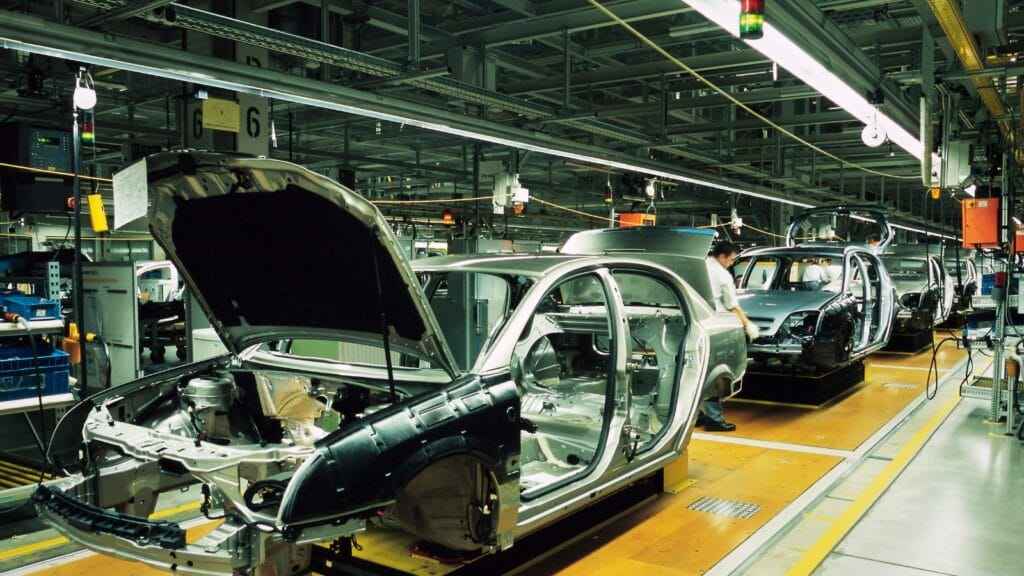
A production line in Tottenham, Ontario, has become a test of what happens when artificial intelligence leaves the computer screen and begins doing physical work. Autonomique, a Montréal- and Menlo Park-based startup, says its software is now controlling semi-humanoid robots that assemble chassis and suspension components at F&P Manufacturing, a major auto-parts supplier. The deployment has moved beyond a pilot and into live production, where finished components can be on their way to vehicle plants within hours.
What makes the development especially striking is the company’s unusually direct description of its goal. Autonomique’s chief executive says the robots are meant to replace human workers, although some employees could move into roles supervising and maintaining the machines. That blunt message turns a technical milestone into a much larger debate about productivity, job security and who benefits when factories become more autonomous.
From Pilot Project to Live Production
The robots are operating at F&P Manufacturing’s Tottenham facility, where Autonomique’s physical-AI software directs their movements during the assembly of automotive chassis and suspension parts. According to the companies’ account reported by BetaKit, the system has progressed from a trial into regular production. That distinction matters. Factory demonstrations can be carefully staged, slowed down or isolated from real operating pressure. A live automotive line must repeatedly meet quality, timing and safety requirements while fitting into a tightly scheduled supply chain.
F&P is not a small experimental workshop. The company is a Canadian subsidiary of Japan’s F-Tech and describes itself as a Tier 1 automotive supplier. Its operations include stamping, welding, hydroforming, painting and modular assembly, with more than 58 million component parts produced annually for over 10 current vehicle models. Parts made at the Tottenham plant may reach a vehicle assembly operation in fewer than four hours. A robot failure in that environment is not merely an awkward demonstration; it can become a production problem with consequences farther down the line.
What Makes These Robots Different
Industrial robots have worked in auto plants for decades, particularly inside fenced cells where they weld, lift or repeat a programmed motion with extraordinary consistency. Autonomique is selling something more adaptable: software that allows third-party robots to perceive conditions, plan movements and adjust when parts are not positioned exactly the same way every time. The company says its systems can handle multi-step assembly, variable part placement and contact-heavy work without relying on cloud computing for every decision.
That flexibility is the central promise of “physical AI.” Instead of building its own robot from the ground up, Autonomique develops the control layer that can be integrated with outside hardware. This approach could lower one barrier to adoption because manufacturers would not necessarily be locked into a single robot maker. It also shifts the competitive focus from impressive hardware demonstrations to reliability on ordinary factory tasks. A backflip may attract attention online, but an auto supplier needs a machine that can pick, align and assemble parts thousands of times without slowing the line or damaging components.
The Replacement Claim Changes the Conversation
Many robotics companies describe automation as a way to assist employees, fill labour shortages or remove people from dangerous and repetitive tasks. Autonomique chief executive Vikrant Tomar used more direct language: the robot is intended to replace human workers. He added that employees could be reassigned to oversee robots through software that tracks machine performance. That possibility may create more technical work, but it does not guarantee that every displaced assembler will move smoothly into a new role.
For workers, the difference between “support” and “replacement” is not semantic. A production employee may hear that a difficult manual task is disappearing while also wondering whether the new monitoring or maintenance job requires credentials, experience or training they do not have. Canada’s official occupational description for motor-vehicle assemblers already includes operating automated and robotic equipment, showing that human-machine work has long overlapped. The sharper issue is whether future plants need the same number of people, whether wages hold up and whether existing employees receive paid pathways into the jobs that remain.
Why Auto-Parts Plants Are an Early Target
Automotive suppliers operate under relentless pressure to deliver large volumes with narrow tolerances and little room for delay. Repetitive assembly tasks are therefore attractive targets for automation, especially when a machine can work consistently across long shifts. F&P’s own product mix—subframes, suspension arms, pedal assemblies, stampings and modular components—shows how many separate processes sit between raw metal and a finished vehicle. Each handoff creates opportunities for speed gains, quality improvements or bottlenecks.
The broader industry is already one of the world’s biggest robot buyers. The International Federation of Robotics reported that automotive companies accounted for 47 per cent of Canada’s industrial-robot installations in 2024, even after total Canadian installations fell 12 per cent to about 3,800 units. Ontario’s auto industry employed nearly 100,000 people in 2025, while Canada’s wider auto sector supported more than 500,000 workers directly and indirectly. That combination—heavy automation spending and a large workforce—means even a modest shift in how assembly work is organized can have consequences well beyond one plant in Tottenham.
Automation Can Grow Firms While Reshaping Jobs
The strongest available evidence does not support a simple story in which every new robot automatically eliminates a job. A Statistics Canada study of robot-adopting firms found that investment in robotics was associated with higher productivity and, on average, increased total employment at the adopting companies. The same research also found changes inside those firms, including fewer managers and different skill requirements. A growing manufacturer may employ more people overall while still eliminating particular tasks or reducing hiring in specific occupations.
That distinction is important for interpreting the Tottenham deployment. Autonomique’s technology could help F&P win contracts, improve output or keep production competitive in Ontario, all of which may protect employment at the company level. At the same time, the explicit purpose of replacing workers means some assembly positions can still disappear. Statistics Canada has estimated that 10.6 per cent of Canadian workers faced a high probability of automation-related job transformation, with another 29.1 per cent at moderate risk. Those figures describe exposure, not guaranteed layoffs, but they show why workers may view each successful factory deployment as both an industrial achievement and a personal warning.
Canada Is Trying to Close an Automation Gap
The deployment also lands in the middle of a national productivity debate. Robot density in North American manufacturing reached 204 units per 10,000 employees in 2024, below Western Europe’s 267 but above Asia’s regional average of 131. Canada installed about 3,800 industrial robots that year, with results heavily influenced by automotive investment cycles. For policymakers and manufacturers, the concern is that companies unable to modernize may lose production to faster, lower-cost plants elsewhere.
Ottawa’s 2026 automotive strategy explicitly identifies automation and connected technologies as areas requiring investment, while setting aside major funds to help the auto sector modernize and adapt. The federal government’s new national AI strategy similarly promises to encourage industrial AI adoption, expand training and prepare workers for high-quality jobs. The tension is obvious: governments want Canadian companies to deploy advanced technology quickly, but the political case for public support rests partly on protecting employment. Tottenham offers a real-world test of whether those two goals can be reconciled rather than merely announced together.
Safety and Oversight Matter as Much as Speed
A robot that works beside people or handles heavy automotive components creates risks that cannot be solved by better artificial intelligence alone. Ontario’s Occupational Health and Safety Act places duties on employers and other workplace parties to protect workers, while industrial rules require guarding against exposed moving parts and proper lockout procedures during maintenance. Provincial inspection campaigns have repeatedly found machine-guarding violations, including 1,705 orders and requirements during a 2020 initiative that visited 425 industrial workplaces.
AI adds another layer because the system may adapt its movement rather than follow only one fixed path. Manufacturers need clear limits on where robots can operate, how people enter a work cell, what happens when sensors fail and who has authority to stop production. Performance-tracking software also raises questions about data: whether it monitors only machines or becomes a tool for measuring nearby employees. Canadian labour organizations are calling for stronger oversight, protections against surveillance and a formal worker voice in decisions about workplace AI. Reliable production is important, but trust will depend on transparent rules and enforceable safeguards.
The First Deployment Is a Signal, Not a Final Verdict
One production line cannot reveal how quickly physical AI will spread or how many jobs it will ultimately affect. The technology still has to prove that it can remain accurate, safe and economical across different parts, shifts and factories. Humanoid and semi-humanoid designs also compete with conventional robot arms, specialized machinery and simpler automation that may be cheaper for predictable work. The winning system will not necessarily be the machine that looks most like a person; it will be the one that delivers the best combination of uptime, flexibility and cost.
Even so, the Tottenham deployment is significant because it moves the debate from forecasts to an operating Ontario factory. Canada’s auto sector is already navigating tariffs, changing vehicle technology and pressure to improve productivity. Physical AI now joins that list. The key questions are no longer whether robots can perform selected assembly tasks, but how employers manage the transition, whether displaced workers receive credible routes into new roles, and whether productivity gains are shared through investment, wages and job security. The machines may be controlled by AI, but the consequences will still be shaped by human decisions.

Alanna Rosen is an experienced content writer that focuses on many EV and educational content. Her articles are regularly published on Get CyberTrucked and syndicated on large publications.