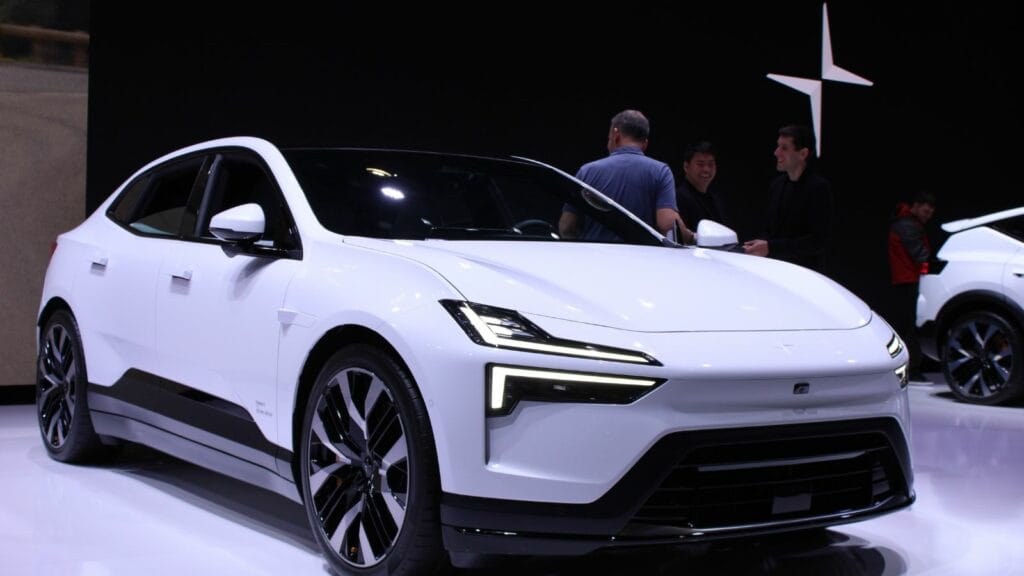
The divide opening across North America’s electric-vehicle market is no longer theoretical. Polestar says it cannot sell model-year 2027 vehicles in the United States after the Trump administration denied it authorization under federal connected-vehicle rules. Yet across the border, Canada has lowered the barrier for a limited number of China-built EVs, allowing Polestar’s Chinese-made fastback to return.
The contrast captures a larger struggle over what matters most in the next automotive era: national security, industrial protection, consumer affordability or access to advanced technology. Washington is treating Chinese-linked vehicle software and ownership as a strategic risk. Ottawa is attempting a controlled opening that preserves limits while bringing more competition into a market where EV demand has recently been uneven.
A Future Sales Ban, Not an Overnight Disappearance
Polestar is not vanishing from American roads immediately. The company can continue selling its existing inventory of Polestar 3 and Polestar 4 vehicles, and it has pledged to keep supporting owners through its service network. The decisive break begins with the 2027 model year, when the U.S. Department of Commerce’s Bureau of Industry and Security will not permit Polestar to sell new vehicles under the Connected Vehicles Rule. In practical terms, that cuts off the company’s future product pipeline even while current cars remain in showrooms.
That distinction matters for customers who already own a Polestar or are considering one from the remaining stock. Polestar says access to its service network will continue, but the decision could create uncertainty around resale values, dealer confidence and the long-term scale of its American operations. It also raises questions about the Polestar 3, which is assembled in South Carolina. The restriction is tied not only to where a vehicle is built, but also to corporate control and connected technology associated with China.
The Rule Targets the Digital Systems Inside Modern Cars
The policy at the centre of the dispute was finalized in January 2025 under President Joe Biden and retained by President Donald Trump. It restricts transactions involving certain vehicle-connectivity hardware and software associated with China or Russia. That includes systems supporting cellular connections, Bluetooth, Wi-Fi and some satellite communications. U.S. officials argue that connected vehicles can gather sensitive information and, in a worst-case scenario, allow a foreign adversary to interfere with vehicles or critical infrastructure.
Polestar had warned that the rule could effectively prevent it from operating in the United States, even when a model was assembled domestically. The company sought a specific authorization, a pathway intended for businesses that can demonstrate that potential risks have been mitigated, but its request was denied. Volvo Cars, which is also controlled by Geely, received authorization in May, showing that the rule is not an automatic ban on every company with Chinese ownership. The different outcomes suggest regulators are evaluating governance, software, supply chains and data controls individually.
Polestar’s Chinese Ownership Became the Central Problem
Polestar presents an unusually complicated identity for regulators. It is headquartered in Gothenburg, markets itself as a Swedish electric-performance brand and traces its roots to Volvo. At the same time, it is majority-owned by China’s Geely Holding, a global automotive group with extensive manufacturing and technology operations in China. That combination once looked like an advantage: Scandinavian design, Chinese scale and access to Volvo-linked engineering. Under Washington’s current approach, it has become a vulnerability.
The U.S. decision indicates that local assembly alone may not be enough to satisfy regulators. The Polestar 3’s South Carolina production footprint did not prevent the broader company from losing authorization for future model years. That sends a message well beyond one relatively small EV manufacturer. Automakers relying on Chinese-developed software, hardware or ownership structures may face deeper scrutiny even when they create American factory jobs. The regulatory test is increasingly about who controls the technology inside a vehicle, not simply which plant puts the vehicle together.
Canada Has Chosen a Controlled Opening Instead
Canada moved in the opposite direction on March 1, 2026, replacing its 100% surtax on China-made EVs with an annual quota of 49,000 vehicles subject to the standard 6.1% most-favoured-nation tariff. The quota is scheduled to grow by 6.5% annually. Ottawa has presented the system as managed access rather than a free-for-all: the first-year volume represents less than 3% of a typical Canadian new-vehicle market, and future allocations will reserve a growing portion for vehicles with an import price of C$35,000 or less.
The approach attempts to balance competing pressures. High purchase prices have remained an obstacle to wider EV adoption, while domestic manufacturers and unions fear being undercut by China’s enormous production scale. Ottawa is therefore opening a narrow door instead of removing the wall. The policy also reflects Canada’s attempt to diversify trade during a period of severe tension with Washington. For automakers, the result is striking: a vehicle can be treated as an unacceptable connected-technology risk in the United States while being admitted through a regulated tariff quota in Canada.
The Polestar 2’s Return Makes the Split Visible
The most concrete example is the Polestar 2. The China-built electric fastback disappeared from the Canadian new-car market after the 100% surtax made continued imports impractical. On June 3, Polestar reopened Canadian orders for the 2027 model, starting at C$69,900. The returning version is offered as a long-range dual-motor model with 421 horsepower, an estimated 447 kilometres of range and several previously optional packages included as standard equipment.
Polestar says more than 7,300 examples of the model are already on Canadian roads, giving the company an existing owner base to build upon. The price, however, demonstrates why the quota will not immediately fill dealerships with ultra-cheap cars. This is a premium performance EV, not the C$25,000 commuter vehicle many consumers imagine when they hear “Chinese EV.” Still, the symbolism is difficult to miss: the same 2027 model year that marks the end of Polestar’s future U.S. sales is bringing its best-known vehicle back to the Canadian market.
Chinese Automakers See Canada as More Than a Small Market
Polestar is only one part of a much larger movement. Reuters reported that BYD has begun Canadian compliance procedures for two passenger vehicles and is planning six dealerships, while Chery has met with Canadian dealer groups and road-tested vehicles in the country’s cold climate. Geely-owned Lotus and state-owned Changan have also explored Canadian expansion. These companies are moving quickly even though the 49,000 quota spaces must be shared among established manufacturers and new entrants.
The strategic value of Canada extends beyond immediate sales. Canadian vehicle regulations and consumer preferences closely resemble those in the United States, while numerous dealership groups operate on both sides of the border. Industry executives have described Canada as a potential proving ground where Chinese automakers can learn about North American warranties, winter performance, retail operations and customer expectations. Canada sold approximately 1.9 million new vehicles in 2025, compared with more than 16 million in the United States. For now, Canada offers a foothold beside a much larger market that remains effectively closed.
Consumers Could Gain Choice Without an Immediate Price Revolution
More competition could benefit Canadian shoppers, especially as battery costs decline and Chinese manufacturers achieve enormous economies of scale. The International Energy Agency estimates that China produced approximately 70% of the world’s electric cars and more than 80% of its battery cells in 2025. It also found that average battery prices declined by 8% that year. Those advantages have allowed Chinese brands to offer feature-rich EVs at prices that established manufacturers often struggle to match.
Even so, the Canadian quota has firm limits, shipping and retail costs remain significant, and the affordable-vehicle requirement will be phased in rather than applied fully from the beginning. The first arrivals may include premium or higher-margin models from companies already familiar with North American certification. Canadian EV demand is also recovering from a weak 2025. Statistics Canada recorded 43,113 new zero-emission vehicles in the first quarter of 2026, representing 10.8% of new registrations and a 15.8% increase from a year earlier. More choice may help, but financing costs, charging access and government policy will continue shaping buying decisions.
Canada’s Auto Industry Faces a Difficult Trade-Off
The potential consumer benefit comes with a serious industrial risk. Canada’s automotive sector directly employs more than 125,000 people, supports hundreds of thousands of additional jobs and contributed C$16.8 billion to national GDP in 2024. It is also deeply integrated with the United States: more than 90% of Canadian-made vehicles and approximately 60% of Canadian-made auto parts are exported south. That dependence makes any major policy split with Washington economically sensitive.
U.S. industry groups have warned that Canada could become a back door for Chinese brands, although selling a vehicle in Canada does not remove American tariffs or connected-technology restrictions. The larger concern is strategic. If Chinese automakers build strong dealer networks, brand recognition and eventually manufacturing operations in Canada, they could reshape investment decisions across the continent. Ottawa must therefore demonstrate that lower-priced imports can coexist with domestic assembly, battery investment and Canadian jobs. The quota gives policymakers time, but it does not eliminate the tension between protecting producers and helping consumers.
Polestar Can Withstand the U.S. Loss—but Not Endless Setbacks
The United States accounted for only 6% of Polestar’s retail sales in the first quarter of 2026, while Europe represented close to 80%. That makes an American withdrawal painful but not immediately fatal. The company sold a record 60,119 vehicles in 2025, an increase of 34%, and its revenue exceeded US$3 billion. It also delivered 13,126 vehicles in the first quarter of 2026, up 7% from the same period a year earlier. Management now plans to concentrate more heavily on Europe, Canada and selected growth markets.
The financial backdrop remains difficult. Polestar reported a US$383-million net loss for the first quarter and said its cash position fell from approximately US$1.16 billion at the end of 2025 to US$676 million by the end of March. The company is cutting costs, expanding its retail network and preparing new products, including a redesigned Polestar 2 and the Europe-built Polestar 7. Losing access to an American market with more than 16 million annual vehicle sales reduces its room for error. Canada cannot replace that scale, but it can preserve Polestar’s North American presence while the company attempts to stabilize its business.
North America Is Splitting Into Two EV Strategies
Washington’s strategy prioritizes security, domestic control and insulation from Chinese automotive technology. Its 100% tariff on Chinese EVs already made direct imports commercially unrealistic, and the connected-vehicle rule adds a barrier that tariffs alone cannot solve. Canada’s strategy accepts some Chinese-built vehicles but controls the volume, preserves a tariff and gradually directs part of the quota toward lower-priced models. One system is designed largely to exclude; the other is designed to manage exposure.
The outcome will be watched far beyond Polestar. If Canada receives attractive and reliable EVs at lower prices without losing major automotive investment, pressure may grow on the United States to reconsider the financial cost of exclusion. If the opening damages Canadian manufacturing or produces security concerns, Washington’s harder line will appear more defensible. For Polestar, the split is already real: its future American lineup has been stopped, while its Canadian lineup is expanding. The border has become a dividing line between two competing visions of the connected, electric car.

Alanna Rosen is an experienced content writer that focuses on many EV and educational content. Her articles are regularly published on Get CyberTrucked and syndicated on large publications.