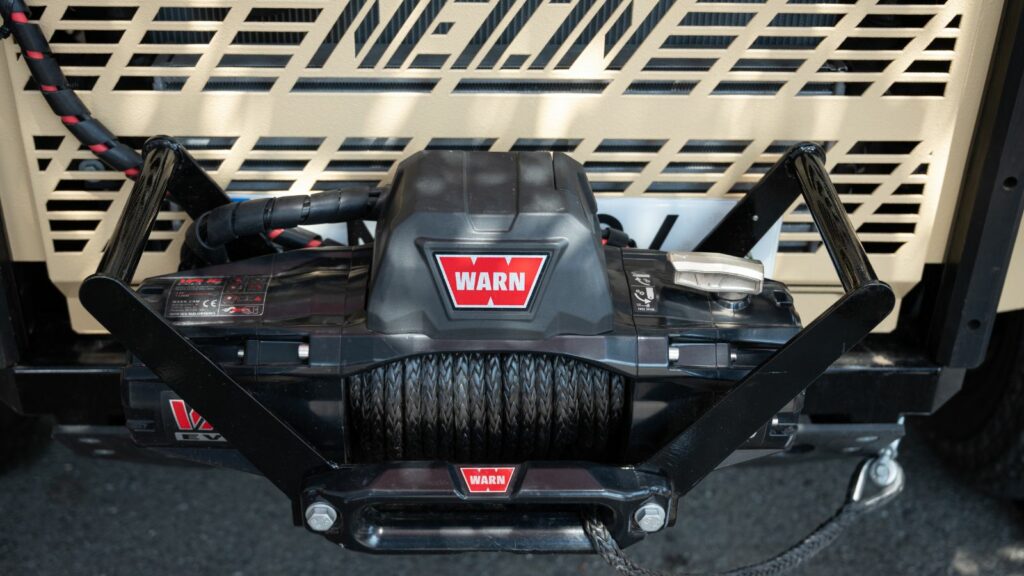
A wireless remote is supposed to give a winch operator more distance and control during a difficult recovery. In a newly announced Canadian recall, however, a compatibility problem can create the opposite result: a winch that may fail to stop when commanded. Health Canada says 441 WARN Wireless Remote Kits for Truck and Utility Winches were sold in Canada before the August 14 recall. The problem is not tied to every WARN winch or every wireless controller. It involves part number 90287 with affected date codes when paired with certain older winches using individual solenoid-type control packs. No incidents or injuries had been reported in Canada as of July 17, but an investigation in the United States provides a closer look at how the potentially hazardous “run-on” condition emerged.
The Canadian Recall Covers 441 Wireless Remote Kits
Health Canada classified the WARN recall as an injury hazard and reported that 441 affected units were sold across Canada. The products were sold from January 2024 through June 2026 and were manufactured in the United States. The Canadian notice was published August 14, 2026, under recall identification RA-82318. The relatively small number of Canadian units does not make the problem insignificant. A winch is a powered recovery device designed to move substantial loads, so the ability to stop it when commanded is a fundamental part of maintaining control during an operation.
What makes this recall unusual is its narrow compatibility issue. Health Canada is not warning that every WARN wireless remote will malfunction, nor is it recalling the winches themselves as a group. The problem arises when the affected receiver is connected to specified legacy winches. For a truck owner who added wireless operation to an older, otherwise familiar recovery setup, that distinction matters. A component purchased relatively recently can interact differently with equipment that may have been in service for many years.
Owners Can Identify the Recalled Kit by Part Number and Date Code
The affected Canadian product is the WARN Wireless Remote Kit for Truck and Utility Winches, part number 90287. Health Canada describes it as a two-piece system consisting of a wireless transmitter and receiver. Both components are black and red and carry a prominent WARN emblem. The affected products have date codes after 5023, with the code presented in a week-and-year format. Checking the part number and date code is therefore more useful than relying simply on the appearance of a remote or remembering when it was purchased.
WARN markets part 90287 as a way to operate compatible truck and SUV winches remotely from as far as 50 feet away. The kit includes the transmitter and receiver along with accessories such as a holster, lanyard and mounting hardware, and it was designed as a plug-and-play control solution. That convenience helps explain why an owner of an older winch might add a new controller rather than replace an entire recovery system. The recall shows why the age and electrical architecture of the winch itself must also be checked.
The Failure Is Linked to the Electrical Demands of Certain Older Winches
Health Canada says the affected wireless receivers may be incompatible with older winches that use individual solenoid-type control packs. The possible consequences include damage to the receiver and a failure of the winch to stop when the operator commands it to stop. A U.S. National Highway Traffic Safety Administration filing from WARN provides additional technical detail, describing the cause as a thermally induced electrical fault associated with some older winches that require higher current to actuate.
The U.S. engineering chronology illustrates what that can mean inside the receiver. During WARN’s investigation, a returned unit examined on June 10 was found with an internally damaged power-feed field-effect transistor, or FET, and melted mounting solder. The federal filing says there may be no warning before the condition occurs. In practical terms, an operator could release or issue the stop command expecting the motor to stop, only to encounter continued operation. That loss of expected control is why regulators describe unexpected winch movement as a potential source of personal injury or property damage.
Eleven Legacy Winch Models or Model Groups Appear on the Compatibility List
Health Canada’s notice identifies 11 WARN legacy winch models or model groups that require attention, with compatibility in many cases depending on the serial number. The list includes the 9.0Rc, XD9000i, XD9000, 9.5 XP, 9.5 ti, 16.5 ti, M8000, M12, M15, 8274 and RAM 12000. Several have specific serial-number cutoffs. For example, the M8000 is listed as incompatible through serial number 1766496, corresponding to production before June 2012, while the M12 cutoff is serial number 2170333 for units produced before November 2017.
Other entries are broader. Health Canada lists all serial numbers of the XD9000i and 9.5 ti as “Do Not Use” with the affected wireless remote. RAM 12000 is also listed as incompatible for all serial numbers. This makes the model badge alone insufficient for several other winches: owners may need both the exact model and serial number to determine whether their combination is affected. WARN’s current product information repeats the same incompatibility list, giving owners a manufacturer source against which to cross-check their equipment.
Canada Has Reported No Injuries, but U.S. Complaints Triggered an Investigation
Health Canada says that, as of July 17, WARN had received no reports of incidents or injuries in Canada associated with the recalled product. That is reassuring, but it does not mean the hazard was only theoretical. WARN’s U.S. safety filing describes how customer complaints led the company to investigate the interaction between the wireless receiver and older winches. According to the chronology, a May 18 complaint involved a replacement wireless kit exhibiting a “run-on” condition after the customer had previously returned the same part number for the same problem.
WARN then searched its customer-service and return databases and identified similar complaints dating to February 2024 and May 2026. A fourth complaint was reported on May 19. On June 2, the company issued a stop-ship order for the wireless remote kits while engineering work continued. Studies conducted through June examined both the receivers and the population of older winches that could be exposed to the condition. WARN decided on June 24 to recall wireless kits intended for use with specified legacy winches.
Canadian Owners Are Being Told to Stop Using Incompatible Combinations and Seek a Refund
Health Canada’s direction is straightforward: consumers should immediately stop using the recalled product with a non-compatible legacy winch and contact WARN Industries for a refund. WARN is providing refunds for part number 90287 when the remote was purchased for use with a winch on the company’s non-compatibility list. Canadian consumers can reach WARN by telephone at 1-800-543-9276 between 7 a.m. and 4 p.m. Pacific Time from Monday through Friday, or through the customer-service contact information provided by the company.
There is another important point for anyone who decides simply to replace the remote and clear the old one out of a garage. Health Canada states that recalled consumer products cannot legally be redistributed, sold or even given away in Canada. That means an affected remote should not be posted on a resale marketplace, passed to another off-road enthusiast or bundled with used equipment. Health Canada also asks consumers to report health or safety incidents involving the product through its consumer product incident reporting system, helping regulators track any additional problems after the recall announcement.
The Recall Highlights Why Accessory Compatibility Can Matter as Much as the Accessory Itself
Part 90287 was built around a useful idea: wireless operation gives the person controlling a winch the ability to stand farther from the control socket, and WARN advertises an operating range of up to 50 feet. The kit also incorporates a two-button activation sequence intended to guard against accidental power-ups. Yet the recall demonstrates that safeguards built into a new accessory cannot eliminate problems caused by an unexpected electrical interaction with older equipment. The relevant question is not simply whether the remote works, but whether the remote and the specific generation of winch were designed to work together.
WARN’s U.S. recall instructions reinforce that point. They tell customers to stop using the wireless function when compatibility is uncertain, use a wired remote if one is available and verify the winch against the compatibility information. The July U.S. filing also said WARN was designing new packaging that would more clearly identify compatible winch models. For Canadian owners, checking a model number, serial number and remote date code now could prevent a much more serious surprise when the winch is actually needed.
