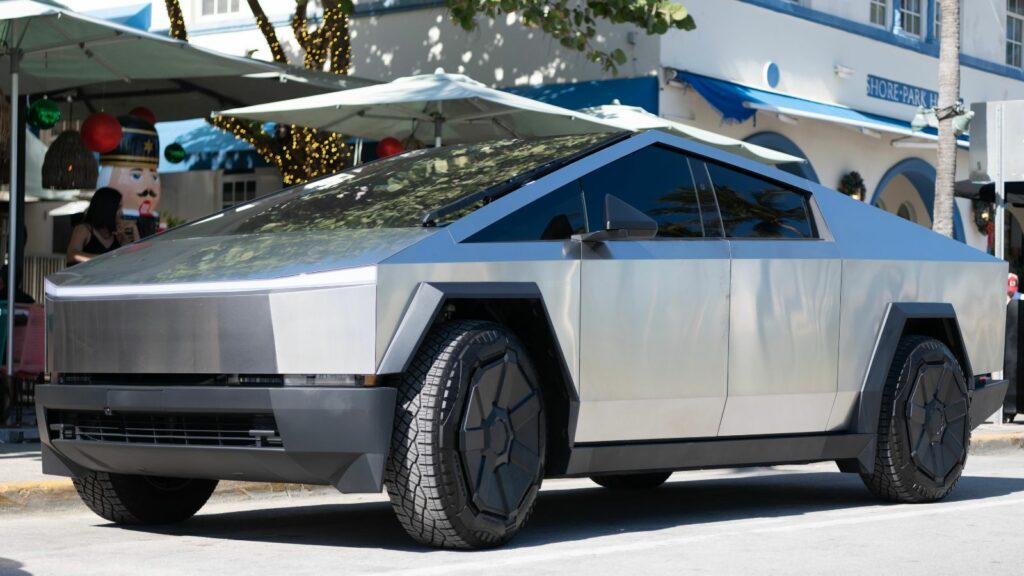
Tesla has raised Cybertruck prices again in the United States, but Canadian shoppers have avoided the latest increase — at least for now. The automaker lifted prices by US$5,000 on two American Cybertruck variants, pushing the Dual Motor model to US$74,990 and the Premium All-Wheel Drive version to US$84,990. Canadian pricing, meanwhile, remains unchanged, with Tesla listing the Premium AWD at C$139,990 and the Cyberbeast at C$167,990.
That may sound like a rare pricing break for Canadians, but the comparison comes with an important catch. Cybertrucks sold in Canada are already dramatically more expensive than their American counterparts, partly because the Texas-built pickup sits in the middle of an increasingly complicated Canada-U.S. tariff fight. The latest move therefore highlights something bigger than a US$5,000 adjustment: Cybertruck pricing has become unusually volatile on both sides of the border.
The U.S. Hike Lands on Two Cybertruck Variants
Tesla’s latest adjustment raises the U.S. starting price of the Cybertruck Dual Motor All-Wheel Drive by US$5,000, from US$69,990 to US$74,990. The Premium AWD received the same increase, climbing from US$79,990 to US$84,990. The changes appeared in Tesla’s American pricing and were reported on August 25. For someone already preparing to order the Premium model, the difference is substantial enough to cover thousands of kilometres of charging, insurance payments or several monthly vehicle payments. Unlike a traditional model-year increase that arrives with a redesigned vehicle, this adjustment came without a corresponding new generation of the truck.
The Cyberbeast is the notable exception. Tesla kept its highest-performance Cybertruck at US$99,990 in this round of changes. That produces an unusual compression in the lineup: the Premium AWD now sits only US$15,000 below the much more powerful Cyberbeast. Tesla has repeatedly altered Cybertruck trims, packages and prices since deliveries began, making the pickup one of the company’s more fluid products from a pricing standpoint.
Canadian Cybertruck Prices Have Not Followed — Yet
Canadian buyers looking at Tesla’s current pricing still see the Premium AWD listed at C$139,990 and the Cyberbeast at C$167,990. Tesla’s Canadian support information lists those two Cybertruck trims, while Canadian EV databases also show the truck beginning at roughly C$140,000. There is no equivalent Canadian listing for the cheaper U.S. Dual Motor configuration that now starts at US$74,990. Consequently, the Canadians who have avoided this week’s price hike are shopping from an already more expensive and narrower Cybertruck lineup.
That distinction matters when describing the increase as good news for Canada. A buyer in Toronto, Calgary or Vancouver has not received a C$5,000 increase matching the American move, but the starting Canadian Cybertruck remains a six-figure purchase before sales taxes and various ownership expenses. Tesla also notes that its published MSRP figures can differ from all-in advertised pricing because provincial requirements determine how freight and other mandatory fees are displayed. For Canadians considering the pickup, the meaningful development is therefore price stability rather than suddenly improved affordability.
Canada’s Auto Tariffs Help Explain the Huge Pricing Gap
Part of the Canadian Cybertruck’s unusual price structure can be traced to the trade confrontation that began reshaping cross-border vehicle pricing in 2025. Canada imposed a 25% tariff on non-CUSMA-compliant vehicles originating in the United States and a 25% tariff on the non-Canadian and non-Mexican content of qualifying U.S.-built vehicles. Electric vehicles are included among the affected tariff classifications. Those countermeasures were introduced after the United States imposed tariffs on Canadian automotive exports and remained part of Ottawa’s automotive strategy in 2026.
That is particularly relevant to Cybertruck because Tesla manufactures the pickup at Gigafactory Texas rather than at a Canadian plant. The Canadian government has maintained its auto counter-tariffs while seeking removal of the corresponding American measures. It would be overly simplistic, however, to calculate the difference between U.S. and Canadian Cybertruck prices and attribute every dollar to tariffs. Currency movements, trim differences, logistics, equipment and Tesla’s own regional pricing decisions also matter. Tesla has not publicly provided a line-by-line breakdown showing precisely how much of the C$139,990 or C$167,990 MSRP represents tariff costs.
The Cheapest U.S. Cybertruck Has Risen US$15,000 in Months
The latest increase looks more significant when viewed against the short history of Tesla’s current Dual Motor variant. Tesla introduced the lower-priced version in February at US$59,990. Elon Musk indicated that the introductory pricing would be temporary, and Tesla soon lifted it by US$10,000 to US$69,990. The latest US$5,000 adjustment means the same basic entry point has climbed a total of US$15,000 from that initial February figure, reaching US$74,990. For buyers who delayed an order for only a few months, the price equation now looks considerably different.
Cybertruck shoppers have already experienced another dramatic example of Tesla’s pricing flexibility. The company raised the Cyberbeast by US$15,000 in August 2025 when it introduced a bundled Luxe Package, taking the truck to US$114,990. Tesla later reversed that increase, and the Cyberbeast currently starts at US$99,990. Such movement makes Cybertruck pricing difficult to treat like the relatively predictable annual MSRP adjustments associated with many established pickup models. Timing alone can materially change the purchase price.
The Increase Comes Despite Questions About Cybertruck Demand
Ordinarily, a sharp price increase might suggest that a manufacturer is struggling to keep up with customers. Cybertruck’s recent sales picture makes this adjustment more complicated. Cox Automotive data cited in industry reporting put U.S. Cybertruck sales at 3,519 units during the first quarter of 2026, roughly 45% below the same period a year earlier. Its estimated 2025 sales were also substantially lower than 2024 levels. Those figures are far removed from the enormous reservation numbers and production ambitions that surrounded the vehicle before deliveries began.
Tesla’s own reporting reinforces the need for caution when estimating Cybertruck volumes. The company delivered 12,364 vehicles in its “Other Models” category during the second quarter of 2026, but that category includes more than the Cybertruck, so the figure cannot be treated as Cybertruck sales alone. Tesla’s latest manufacturing information lists installed Cybertruck capacity at Gigafactory Texas above 125,000 vehicles annually, while explicitly warning that installed capacity is not the same as the current production rate. The combination of large theoretical capacity and much lower observed sales estimates makes the new price increase especially noteworthy.
Canadian Buyers Are Far Outside the Federal EV-Rebate Market
Canada’s latest federal electric-vehicle incentive does little to soften Cybertruck pricing. The Electric Vehicle Affordability Program offers incentives of up to C$5,000 in 2026 on qualifying battery-electric vehicles, but imported vehicles generally need a final transaction value of C$50,000 or less. Canadian-made EVs are exempt from that transaction-value ceiling. With the Cybertruck manufactured in Texas and Canadian prices beginning at C$139,990, the pickup is nowhere near the affordability threshold that determines eligibility for most imported vehicles.
The comparison helps illustrate how different the Cybertruck’s market position has become from that of mainstream EVs. Federal incentives are currently aimed at vehicles such as affordable electric crossovers, sedans and compact SUVs, while Tesla’s stainless-steel pickup occupies luxury-vehicle territory in Canada. A C$139,990 starting price is nearly three times the normal C$50,000 EVAP transaction limit. Avoiding another C$5,000 increase is still meaningful to a potential buyer, but it does not transform the Cybertruck into a mass-market electric truck. Its Canadian economics remain dominated by the initial purchase price, taxes, financing and the tariff environment.
Canadian Price Stability Could Be Temporary
For the moment, the clearest takeaway is simple: Tesla’s latest US$5,000 Cybertruck increase has stopped at the border. Canadian pricing was unchanged when the U.S. adjustment was reported, leaving the Premium AWD at C$139,990 and the Cyberbeast at C$167,990. Tesla has changed vehicle prices frequently in the past, however, and its own Canadian materials state that prices are subject to change. With Cybertruck pricing already altered repeatedly in the United States, there is no guarantee that today’s Canadian figures will remain intact.
Trade policy adds another layer of uncertainty. Canada’s existing auto counter-tariffs remain connected to U.S. measures against Canadian vehicles, and the broader Canada-U.S. dispute has intensified again. That means Canadian Cybertruck pricing is exposed not only to Tesla’s product strategy but also to decisions made in Ottawa and Washington. A future tariff adjustment, trim reshuffle or Tesla price change could quickly alter the calculation. Canadian buyers have escaped this particular US$5,000 increase, but after nearly two years of Cybertruck price changes, “for now” may be the most important part of that statement.
