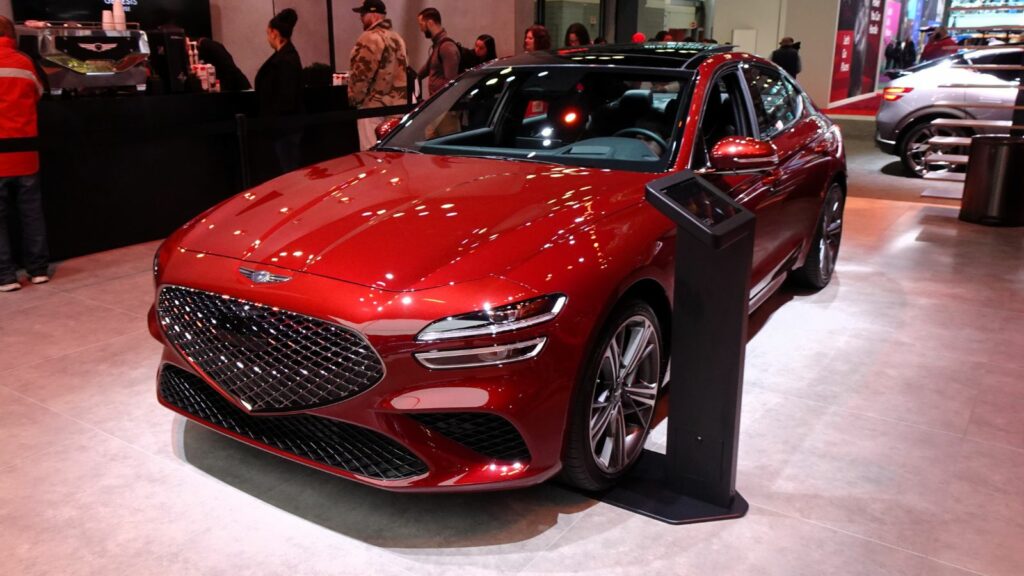
Genesis is preparing to remove one of the defining ingredients from its smallest sport sedan just as Canadian buyers appear to be rediscovering it. The automaker has confirmed that the twin-turbocharged 3.3-litre V6 will disappear from the Canadian G70 lineup for the 2027 model year, leaving the turbocharged four-cylinder as the sole engine. The timing creates an unusual contradiction. Canadian G70 sales fell 27% in 2025, dropping to only 595 units, yet demand rebounded by roughly 33% during the first half of 2026. That recovery suggests the sedan still has an audience, even as the broader Canadian market continues moving decisively toward SUVs. For Genesis, the decision therefore looks less like a reaction to one weak year and more like another sign of how difficult the business case for powerful luxury sedans has become.
The G70’s V6 Is Officially on Borrowed Time
Genesis Canada has told The Car Guide that the 3.3-litre twin-turbocharged V6 will be removed for the 2027 model year. That means the current 2026 G70 represents the last Canadian model year in which buyers can order the sedan with six-cylinder power. The Canadian lineup presently includes the 3.3T Sport AWD as well as the limited G70 Graphite, while lower versions use the 2.5-litre turbocharged four-cylinder. The move is significant because the V6 has long distinguished the G70 from many compact luxury competitors that increasingly rely on smaller turbocharged engines, hybrid assistance or considerably more expensive performance variants.
For 2026, Genesis Canada lists the 3.3T Sport AWD at an all-inclusive price of $67,150 before applicable sales taxes and certain registration-related costs. The limited Graphite sits above it at $69,650. Its twin-turbo V6 produces 365 horsepower, with Genesis citing an additional three horsepower when the variable exhaust system is active, along with 376 lb-ft of torque. The Car Guide recorded a 0–100 km/h time of 5.3 seconds in its testing. Those numbers made the V6 G70 more than a cosmetic alternative to established German luxury sedans. Its departure removes the version most clearly built around performance rather than merely premium transportation.
The 27% Sales Drop Was Real, but So Is the Rebound
The decision arrives after a difficult 2025 for the G70 in Canada. Sales data show 818 units were sold in 2024, followed by only 595 in 2025. That works out to a decline of roughly 27%, matching the figure cited by Canadian automotive publications. The contraction also extended a longer slide from 1,019 Canadian sales in 2023 and more than 1,100 annually earlier in the decade. For a low-volume luxury sedan, a loss of a few hundred customers can therefore represent a substantial percentage change even when the underlying volumes remain modest compared with mainstream vehicles.
Yet 2026 has brought a noticeable change in direction. The Car Guide reports that Canadian G70 sales increased 33% during the first half of the year compared with the same period in 2025. That does not suddenly make the G70 a mass-market success, but it complicates the idea that Canadians have simply stopped buying it. An aging product can sometimes receive a late-cycle lift from incentives, improved availability, refreshed trims or buyers who recognize that a particular configuration may soon disappear. Whatever combination is driving the rebound, Genesis is withdrawing the V6 while demand for the G70 itself is moving upward rather than continuing its 2025 decline.
Canada’s Broader Sedan Market Is Working Against It
The G70’s difficulties make more sense when viewed beyond one nameplate. Statistics Canada recorded 1.87 million new motor-vehicle registrations in 2025, but passenger-car registrations declined 7% from the previous year. Multipurpose vehicles, a category heavily populated by SUVs and crossovers, represented 63.2% of all new registrations. Separate Statistics Canada sales figures show the transformation over a longer period even more dramatically: passenger-vehicle sales fell from nearly 497,000 units in 2019 to approximately 234,000 in 2025, a decline of more than half.
Luxury cars faced particularly difficult conditions. DesRosiers Automotive Consultants reported that the luxury-car segment fell sharply in 2025, although the size of that decline was influenced heavily by lower Tesla Model 3 volume. Compact, subcompact and intermediate SUVs together now represent more than half of Canada’s light-vehicle market, according to the firm. That shift matters because the G70 is fighting not merely BMW, Mercedes-Benz, Audi, Lexus and Cadillac sedans. It is competing for the same household budget as premium crossovers offering more cargo space, easier entry, higher seating positions and the body style Canadian consumers increasingly choose by default.
Genesis Tried to Give the G70 One More Shot of Exclusivity
Genesis did not enter 2026 without trying to renew interest in the sedan. The company introduced the G70 Graphite as a North America-specific special edition, giving the aging model a more distinctive appearance and a stronger performance identity. In Canada, the Graphite uses the 3.3-litre V6 and adds details such as dark exterior trim and a lowered electronically controlled suspension that reduces ride height by 10 millimetres. Its $69,650 all-inclusive Canadian price positions it as the most expensive G70 configuration currently offered.
That investment is noteworthy because the G70 remains an important sedan within an otherwise SUV-heavy Genesis portfolio. Canadian reporting earlier this year described it as the brand’s best-selling sedan, with its 595 sales in 2025 comfortably exceeding the volumes generated individually by the larger G80 and G90. The Graphite therefore looked like an attempt to extract more life from the G70 by emphasizing exactly what enthusiasts still find appealing: a relatively compact footprint, strong acceleration and traditional sport-sedan proportions. The irony is that the special edition also celebrates the V6 during what has now become the engine’s farewell year.
Losing Two Cylinders Changes More Than the Specification Sheet
The 2027 G70 is expected to rely entirely on Genesis’s 2.5-litre turbocharged four-cylinder. That engine is hardly underpowered. In Canadian specification it develops 300 horsepower and 311 lb-ft of torque, figures that would have been serious performance-car numbers not long ago. The Car Guide estimates a 0–100 km/h time of about 5.8 seconds, only half a second behind the publication’s recorded result for the V6. For everyday commuting, highway passing and winter driving, the remaining powertrain should therefore provide considerably more performance than most owners actually require.
But the difference between the engines cannot be measured solely by acceleration. The 3.3T brings another 65 horsepower, another 65 lb-ft of torque and the smoother delivery associated with a six-cylinder engine. It also anchors the G70’s identity as an alternative to significantly more expensive European performance sedans. Once the four-cylinder becomes mandatory, buyers comparing specifications may find less separating a G70 from other premium models using similarly sized turbo engines. Genesis can still compete through equipment, warranty coverage, design and pricing, but one of the car’s easiest emotional selling points will have vanished.
The G70 Is Not Dead Yet — but Its Future Looks Less Certain
Removing the V6 should not be confused with confirmation that Genesis is ending G70 production altogether. Genesis Canada has confirmed the engine change, but the company has not announced that the sedan itself will disappear after 2027. In the United States, regulatory filings examined by Car and Driver similarly point toward a four-cylinder-only 2027 lineup. The publication characterized the coming model year as potentially the G70’s last, but Genesis has said more complete information about the 2027 model will be released later. Treating the sedan’s retirement as settled fact would therefore go beyond what the manufacturer has announced.
Still, the surrounding signals are difficult to ignore. The G70 is an aging sedan competing in a Canadian market overwhelmingly dominated by utility vehicles, and its most powerful engine is now being removed. At the same time, the 33% rebound in first-half 2026 sales demonstrates that there remains a small but meaningful audience for the car. That may make the final Canadian V6 models especially interesting to enthusiasts. For Genesis, however, the more consequential question is whether that audience is large enough to justify another generation—or whether 2027 becomes the beginning of a quieter exit.
