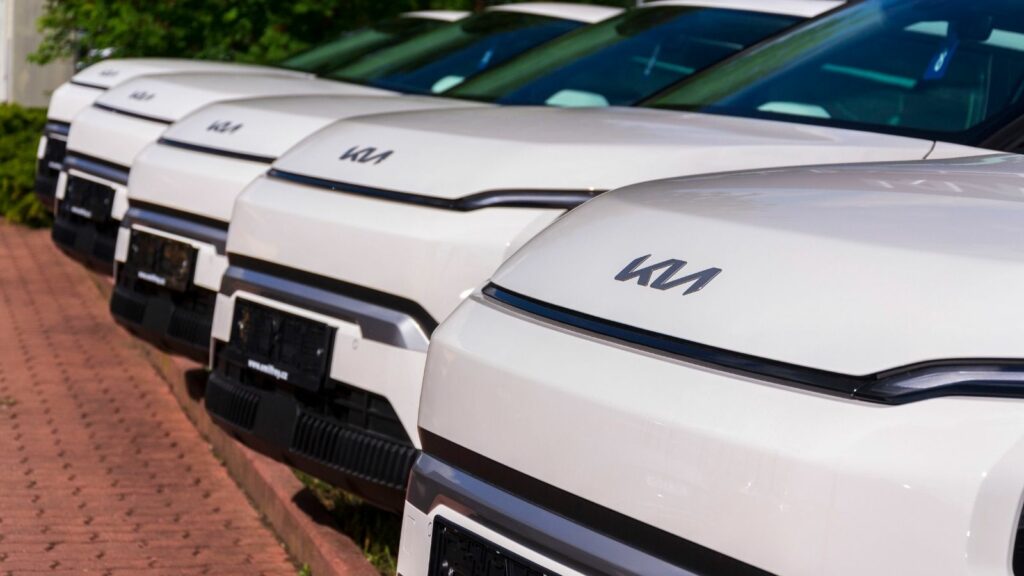
Kia’s smallest electric SUV has entered the U.S. market with a modest but notable early result. The 2027 Kia EV3 recorded 514 U.S. sales in September, its first full month on sale, after six deliveries were logged in August. That puts the new model at 520 units through the first nine months of 2026 and gives Kia an early foothold in a part of the EV market increasingly defined by price rather than prestige.
The timing matters. The EV3 arrives as Chevrolet and Nissan sharpen their own low-cost electric offerings, while federal clean-vehicle purchase credits are no longer available for vehicles acquired after September 30, 2025. With a sub-$30,000 starting MSRP, available 321-mile range and a native NACS charging port, Kia is trying to make the EV3 feel less like a compromise EV and more like a mainstream small SUV that happens to be electric.
514 Sales Give the EV3 Its First U.S. Benchmark
Kia’s September sales report gives the EV3 its first U.S. benchmark. The company sold 514 units during the month, while year-to-date sales stood at 520, reflecting six earlier deliveries as the model began reaching customers in August. For a brand-new nameplate, that is enough to show real retail activity without suggesting the model has already become a mass-market hit. It also gives Kia a base from which to judge whether awareness and dealer availability translate into stronger volumes later in the year.
The broader Kia business was much larger. The Sportage alone recorded 16,033 U.S. sales in September, while Kia’s total volume reached 77,009 vehicles. That contrast is useful because it puts the EV3’s launch in perspective. Five hundred-plus sales are meaningful for an unfamiliar electric model entering a crowded category, but the real test will be whether monthly demand can scale beyond an early-adopter audience as inventory becomes available.
The $29,890 Sticker Is the Main Weapon
The EV3’s argument is its price. Kia set the 2027 EV3 Light FWD at a starting MSRP of $29,890 before a $1,495 destination charge, placing the vehicle among the least expensive EVs available in the United States. That works out to $31,385 before taxes, registration, options or dealer charges. For buyers who have watched electric crossovers drift above $40,000, the EV3 enters at a level closer to mainstream compact-car and small-SUV territory today.
Kia is also using a broad trim ladder rather than treating affordability as a single stripped-down configuration. Higher versions add a larger battery, longer range, all-wheel drive and more equipment, while the performance-oriented GT sits at the top. That matters because the EV3 can compete for budget-focused shoppers at the bottom while giving buyers room to spend more without moving to a larger model. Kia is trying to make price the entry point, not the limitation overall.
Long-Range Versions Push Beyond 300 Miles
The base EV3 Light keeps its price down with a 58.3-kWh battery and an EPA-estimated 221 miles of range. The more consequential numbers appear one step higher in the lineup. Wind FWD and Land FWD models use an 81.4-kWh battery and carry an EPA-estimated 321-mile range, putting the EV3 beyond the 300-mile threshold many buyers use as a comfort benchmark for an electric daily driver.
All-wheel-drive versions trade some efficiency for traction, with Kia listing an EPA-estimated 280 miles for those configurations. That creates a spread: a lower-cost model for shorter commutes, long-range front-wheel-drive versions for buyers prioritizing distance, and AWD models for drivers wanting extra capability. The range strategy also helps distinguish the EV3 from affordable EVs that paired a low sticker price with shorter driving distances. Kia is effectively asking buyers to choose how much range they need rather than forcing every customer into the same battery package.
Kia Has Made NACS Part of the Package
Charging hardware is another area where Kia has tried to remove friction. The EV3 arrives with a native North American Charging Standard port, rather than requiring owners to depend on an adapter for NACS fast chargers. Kia says the vehicle can use more than 30,000 Tesla Superchargers, and it supports Plug & Charge through Kia Charge Pass, allowing stations to identify the vehicle and handle authentication after it is plugged in.
The EV3 uses a 400-volt version of Kia’s E-GMP architecture. Kia lists a 10-to-80-percent DC fast-charge time of about 31 minutes on powerful equipment, with the Light trim capable of completing that window in as little as 29 minutes under specified conditions. Those figures are not speeds associated with the 800-volt EV6, but they are competitive for a value-focused model. More importantly, NACS access, public-network compatibility and fast-charging speed make the EV3 easier to live with beyond home charging.
The Bolt and Leaf Make This a Real Price Fight
Kia is not entering an empty value segment. Chevrolet’s 2027 Bolt page lists a starting price of $27,600, an EPA-estimated 262 miles of range and a standard NACS port, while Chevrolet says 10-to-80-percent DC fast charging can take about 25 minutes. Nissan’s redesigned 2026 Leaf starts at $29,990 before destination, offers up to 303 miles of EPA-estimated range and also uses NACS with Plug & Charge. Comparisons require care because destination fees and trims differ.
The policy environment makes those sticker prices more important. IRS guidance says the federal new clean vehicle credit is unavailable for vehicles acquired after September 30, 2025. That means 2026 shoppers cannot assume a federal incentive will erase several thousand dollars from the purchase price. It shifts pressure onto manufacturers to build affordability into the vehicle, financing offer or lease structure—and explains why the EV3, Bolt and Leaf are converging around a similar price band.
Kia’s Bigger Sales Picture Makes the EV3 More Important
The EV3 is arriving during an unusual moment for Kia’s electrified lineup. Kia America posted September sales of 77,009 vehicles and a record third quarter of 236,659. The company also said hybrid sales rose 152 percent year over year in September and total electrified sales increased 60 percent. Those are strong headline figures, but they do not mean every battery-electric model was growing at the same pace.
Kia sold 835 EV6s in September, down from 2,116 a year earlier, while EV9 sales slipped to 1,955 from 3,094. The new EV3 therefore enters as Kia’s most affordable opportunity to rebuild momentum on the fully electric side of the showroom while hybrids continue carrying much of the brand’s electrified growth. Its 514-unit debut does not offset declines of the EV6 and EV9 by itself, but it adds a new price point at the end of the market where Kia had less coverage.
Canada Shows How Quickly the Price Lead Can Disappear
Canada shows how quickly the affordable-EV order can change. Kia announced the 2027 EV3 in August with a starting Canadian MSRP of C$36,995 and an all-in price of C$39,744 before taxes, calling it the country’s lowest-priced new EV. The base Light FWD uses a 58.3-kWh battery and carries a Kia-estimated range of up to 356 kilometres, while longer-range versions can reach 517 kilometres.
Less than a month later, Nissan Canada introduced a 2027 Leaf S at C$34,998 MSRP and a C$37,966 selling price before taxes, making it the lowest-priced EV by Nissan’s comparison. The Leaf S uses a 53-kWh battery and is estimated at up to 341 kilometres of range. The back-and-forth illustrates how aggressively automakers are competing for cost-conscious buyers. A model can claim the affordability crown in August and lose it by September, forcing brands to compete on equipment, range, charging and ownership experience as well as price.
Overseas Sales Suggest the Formula Has Potential
The EV3 arrives in America with evidence that its formula can work elsewhere. In the United Kingdom, 11,188 EV3s were registered during 2025, its first full year on sale. Society of Motor Manufacturers and Traders data placed the EV3 eighth among battery-electric models by registrations, while Kia said it was one of the three best-selling EVs in the retail market and the brand’s best-selling electric model.
That track record does not guarantee a similar U.S. result. Market conditions, incentives, charging access and pricing differ, and 514 sales remain one month of data. Still, the early American result is more meaningful when viewed alongside a full year of overseas demand. Kia now has a product with demonstrated appeal, a U.S. price close to the cheapest new EVs, and range that can exceed 300 miles. The question is whether those advantages can produce sustained monthly growth once the launch period is over.
