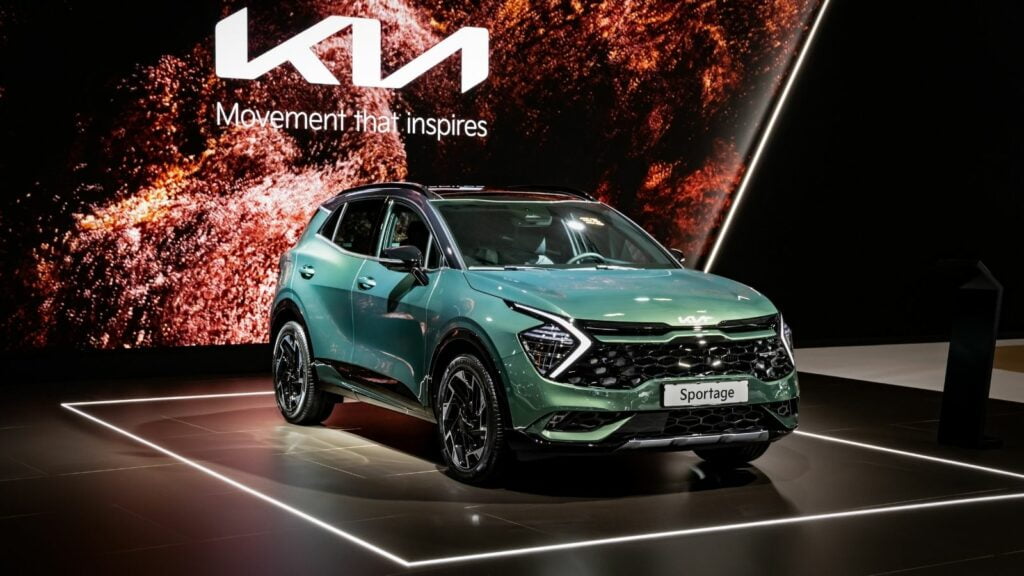
Kia has only recently refreshed the current Sportage, but development work is already pointing toward a substantially different successor. Prototype sightings of the sixth-generation model, known internally as NQ6, suggest a longer and more upright compact SUV, while industry reporting increasingly points to hybrids becoming the centre of the powertrain strategy.
The important distinction is that much of the next Sportage remains under development rather than officially revealed. Kia has not published final dimensions, specifications or market-by-market lineups. Even so, the prototypes, reports from South Korea and Kia’s own rapidly expanding hybrid plans provide an increasingly detailed picture: more space, stronger electrification and potentially much greater plug-in electric range when the next Sportage arrives.
A Bigger Sportage Is Already Taking Shape
Heavily camouflaged Sportage prototypes have begun appearing on public roads, offering the first physical evidence of what Kia is preparing beyond the current NQ5 generation. Recent photographs taken during European testing suggest that the successor has grown noticeably from front to rear. Although camouflage and temporary body panels make precise measurements impossible, the vehicle appears longer and more substantial than today’s Sportage. The proportions also look more upright, reinforcing the impression that Kia is moving the model toward a squarer SUV shape rather than trying to make it resemble a low-slung crossover.
That would fit comfortably with the direction Kia has taken elsewhere in its range. Recent products have increasingly adopted vertical lighting, stronger geometric surfaces and more upright silhouettes. The Sportage remains heavily disguised, so individual details such as its production headlights, grille and tail lamps cannot yet be treated as final. The important development is the overall footprint. If the apparent growth survives into production, the next Sportage could gain space for passengers or cargo while giving Kia more room to accommodate larger hybrid batteries and associated electrified hardware without compromising everyday practicality.
A Late-2027 Debut Is the Working Target
The next Sportage is not expected to arrive immediately. Multiple reports tracing development of the NQ6 program point toward a South Korean launch during the third quarter of 2027, meaning somewhere between July and September if the reported timetable holds. Prototype testing beginning well in advance of that window is normal for an all-new vehicle. Engineers still need to validate powertrains, cooling systems, suspension components, electronic architecture, durability and production readiness before a new generation can reach dealerships.
The timing also explains why Kia recently invested heavily in updating the existing Sportage. The current generation first appeared globally in 2021 and subsequently received a significant mid-cycle redesign, including revised lighting, interior technology and updated hybrid hardware. North American versions entered the 2026 model year with those changes, while the 2027 Sportage Hybrid has continued largely with the same fundamental architecture. A 2027 unveiling of the NQ6 would therefore give the refreshed model several years in the market before the next generation takes over. Depending on regional model-year conventions, North American buyers could ultimately see the redesigned vehicle marketed as a 2028 model.
Hybrid Power Is Moving to the Centre of the Lineup
The biggest reported change may be under the bodywork rather than in the styling. South Korean industry reporting has indicated that Kia intends to make electrified combustion powertrains the foundation of the next Sportage range. Reports have specifically identified conventional hybrids and plug-in hybrids, while more recent coverage suggests mild-hybrid versions may also remain available in certain markets. Europe and South Korea appear likely to move furthest away from conventional gasoline- or diesel-only models.
North America may be different. Recent reporting on the NQ6 has specifically cautioned that the United States could retain some conventional gasoline versions rather than adopting an entirely hybrid-only lineup. That distinction matters because Kia routinely adjusts Sportage engines and configurations for regional regulations, pricing and consumer preferences. The broad trend is nevertheless increasingly difficult to miss: electrification is moving from being one branch of the Sportage family toward becoming its defining powertrain strategy. Instead of hybrids serving mainly as fuel-saving alternatives, the sixth-generation Sportage could increasingly be engineered around them from the beginning.
Today’s Sportage Shows Why the Hybrid Has Become So Important
The current Sportage provides an unusually clear example of how electrification can change the character of a mainstream SUV. Kia’s existing North American Sportage Hybrid combines a turbocharged 1.6-litre gasoline engine with electric assistance and produces 232 horsepower. The plug-in hybrid goes further, delivering 268 horsepower while allowing a portion of everyday driving to be completed without operating the gasoline engine. Those outputs place the electrified Sportages above the conventional 187-horsepower gasoline version sold in the United States.
Fuel economy has become another selling point. Front-wheel-drive versions of the current Sportage Hybrid are rated at up to 42 mpg combined by the EPA, although ratings fall with all-wheel drive and real-world results depend heavily on conditions and driving style. The broader lesson for Kia is significant: hybridization does not have to mean accepting weaker performance to lower fuel consumption. Electric motors can provide immediate low-speed assistance while the gasoline engine handles sustained driving. That combination helps explain why manufacturers increasingly see hybrids as mainstream replacements for traditional engines rather than specialist efficiency models.
The Next Hybrid System Could Bring More Than Better Mileage
The next Sportage is expected to benefit from Hyundai Motor Group’s latest generation of hybrid technology, although Kia has not yet confirmed the final NQ6 powertrain specifications. Hyundai Motor Group has already detailed an upgraded hybrid architecture that uses two integrated electric motors and has been engineered to improve efficiency, refinement and performance. Importantly for the Sportage-sized class, the company has confirmed development of a next-generation 1.6-litre turbo-hybrid system.
Hyundai says that version can improve fuel efficiency by more than four per cent in a midsize SUV application compared with the previous system, while maximum system torque rises from 367 Nm to 380 Nm. The technology also supports functions extending beyond simple fuel savings, including enhanced regenerative braking and electrified assistance designed to improve handling and ride behaviour. Industry reporting specifically connects the next Sportage with upgraded motors and larger batteries. If the production NQ6 receives that technology, the improvement could therefore be felt during acceleration, low-speed driving and transitions between gasoline and electric operation, not merely when owners calculate fuel consumption at the pump.
The Plug-In Sportage Could Make a Major Range Leap
One of the most intriguing claims surrounding the next Sportage concerns its plug-in hybrid. Industry reports have repeatedly pointed toward a target of approximately 100 kilometres, or 62 miles, of electric driving under the WLTP test cycle. That figure has not yet been formally announced by Kia for the production vehicle, so it should be treated as a development target rather than a confirmed specification. Even so, reaching anything close to it would substantially change how the Sportage PHEV could be used.
For comparison, the current North American Sportage Plug-in Hybrid uses a 13.8-kWh battery and carries an EPA electric-range figure of roughly 34 miles. European testing standards are different and generally cannot be compared directly with EPA numbers, but the reported 100-kilometre ambition still points toward a larger usable battery and a much stronger emphasis on electric operation. For households able to charge at home, that could allow many routine commutes, school runs and local errands to take place primarily on electricity while retaining a gasoline engine for long-distance travel. It would make the PHEV considerably more than a lightly electrified gasoline SUV.
Extra Length Could Help Kia Solve a Packaging Challenge
Growing the Sportage would not necessarily be about making the vehicle look more imposing. Electrified SUVs require designers to find room for batteries, motors, power electronics, cooling components and structural protection while preserving the cabin and cargo space buyers expect. The existing North American Sportage is already approximately 184 inches long and has built much of its appeal around generous interior space within the compact-SUV category. Even modest dimensional growth could therefore give Kia valuable flexibility when engineering more sophisticated hybrid versions.
The effects would depend on where engineers place the additional length. A longer wheelbase could potentially improve rear-seat space or ride characteristics, while extra rear overhang could contribute more directly to luggage capacity. Kia has not published either measurement for the NQ6, so there is no basis yet for assigning the apparent growth to one specific purpose. Prototype proportions simply indicate that the vehicle may occupy slightly more road space than its predecessor. For families, the meaningful test will come later: whether Kia converts that footprint into noticeably better passenger comfort and cargo usability rather than simply a larger exterior.
The Interior Is Expected to Become More Software-Driven
Powertrain development is only one part of the next Sportage program. Industry reporting has linked the model with Hyundai Motor Group’s new Pleos Connect infotainment architecture, potentially giving the sixth-generation SUV a substantially different digital experience. Pleos Connect is based on Android Automotive OS and has been designed to support downloadable applications, connected services and a more smartphone-like interface. Hyundai Motor Group has said it intends to expand the platform across more than 20 million vehicles by 2030.
Another important component is Gleo AI, the group’s large-language-model-based voice assistant. Hyundai Motor Group says Gleo is being developed to handle vehicle controls and convenience functions through more natural conversational commands, with broader services planned over time. A specific production specification for the Sportage has not yet been officially released, so features attributed to the NQ6 remain expected rather than guaranteed. Still, the timing fits. A Sportage launching late in 2027 would arrive just as Hyundai Motor Group is scaling up its software-defined vehicle technologies, making one of Kia’s highest-volume models an obvious candidate for deeper integration.
Kia’s Corporate Strategy Is Tilting Strongly Toward Hybrids
The reported Sportage strategy is occurring within a much larger change at Kia. At its 2026 CEO Investor Day, the company said it expects hybrid sales to climb from about 690,000 vehicles in 2026 to 1.1 million annually by 2030. That represents an increase of roughly 60 per cent in only four years. Kia also reported that its hybrid sales jumped 32.1 per cent year over year during the first quarter of 2026, reaching approximately 138,000 vehicles.
Those numbers help explain why a high-volume nameplate such as the Sportage is receiving so much electrification attention. Kia still has substantial battery-electric ambitions, but it has revised some EV targets as demand patterns evolve and is using hybrids to cover more customers during the transition. The company plans a broader range of electrified vehicles rather than relying on one technology. In that context, moving the Sportage toward HEV and PHEV power is less an isolated model decision than an expression of company-wide strategy. A compact SUV sold in large numbers can move Kia’s hybrid totals far more dramatically than a low-volume specialty model ever could.
North America Will Be One of the Sportage’s Most Important Tests
Kia is already changing where the Sportage Hybrid is built, underscoring the importance of North America before the new generation even arrives. In June 2026, Kia announced production of the 2027 Sportage Hybrid at Hyundai Motor Group Metaplant America in Georgia. The model is now being dual-sourced for the U.S. market rather than relying exclusively on Korean production, strengthening Kia’s regional manufacturing footprint for hybrids.
Competition is simultaneously becoming more electrified. Toyota’s sixth-generation 2026 RAV4 moved to an all-hybrid and plug-in-hybrid lineup, including in Canada. Toyota Canada says more than 940,000 RAV4s have been sold in the country since the model’s 1996 Canadian debut, illustrating the scale of the segment Kia is contesting. The next Sportage therefore will not be entering an experimental corner of the market. It will face rivals that have already made hybrid technology central to their compact-SUV strategies. If Kia delivers the larger body, improved hybrid system and longer-range PHEV now being reported, NQ6 could represent one of the company’s most consequential mainstream redesigns of the decade.
