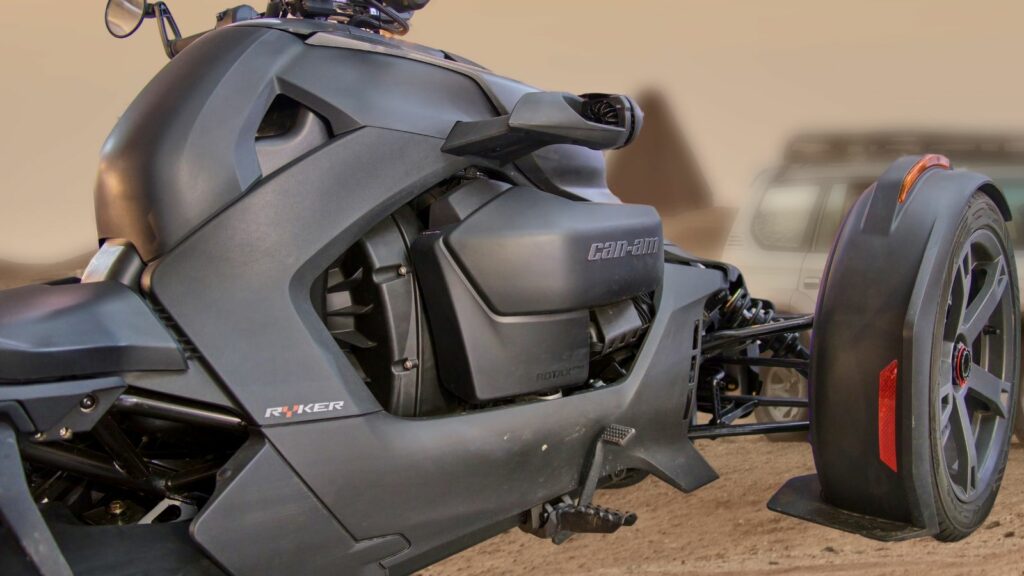
Can-Am is making its most substantial bet yet on the Ryker, the unconventional three-wheeler that has spent nearly a decade trying to make open-road riding approachable to people who might never buy a traditional motorcycle. Quebec-based BRP has unveiled the 2027 Ryker with major changes to its chassis, steering, powertrain, electronics and exterior design, describing the update as the platform’s biggest evolution since its 2018 debut.
The changes arrive without abandoning the formula that made the Ryker distinctive: two wheels in front, one driven wheel at the rear, an automatic transmission and an emphasis on accessibility. Instead, Can-Am is attempting to polish that formula, giving newcomers a smoother entry point while offering experienced owners stronger performance and a substantially more modern cockpit.
The Ryker Is Getting Far More Than a Typical Model-Year Refresh
When the Ryker appeared in 2018 as a 2019 model, Can-Am positioned it as a less expensive, highly customizable alternative within its three-wheel family. The original machine was deliberately simple: automatic power delivery, adjustable ergonomics and the stability of Can-Am’s reverse-trike layout were intended to reduce many of the barriers associated with conventional motorcycles. Eight model years later, BRP is describing the 2027 changes as the most significant evolution the Ryker platform has received.
That wording matters because previous updates generally concentrated on new packages, accessories, colours or revisions aimed at particular riding styles. The 2027 program reaches much deeper. Can-Am says it has worked on four major areas—chassis, powertrain, technology and styling—rather than merely changing trim combinations. For an owner approaching a dealership, the new machine may therefore feel less like last year’s Ryker with different body panels and more like an effort to address how the vehicle steers, delivers power and communicates information to the person riding it.
A Stiffer Chassis Targets One of the Most Important Parts of the Experience
Perhaps the least visible changes could make some of the greatest difference from behind the handlebars. Can-Am says the 2027 Ryker receives increased chassis rigidity, a reinforced steering system, revised aerodynamics and a recalibrated Vehicle Stability System. Those components affect how a three-wheeled vehicle responds when entering a corner, changing direction or encountering irregular pavement, making the engineering underneath the bodywork particularly important.
A Ryker does not lean through corners like a conventional motorcycle, so steering feel and chassis behaviour form a large part of its personality. Can-Am says the combined modifications are intended to produce sharper handling, improved stability and a smoother connection between rider and machine. The stability system remains an especially important part of the formula because the Ryker relies on electronic controls alongside its three-wheel layout. Rather than chasing a dramatic horsepower increase across every trim, BRP appears to have devoted significant attention to making the vehicle feel more predictable. For newcomers, that could be just as meaningful as adding more outright speed.
The Entry Ryker Trades Its 600cc Twin for a 900cc Three-Cylinder Engine
The biggest mechanical surprise sits in the least expensive Ryker. The outgoing entry model could be purchased with a 600cc two-cylinder Rotax ACE engine, but Can-Am is replacing that setup for 2027 with a three-cylinder Rotax 900 ACE producing 52 horsepower. It is an unusual strategy: rather than reserving the larger-displacement engine exclusively for more expensive versions, Can-Am is using a lower-output version of the 900 in its gateway model.
Can-Am says the change is intended to provide stronger low-end torque while reducing vibration and noise and delivering smoother power. That makes sense for a vehicle aimed heavily at first-time riders, where manageable response can matter more than a dramatic peak-power figure. The automatic continuously variable transmission also remains part of the package, meaning there is still no conventional clutch lever or manual gearbox to master. In practical terms, the base Ryker receives a physically larger three-cylinder engine without suddenly becoming the highest-performance machine in the family, preserving a clear step between the entry model and the 80-horsepower versions above it.
The Ryker Sport Keeps 80 Horsepower for Riders Wanting More Pace
The performance hierarchy becomes clearer with the Ryker Sport. It retains the 80-horsepower version of the Rotax 900 ACE three-cylinder engine rather than the new 52-horsepower calibration used in the entry model. Can-Am also equips the Sport with a dedicated Sport mode, KYB suspension at the front and rear, cruise control and signature lighting, giving buyers several functional reasons to move beyond the least expensive version.
That distinction allows the company to serve two audiences with essentially the same engine architecture. A new rider can start with the softer 52-horsepower configuration, while someone looking for stronger acceleration and a more energetic setup can choose the Sport. The Canadian price reflects that separation: Can-Am lists the 2027 Sport from C$16,999, compared with C$12,999 for the entry Ryker before transport and preparation charges. For buyers who use a Ryker for longer weekend trips rather than short urban outings, cruise control and upgraded suspension may prove just as relevant as the additional 28 horsepower.
A One-Year Special Series Sits at the Top of the New Range
Can-Am is also introducing a Ryker Special Series, and the company has already placed an expiration date on the idea: it is being presented as a one-year-only package for 2027. Based on the Ryker Sport, the Special Series retains the 80-horsepower Rotax 900 ACE while adding features aimed at buyers who want a more distinctive and premium version of the three-wheeler.
The specification includes exclusive body panels and wrap treatments, Liquid Titanium wheel finishes, upgraded suspension components, a unique seat treatment and an Akrapovič exhaust. Can-Am’s Canadian product information also identifies premium suspension with Kashima coating. The model starts at C$19,499 in Canada, or C$20,624 with the company’s listed transport and preparation charges. That makes it C$6,500 more than the base vehicle before those charges. Instead of creating an entirely separate performance machine, Can-Am has essentially taken the Sport’s mechanical foundation and layered higher-end hardware and visual differentiation on top, making scarcity and equipment part of the appeal.
A Five-Inch Colour Display Replaces the Ryker’s More Basic Cockpit Feel
Technology is another area where the redesigned Ryker becomes immediately recognizable. Every 2027 version gains a new five-inch colour display, accompanied by redesigned controls mounted on the handlebars. Can-Am says the combination improves visibility and gives riders more intuitive access to vehicle information. For a machine conceived when compact monochrome motorcycle instrumentation remained common, the change represents a significant modernization.
The screen is particularly notable because the Ryker has historically built much of its appeal around mechanical simplicity rather than a dashboard packed with technology. Can-Am is not turning the vehicle into the company’s most elaborate touring machine—the larger Spyder and Canyon models occupy that territory—but a clearer colour interface brings the Ryker closer to what buyers increasingly expect from modern powersports products. Someone moving to a Ryker from a newer automobile, for example, is accustomed to easily readable digital information rather than tiny displays and complicated button sequences. Updating those everyday touchpoints can make a vehicle feel dramatically newer even before it moves away from the curb.
New LED Lighting and Bodywork Give the Ryker a Noticeably Different Face
Can-Am has also reworked the parts owners and passersby will notice first. The 2027 Ryker receives new LED headlights, redesigned body panels, revised wheels and fresh colour choices. Together, those elements give the three-wheeler a more contemporary appearance while retaining the low, wide stance that has defined the Ryker since its introduction. The LED headlights are functional as well as cosmetic, with Can-Am highlighting improved illumination alongside the styling change.
The redesign is significant because visual personalization has always been central to the Ryker’s identity. When BRP introduced the vehicle in 2018, it emphasized tens of thousands of possible customization combinations, including easily changed panels and adjustable components. By 2026, Can-Am was still promoting an extensive accessory ecosystem and interchangeable styling choices. The 2027 update therefore does not abandon customization in favour of one fixed appearance. Instead, it gives owners a new foundation to personalize. For a product whose parking-lot presence is arguably part of its attraction, fresh bodywork helps signal that this is not simply another colour cycle.
Can-Am Still Sees New Riders as the Ryker’s Most Important Audience
Despite all the engineering work, Can-Am has not changed the basic mission of the Ryker. The company continues to describe the standard model as an entry point into three-wheel riding, and recent ownership data helps explain why. Citing S&P Global Mobility U.S. registration information covering April 2025 through March 2026, BRP says nearly half of new Ryker owners during that period were newcomers to motorcycling, while more than one-third were women.
Those figures help put the redesign in context. Traditional powersports manufacturers often compete over greater horsepower, advanced electronics and increasingly specialized machines, but the Ryker has been built around expanding the pool of people willing to ride at all. Automatic CVT operation, three-wheel stability and approachable ergonomics support that strategy. Improving refinement rather than simply making the machine faster could therefore be commercially important. A person arriving at a Can-Am dealership with no motorcycle background is more likely to notice smooth power delivery, manageable controls and confidence at low speeds than a specification-sheet victory measured entirely in peak horsepower.
Canadian Buyers Now Have Three Clearly Separated Price Points
The Canadian 2027 Ryker lineup creates a straightforward three-step ladder. The entry Ryker begins at C$12,999, with Can-Am listing C$14,124 after transport and preparation. The Ryker Sport starts at C$16,999, or C$18,124 with those charges, while the Special Series starts at C$19,499 and is listed at C$20,624 including transport and preparation. Dealer fees, taxes, registration and optional equipment can add further costs depending on the purchase.
Each price increase corresponds with a tangible change in equipment. The base version gets the new 52-horsepower three-cylinder and automatic CVT; the Sport moves to 80 horsepower while adding KYB suspension, cruise control, Sport mode and signature lighting; and the Special Series adds its limited-run styling, premium suspension treatment and Akrapovič exhaust. Notably, Can-Am’s announced 2027 range consists of these three packages, whereas the 2026 lineup included Standard, Sport and Rally offerings. That creates a simpler street-oriented progression for the redesigned generation.
The Redesign Carries Added Weight Because Can-Am Remains a Major Quebec Export Brand
The Ryker may travel on three wheels, but the company behind it has a considerably larger footprint. BRP is headquartered in Quebec and reported annual sales of C$8.4 billion across more than 110 countries, with close to 17,000 employees as of January 31, 2026. The business encompasses Can-Am on- and off-road vehicles along with Ski-Doo, Lynx, Sea-Doo, Quintrex and Rotax-branded products, making the Ryker one piece of a broad global powersports operation rooted in Quebec.
That scale makes the 2027 overhaul more than a styling exercise for a niche vehicle. The Ryker was created to attract customers who might otherwise remain outside motorcycling, and BRP is now investing in that concept again rather than allowing the original platform to age quietly. A stronger chassis, new engine strategy, modern display and revised model hierarchy suggest Can-Am still views accessible three-wheel transportation as an important part of its road business. Nearly a decade after the Ryker first challenged conventional ideas of what a motorcycle-like experience should look like, Quebec’s powersports manufacturer is giving that experiment its most substantial reset yet.
