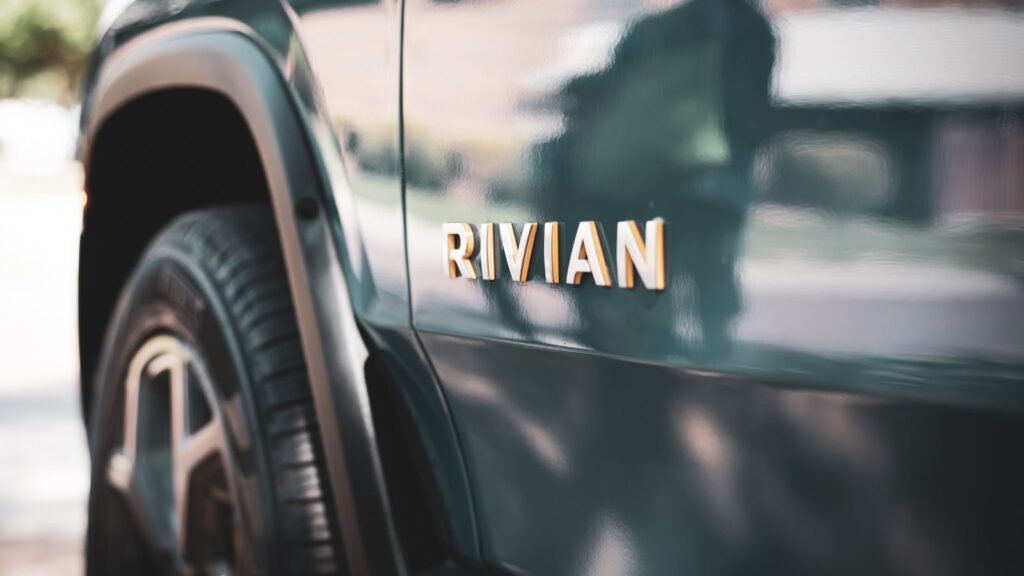
Canadian Rivian R2 reservation holders will eventually receive a slightly different version of one comfort feature than some of the first American buyers experienced. Rivian has confirmed that newer R2s no longer use a ventilation fan inside each front-seat backrest, leaving airflow concentrated in the lower seat cushion. The company says it made the change because the backrest system generated excessive cabin noise. Seat heating remains unchanged, and Rivian continues to advertise ventilated front seats on higher R2 trims. The revision is small compared with the electric SUV’s battery, motors or chassis, yet it has attracted attention because early production vehicles had ventilation through both portions of the seat. With the R2 scheduled to reach Canada in 2027, the change offers Canadian buyers an early look at how Rivian is refining its highest-volume product while production rapidly expands.
Rivian Says Excessive Noise Led to the Change
The change first surfaced through owner discussions before Rivian publicly explained what had happened. RivianTrackr reported on October 7 that newer R2 vehicles were arriving without the fan previously installed inside each front-seat backrest. After initially investigating the reports through owners and a Rivian technician, the publication received confirmation directly from Rivian. The company said the backrest ventilation generated excessive cabin noise and that it had therefore streamlined the system.
What remains is ventilation through the bottom seat cushion. Rivian says that area is where occupants retain the most heat, while the heating system is unaffected by the hardware revision. That distinction matters because reports that Rivian has completely removed ventilated seats would be inaccurate. The function still exists on appropriately equipped R2s, but airflow is no longer produced independently from both the cushion and backrest. For someone who tested an early vehicle and felt cool air across the back, however, a later production R2 may provide a noticeably different experience even though the feature continues to carry the same general “ventilated seats” description.
The Exact VIN Cutoff Is Less Certain Than It First Appeared
Initial owner reports suggested a relatively clean transition somewhere around VIN 9,800 to 10,000. Earlier vehicles generally appeared to contain two ventilation fans per front seat—one underneath the cushion and another behind the occupant’s back—while later vehicles were said to have only the lower unit. RivianTrackr consequently described R2s around VIN 10,000 and higher as the vehicles most likely to contain the revised design.
The community evidence is not precise enough to treat 10,000 as an official production cutoff. In the same discussion, one owner reported that a vehicle in the 10,0XX range still had both fans, while another owner with a VIN in the 9,3XX range reported no backrest ventilation. Rivian itself confirmed the design change but did not publicly provide a specific VIN at which every vehicle switched configurations. That makes a physical check more useful than relying solely on serial numbers. Canadian buyers are unlikely to face the same uncertainty by the time deliveries begin because production should have moved well beyond the early transition period, but the episode illustrates how running changes can occur while a new vehicle is being rapidly scaled.
Ventilated Seats Have Not Disappeared From the R2
Rivian’s Canadian specifications still list heated and ventilated front seats as part of the R2 Premium equipment package. The R2 Performance likewise receives the premium interior with heating and ventilation, along with heated rear seats. Rivian has not removed those features from its Canadian product description following confirmation of the backrest change. From the company’s perspective, that description remains accurate because the front seats continue circulating air through the lower cushions.
The difference is more about the amount and location of airflow than the name of the feature. An early R2 could direct ventilation through two separate areas of each front seat, potentially giving someone wearing a heavy shirt or jacket more direct airflow across the torso. The revised seat concentrates the effect lower down. Whether that matters will depend heavily on climate and personal preference. A driver in Vancouver may rarely use maximum ventilation, while someone travelling through an Ontario heat wave could value every available source of airflow. The control still works; the physical hardware behind that control has simply become less extensive than it was on the earliest production examples.
Heating Is Unchanged, Which Matters in Canada
Rivian specifically told RivianTrackr that the modification does not affect seat heating. The heating elements are separate from the removed ventilation fan, so both the cushion and seat-back heating function remain independent of the revised airflow arrangement. For Canadian drivers, that may be reassuring because heated seating is likely to see considerably more annual use than ventilation in much of the country.
Seat heating can also be especially useful in an EV because warming occupants directly can reduce the need to make the entire cabin extremely warm immediately after a cold start, although actual energy savings depend on how the vehicle is operated. Rivian has paid considerable attention to cold- and hot-weather thermal management in the R2 more broadly. The company says every R2 receives a heat pump, and its engineers increased compressor displacement compared with the larger R1 while improving the interface between the battery coolant and refrigerant systems. Those changes are intended to maintain cabin and battery thermal performance efficiently. Removing one ventilation fan therefore should not be confused with a wholesale reduction in the R2’s climate-control system; it is a localized seat-design revision.
Early Drivers Had Already Noticed the Fans Were Loud
Rivian’s explanation did not appear in a vacuum. Months before confirmation of the change, some people who drove early R2s were already discussing noise from the ventilated seats. In June, contributors to Rivian Forums described demo vehicles in which the ventilation fan was unusually noticeable, including reports of high-pitched sound and vibration through the seat back. Other drivers in the same discussion reported that their test vehicles worked well and that they did not find the noise objectionable.
Those contradictory experiences are useful context. They suggest the issue was not universally perceived in the same way, but there was enough discussion around fan noise for Rivian’s explanation to be plausible. One owner later reported a popping sound that a service technician believed could involve the seat-back fan interacting with surrounding trim when pressure was applied to the seat. Rivian has not publicly identified that physical interference as its official reason for changing production, so it should remain separate from the company-confirmed explanation. What Rivian has formally said is simpler: backrest ventilation created too much cabin noise, and eliminating that component allowed the system to be streamlined.
The Change Mainly Matters to Premium and Performance Buyers
Not every R2 customer is losing something that was included in their chosen configuration. Rivian’s entry-level R2 Standard uses a simpler interior and does not include the ventilated front seats offered with the Premium and Performance versions. That differentiation was already clear when journalists drove production R2s ahead of the U.S. launch. Standard models also give up several other convenience features associated with the more expensive interior package.
Canadian specifications currently show the Standard with a single rear motor in its basic configuration, an estimated 442 kilometres of range, 350 horsepower and a 6.1-second 0-to-100-km/h time. Premium steps up to dual-motor all-wheel drive, 450 horsepower and an estimated 531 kilometres of EPA-rated range. Performance uses the same quoted 531-kilometre range while increasing output to 656 horsepower and cutting the claimed 0-to-100-km/h time to 3.8 seconds. Both higher trims are the ones where ventilated seating forms part of the value proposition, making the hardware change most relevant to customers already paying for a more comprehensively equipped R2.
Canadian Buyers Are Still Waiting Until 2027
The R2 has already reached American customers, but Rivian’s Canadian website currently describes every version as “Coming 2027.” Canadian reservation holders were told during the summer that the first order invitations were expected in the first half of 2027. That gives the company considerably more time to mature production before large numbers of R2s reach Canadian driveways.
The delay means Canadians will miss some of the earliest-production quirks, but it also means the vehicle they eventually receive may differ in small ways from the R2s appearing in initial U.S. reviews and owner videos. Rivian has not currently published a Canadian price on its official R2 page. An earlier C$66,500 starting figure disappeared after the Canadian timeline changed, so that old number should not be treated as current pricing. What Canadian shoppers can evaluate today are the specifications: 245 millimetres of ground clearance, a North American Charging Standard port, access to more than 21,000 compatible Tesla Superchargers in the U.S. and Canada, and up to 531 kilometres of estimated range on the longer-range versions.
R2 Production Is Scaling Quickly in the United States
The seat revision is occurring during a major manufacturing ramp rather than late in a mature vehicle’s life. Rivian began producing the R2 at its Normal, Illinois factory in April 2026, and external customer deliveries officially began June 9. The SUV is strategically important because it moves Rivian below the price territory occupied by its larger R1T pickup and R1S SUV, potentially exposing the brand to a much larger customer base.
Companywide deliveries reached a record 19,248 vehicles during the third quarter of 2026, according to Rivian, while production reached 19,751. Rivian does not break those totals into individual R1, R2 and commercial-van figures, so they should not be interpreted as R2 sales alone. Reuters nevertheless identified the R2 rollout as a major contributor to the company’s improving volume. Rivian maintained full-year guidance of 65,000 to 70,000 vehicle deliveries after the quarter. At that production pace, small design changes can affect thousands of vehicles relatively quickly. The removed seat-back fan is therefore an example of a startup manufacturer making a running engineering change while moving from initial launches toward broader-scale manufacturing.
Owner Frustration Is as Much About Communication as Cooling
Reaction among R2 owners and reservation holders has been sharply divided. Some said the original fans were loud enough that they understood Rivian’s decision, and at least one owner reported little useful cooling contribution from the backrest compared with the lower cushion. Others viewed back ventilation as one of the reasons they were excited about the vehicle, particularly in hot U.S. climates, and said they would rather tolerate extra sound in exchange for stronger airflow.
A recurring concern was not simply the missing fan but the absence of advance disclosure. Several reservation holders said they had experienced stronger ventilation during demonstration drives and expected their eventual vehicle to behave similarly. Others argued that a buyer should be told when a feature changes between test drive and delivery, even if the manufacturer continues to meet the broad specification of providing “ventilated seats.” Those comments do not represent every R2 buyer, but they reveal the risk involved in quiet running changes. In a software-defined vehicle, customers may expect functions to improve after purchase; discovering that physical hardware has been simplified can create a different emotional response.
Canadian Buyers Should Focus on the Vehicle They Will Actually Receive
For prospective Canadian owners, the practical lesson is not that the R2 has suddenly become a different vehicle. Its core specifications remain compelling on paper: the Premium and Performance models offer dual-motor all-wheel drive, up to an estimated 531 kilometres of range, 2,000 kilograms of quoted towing capacity and substantial passenger and cargo space in a package considerably smaller than an R1S. The removal of two small seat-back fans does not change those fundamentals.
It does underline the importance of evaluating production vehicles rather than assuming every detail from an early review, prototype or American launch unit will carry forward unchanged. By the time Canadian R2 deliveries begin, buyers should be able to experience the revised seat design through demonstration vehicles and decide whether cushion-only ventilation provides enough comfort. They should also wait for final Canadian pricing and trim details before making value comparisons. Rivian has now been clear about why the seat changed: the backrest fan was judged too noisy. The larger question is whether Canadian customers will consider quieter operation a worthwhile trade for losing the airflow that some of the earliest R2 owners received.
