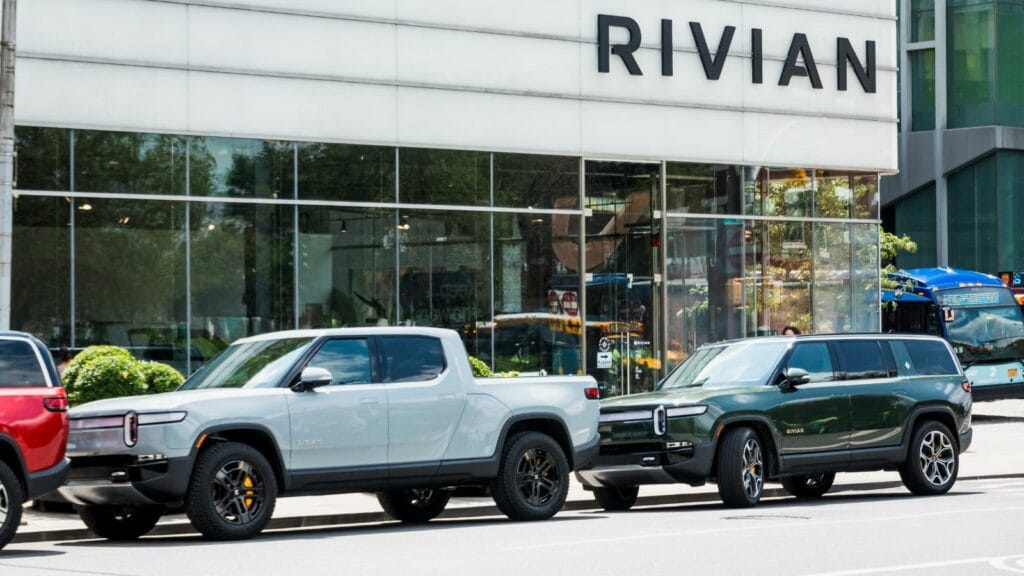
Rivian is not reinventing its flagship electric vehicles for 2027. Instead, it is refining the details that can matter enormously when buyers are spending luxury-car money. The R1S gains long-requested second-row captain’s chairs, the R1T gets a more adventure-focused standard wheel-and-tire setup, and both models adopt a simpler Premium, Performance and Quad trim structure.
Those changes arrive as the premium EV market becomes considerably tougher. Cadillac and Lucid are pushing electric SUVs with extraordinary range and increasingly lavish cabins, while the broader U.S. EV market remains smaller than it was a year ago. For Rivian, the challenge is no longer simply proving that an electric truck or three-row SUV can be fast and capable. The company now has to persuade affluent customers that an R1 still feels special enough to command its price.
A Simpler Lineup Replaces the Motor-Count Puzzle
One of Rivian’s most visible changes is also one of its simplest. The company is retiring the Dual and Tri names that described how many motors were fitted to an R1 and replacing them with Premium and Performance. Quad remains the designation for the range-topping four-motor vehicles. Premium therefore uses a dual-motor all-wheel-drive system, Performance uses three motors and Quad uses four. It is essentially the same underlying hierarchy presented in language that tells buyers more about positioning than engineering architecture. The structure also brings R1 naming closer to Rivian’s newer R2 family, giving the brand a more consistent showroom identity.
The mechanical differences remain substantial. Premium starts with 533 horsepower, while an available power upgrade raises output to 665 horsepower. Performance delivers 850 horsepower, and Quad reaches 1,025 horsepower. U.S. starting prices remain firmly in premium territory, at $79,990 for the R1T Premium and $83,990 for the R1S Premium before applicable destination charges and other fees. Performance versions move well beyond the $100,000 mark. In other words, the new names may simplify shopping, but Rivian is not repositioning the R1 as a value-oriented EV. These remain expensive flagship vehicles expected to compete on experience as much as specifications.
Captain’s Chairs Turn the R1S Into a More Convincing Luxury SUV
The most meaningful 2027 change may be sitting in the second row. Rivian says captain’s chairs were the most requested interior feature from R1S customers, and the new configuration finally gives the three-row SUV an alternative to its traditional bench. Choosing the two individual seats reduces capacity from seven occupants to six, but it creates a centre aisle that makes the third row easier to reach. That is particularly useful for families that regularly install child seats, because passengers can move toward the rear without necessarily disturbing the second-row seating arrangement.
The chairs are heated, fold flat and retain child-seat attachment provisions. Individual armrests can be stowed against the seats, while integrated cupholders deploy when needed. The open space between the chairs can also serve as a pass-through for long equipment such as skis. Pricing underscores Rivian’s premium strategy. On Premium models, the captain’s chairs themselves add $1,500 but require the Sound + Vision package, making the effective upgrade several thousand dollars depending on the interior selected. Performance and Quad buyers can also choose the chairs, with pricing varying by interior theme. It is not revolutionary technology, but for a six-figure family SUV, convenience can be as persuasive as another burst of horsepower.
The R1T Gets a More Adventure-Focused Starting Point
Rivian is making a different calculation with the R1T. Premium versions now use a 20-inch Adventure wheel paired with a Goodyear all-season tire as standard equipment. Rivian describes the tire as optimized to combine useful traction, year-round versatility and range efficiency. The tire is also Three-Peak Mountain Snowflake certified, making it more credible for winter conditions than a conventional warm-weather road tire. Performance R1T buyers can select the setup without an additional charge, giving drivers another way to prioritize trail and all-weather usability.
There is a trade-off, however, illustrating how complicated electric-truck range claims can become. With the new 20-inch setup, Rivian lists roughly 300 miles of range for a standard Premium R1T and about 380 miles for Premium Long Range. Performance is rated around 348 miles with the setup. Other wheel-and-battery combinations can push an R1T to approximately 420 miles. That means the highest possible range number is not necessarily attached to the new adventure-oriented configuration. Rivian appears willing to sacrifice some headline mileage in exchange for a combination that better reflects the R1T’s original identity: a truck intended to commute during the week and travel beyond pavement on the weekend.
Most of the Serious Performance Hardware Carries Over
The 2027 changes should not be mistaken for another ground-up engineering overhaul. Rivian already performed a major second-generation R1 rework earlier in the product cycle, updating batteries, electrical architecture and powertrains. For 2027, the basic performance proposition largely remains intact. Premium versions combine everyday usability with genuinely quick acceleration, while Performance and Quad models occupy territory that would have been associated with exotic sports cars not long ago. An R1S Performance can reach 60 mph in roughly 2.9 seconds, while the most powerful Quad versions can do it in around the mid-two-second range under the appropriate conditions.
Driving range also remains competitive. Depending on battery and wheel selection, a Premium R1S can carry an EPA estimate from roughly 329 to 410 miles, while long-range R1T configurations can reach approximately 420 miles. Performance R1S models carry an EPA estimate around 371 miles, and the R1S Quad can reach approximately 374 miles with its range-oriented configuration. Those numbers illustrate why Rivian does not need a dramatic powertrain reset every model year. The challenge is increasingly elsewhere: turning impressive hardware into a cabin, ownership experience and configuration menu that affluent buyers consider worth the considerable purchase price.
Rivian Faces Rivals That Are Becoming Much Harder to Ignore
When the R1S first established itself, the market for large premium electric SUVs was relatively thin. That advantage is fading. Cadillac’s 2026 Escalade IQ starts above $127,000 in the United States and advertises a Cadillac-estimated range of as much as 465 miles. It combines that battery capacity with a 55-inch dashboard display, standard Super Cruise hands-free driver assistance, air suspension and available high-end audio and seating packages. Cadillac is effectively taking the familiar Escalade formula—size, presence and indulgence—and electrifying it rather than asking buyers to embrace an unfamiliar luxury philosophy.
Lucid attacks the same segment from another direction. The Gravity Touring starts around $79,900, while Grand Touring begins near $98,900. A suitably configured Gravity Grand Touring carries an EPA-estimated range as high as 450 miles, with a 926-volt electrical architecture and charging rates that can reach 400 kW under appropriate conditions. Genesis has also unveiled its large GV90 electric SUV, including an especially lavish Neolun variant. None is an exact R1S substitute: Rivian still emphasizes towing, trails and outdoor utility more heavily. But buyers spending $80,000 to well over $100,000 now have more credible choices, making features such as seating comfort and interior differentiation increasingly important.
A Softer EV Market Makes Every Premium Customer More Valuable
Rivian’s tweaks are arriving against a considerably different EV backdrop than the growth-at-any-cost environment of several years ago. Cox Automotive estimated that Americans bought 247,226 new electric vehicles during the second quarter of 2026. That was a healthy 14.7% improvement from the revised first-quarter total, but sales were still 20.5% below the second quarter of 2025. EVs represented approximately 5.8% of U.S. new-vehicle volume, far below the 10.6% share reached during the incentive-driven surge in the third quarter of 2025.
That environment changes how manufacturers must compete. A buyer interested in an expensive electric SUV can now compare several vehicles with 300-plus-mile range, extraordinary acceleration, sophisticated software and upscale interiors. Simply having an electric powertrain is no longer distinctive enough. Rivian’s decision to simplify trims, answer a specific R1S customer request and refine the R1T’s everyday adventure credentials reflects that reality. Even relatively small improvements can matter when the addressable market is under pressure. Luxury customers are also profitable customers, so retaining them becomes particularly important while automakers simultaneously spend billions developing less expensive EVs intended to broaden demand.
The R1 Must Remain a Halo Vehicle While R2 Chases Volume
The timing is especially important because Rivian is entering a new stage of its business. External customer deliveries of the smaller R2 began during the second quarter of 2026, giving the company a vehicle intended to reach a much wider audience than the R1S or R1T. Rivian delivered 12,194 vehicles in the quarter and produced 12,613. Revenue reached $1.658 billion, 27% higher than a year earlier, and the company reported $179 million in gross profit. Rivian ended the period with approximately $5.3 billion in cash, cash equivalents and short-term investments.
That makes the relationship between R1 and R2 increasingly important. R2 is supposed to provide scale, but the expensive R1 vehicles still establish what a Rivian represents at the top of the market. They showcase the company’s performance, software, off-road engineering and brand personality while giving customers something to move up to. The 2027 revisions therefore look less like emergency reinvention and more like careful repositioning. Rivian is making its flagships easier to understand and more luxurious where customers have asked for it, precisely as the company’s less expensive models begin taking centre stage.
