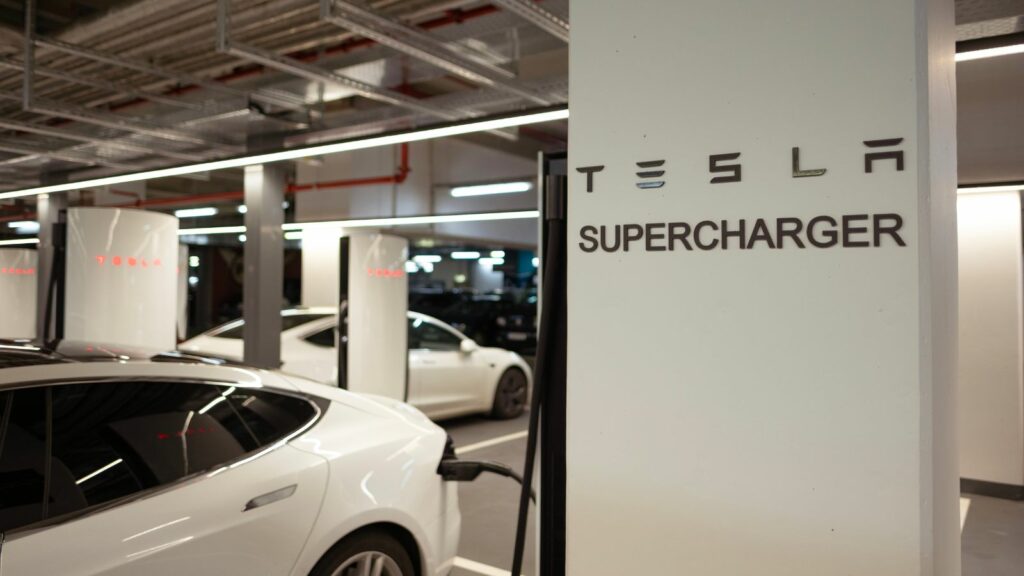
Tesla’s Canadian charging network is getting another boost in Montreal. A new Supercharger project in the city was marked as under construction on October 6, adding to a rapidly expanding collection of charging sites around Greater Montreal and across Quebec.
The timing is notable. A Canadian Supercharger tracker now counts 290 open Tesla locations nationwide, while a recently opened 24-stall station in Mont-Tremblant marked Tesla’s 3,000th Canadian Supercharger stall. Exact details for the latest Montreal project—including its address, number of charging stalls and maximum power—have not yet been publicly confirmed in the sources available. Even so, the start of construction points to continued investment in a market where Tesla’s older Montreal chargers increasingly sit beside much faster new-generation installations.
Construction Has Started, but Important Details Are Still Missing
Drive Tesla Canada’s national Supercharger tracker recorded a new Montreal, Quebec location as under construction on October 6, 2026. That represents a meaningful change from a project merely appearing on a future-development map: construction status indicates visible work has begun at a specific site. As of the latest verifiable information, however, the tracker does not publicly provide enough detail to establish the exact address, number of charging stalls or generation of Supercharger hardware with confidence.
That distinction matters because Tesla’s newest Canadian sites can differ dramatically from older installations. A modern location could potentially contain V4 equipment and substantially more stalls, but applying those specifications to Montreal before they are confirmed would be speculation. There is also no verified opening date yet. Charging projects can move quickly once hardware arrives, or spend months waiting for utility connections and final commissioning. For Montreal drivers, the important development today is therefore straightforward: another Tesla fast-charging project has moved into the construction phase, while its eventual capacity remains an open question.
Canada Has Reached 290 Open Supercharger Locations
The same Canadian Supercharger map currently lists 290 open locations across the country, alongside 33 sites under construction and another 64 categorized as proposed. Five locations are listed as closed. Those figures provide a snapshot rather than a permanent total—the network changes whenever a station opens, closes, expands or advances to a new development stage—but they demonstrate how far Tesla’s Canadian footprint has grown from the handful of highway sites available during the brand’s earlier years.
Location counts also tell only part of the story. One Supercharger site can contain four stalls while another can contain several dozen, meaning the number of individual charging plugs is a better indication of total capacity. Canada recently crossed another important threshold on that measure when Tesla identified its 3,000th Canadian Supercharger stall. With thousands of individual charging positions spread among hundreds of locations, the network now serves both cross-country travel corridors and increasingly dense urban markets. Montreal’s latest project falls into the second category, where adding capacity can reduce pressure on older stations rather than simply filling a blank spot on a highway map.
Montreal’s Existing Superchargers Include Much Older Hardware
Tesla’s two established Montreal listings illustrate why another installation could matter even in a city that already has Supercharging. At Place Vertu on Côte-Vertu Boulevard in Saint-Laurent, Tesla operates 12 Superchargers rated at up to 150 kW. The downtown Rue Viger location at the Hampton Inn has eight Superchargers listed at only 72 kW. Both are available 24 hours a day, according to Tesla’s current location pages.
Those power levels are modest beside Tesla’s newest Canadian installations. A driver using an older station may still get an entirely adequate charge, particularly if the vehicle itself cannot sustain extremely high charging rates, but newer hardware can move substantially more energy when a compatible battery is ready to accept it. Site size matters as well. Twenty or more stalls can absorb a busy dinner-hour rush more easily than eight. Montreal therefore does not simply need dots on a charging map; capacity, charging speed and location all determine how useful those dots become. The specifications of the new project will reveal whether Tesla is adding incremental coverage or making a more substantial upgrade to its urban network.
Greater Montreal Is Already Seeing a New Generation of Sites
The latest Montreal construction project is part of a much broader buildout around the metropolitan area. In March, Tesla opened a new Supercharger at Centropolis in Laval with 16 V4 stalls rated at up to 325 kW. The station sits in the Cineplex parking area at 2800 Avenue du Cosmodôme, close to Autoroute 15. It offers a much more modern charging experience than several of the region’s older 150-kW installations and is available to compatible non-Tesla EVs.
South of Montreal, another Supercharger project has been under construction at Mail Champlain in Brossard. Photos from that development indicated a planned installation of roughly 16 to 20 stalls, although the final configuration should be treated as provisional until the completed station is confirmed. A separate 16-stall project has also been under development in Mirabel. Taken together, Laval, Brossard, Mirabel and the newly identified Montreal project show Tesla increasing capacity on multiple approaches to the island rather than relying exclusively on the city’s long-established charging locations.
The 3,000th Canadian Stall Opened in Quebec Just Days Ago
Quebec also hosted one of Tesla Canada’s biggest charging milestones only a week before the latest Montreal construction update. On September 29, Tesla opened a 24-stall Supercharger on Montée Ryan in Mont-Tremblant. Tesla Charging identified the location as the site containing Canada’s 3,000th Supercharger stall. The station is available to compatible non-Tesla electric vehicles as well, broadening its usefulness beyond Tesla owners travelling into the Laurentians.
Its unusually long road to opening also demonstrates why construction does not guarantee an immediate launch. Drive Tesla reported that the Mont-Tremblant facility had been substantially built for more than a year before being energized. A commemorative plaque even referenced January 2026, suggesting an opening was originally expected much earlier. According to the report, utility-connection delays pushed activation into September. The experience is relevant to the new Montreal project. Seeing equipment and excavation is an important milestone, but electrical infrastructure, inspections and commissioning still have to follow. Until Tesla confirms an opening date, the new Montreal location should be considered a construction project rather than an imminent charging option.
Superchargers Are Increasingly Useful Beyond Tesla Vehicles
Tesla’s network is also becoming more relevant to drivers who do not own one of the company’s vehicles. Tesla explains that owners of compatible non-Tesla EVs can use the Tesla app or its Find Us map to identify Supercharger locations available to them. Access is not universal, particularly at older installations, and some vehicles require a NACS adapter. Individual Tesla location pages identify compatible stations and display separate pricing for Tesla members and other EV drivers where applicable.
That difference is especially visible around Quebec. Newer installations such as the Laval V4 station were opened to compatible non-Tesla vehicles, while older sites including Montreal’s Côte-Vertu and Rue Viger locations remain listed simply with Tesla pricing. For drivers, that makes the hardware chosen for the new Montreal site more important than it might have been several years ago. If the station becomes a NACS Partner Site, it could provide additional fast-charging capacity to a growing range of Ford, General Motors and other compatible EVs, rather than operating as infrastructure primarily for Tesla’s own fleet. Confirmation will have to wait until the site’s final specifications appear.
Quebec Already Has One of Canada’s Most Developed Charging Ecosystems
Tesla is expanding in a province that already treats public charging as a significant part of its transportation strategy. The Quebec government identifies Tesla alongside the Circuit électrique, FLO, ChargePoint, RechargÉco and Electrify Canada as major public charging networks operating in the province. Drivers therefore encounter a more diverse charging environment than the Tesla network alone might suggest, particularly on major intercity routes and in larger urban centres.
Quebec plans to have 6,700 public fast-charging points operating by 2030. The provincial government says Hydro-Québec’s Circuit électrique currently accounts for more than half of the province’s DC fast-charging points. Public chargers can be found at shopping centres, restaurants, hotels, service areas and other destinations where motorists naturally spend time. That gives Tesla both competition and an incentive to continue expanding. A Montreal EV driver may have multiple networks available for the same journey, meaning charging speed, reliability, price, stall availability and location can influence which station gets used. Another Supercharger therefore adds capacity within a market where expectations for public charging are already relatively high.
Tesla Still Has Dozens of Canadian Sites in the Construction Pipeline
Montreal is only one entry in a sizeable national development pipeline. As of October 6, Drive Tesla’s tracker listed 33 Canadian Supercharger locations as under construction and 64 more as proposed. Squamish, British Columbia, moved into the construction category one day before Montreal. Port Hope, Ontario, and Montcerf-Lytton, Quebec, were both recorded as under construction in late September, while new stations in Prince Rupert and Terrace, British Columbia, recently moved into the open category.
The geographic spread is important because the problems facing EV charging differ across Canada. Dense urban areas need enough stalls to prevent congestion, while smaller communities need strategically placed sites to make long-distance travel practical. Northern and rural routes can be particularly sensitive to large gaps between reliable high-speed chargers. Tesla’s current pipeline touches both kinds of markets. Montreal adds urban capacity in Canada’s second-largest metropolitan area, while projects in communities such as Prince Rupert or Montcerf-Lytton address very different travel patterns. A national charging network has to solve both problems at once.
The Global Supercharger Network Is Getting Busier as It Expands
Canada’s growth is taking place inside a Supercharger network that has now surpassed 85,000 stalls at more than 9,000 locations worldwide, according to figures announced by Tesla Charging in early October. Tesla had crossed 80,000 stalls only months earlier, meaning approximately 5,000 additional charging positions were added during that period. The company reached 70,000 stalls in June 2025, illustrating how quickly physical charging infrastructure has continued to accumulate.
Usage is rising at the same time. Tesla reported 69 million Supercharging sessions globally during the third quarter of 2026, up 29% from a year earlier. Roughly 2.4 terawatt-hours of electricity were delivered through the network during the quarter, also up 29%. Those numbers help explain why simply maintaining the existing footprint is not enough. More EVs, expanding access for other brands and higher charging frequency can place additional pressure on popular sites even while the network grows. In Montreal, another location could therefore serve two purposes: expanding geographic convenience and adding redundancy when established chargers are already occupied.
The Biggest Question Now Is What Tesla Is Actually Building
The most important facts about Montreal’s newest Supercharger remain the ones still waiting to be confirmed. Its precise location will determine whether it primarily serves neighbourhood drivers, commuters or motorists passing through the city. Its stall count will determine how much capacity it adds, while its hardware generation will reveal whether it resembles Montreal’s older 72- and 150-kW stations or newer Quebec installations capable of substantially higher charging speeds.
Non-Tesla access will also be worth watching. Quebec’s public-charging market is increasingly built around interoperability, and Tesla’s newest stations frequently serve compatible vehicles from other manufacturers. None of those features should be assumed until Tesla publishes the final site information. What is already clear is the direction of travel. Canada now has about 290 open Supercharger locations on Drive Tesla’s current tracker, Quebec just hosted the country’s 3,000th stall, and additional stations continue to move from planning into construction. Montreal’s latest project is one more piece of a network that is becoming denser rather than simply longer.
