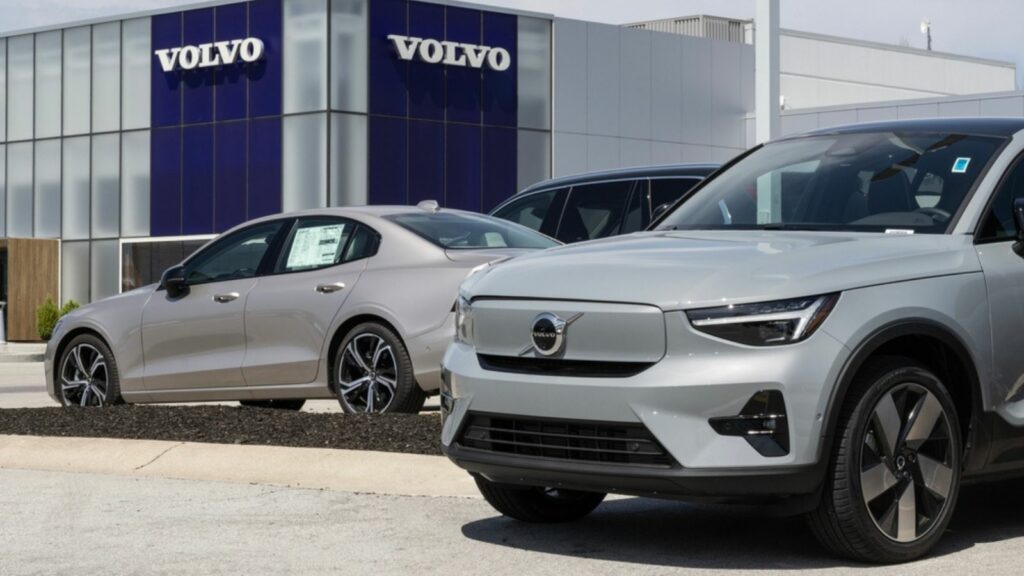
Volvo Cars is selling more fully electric vehicles, but that progress has not been enough to offset a broader retreat across its lineup. Figures released on November 4 show that the Swedish automaker sold 141,656 vehicles worldwide during August–October 2026, a 16% decline from the same period last year. Fully electric sales rose 27%, while plug-in hybrid sales fell 30%, exposing a widening divide within the company’s electrification strategy. Difficult conditions in China and the United States are weighing on total volumes, even as European buyers are showing stronger interest in battery-powered models. For Volvo, the challenge is no longer simply persuading customers to consider electric cars; it is turning that demand into enough deliveries to stabilize the business.
The 16% Decline Covers Three Months, Not October Alone
Volvo reported 141,656 global sales for August through October, compared with 168,967 in the same period of 2025. That represents 27,311 fewer vehicles sold, a substantial shortfall for a manufacturer competing in the crowded premium market. The new figure also looks weaker than Volvo’s previously reported third-quarter result: sales for July through September had fallen 10.7% year over year. Both comparisons point to persistent pressure, although they use overlapping rather than identical periods and should not be treated as interchangeable monthly measurements.
That distinction matters because Volvo changed its reporting practice in February 2026. Instead of announcing a standalone monthly total, it began publishing rolling three-month figures, saying the approach gives a more meaningful picture of performance over time. Consequently, the November 4 release does not by itself establish how many vehicles Volvo sold in October alone. It does show that the broader sales slowdown has continued despite meaningful gains in one of the company’s most important future product categories.
Fully Electric Vehicles Deliver the Strongest Growth
Battery-electric vehicles were the standout in an otherwise difficult sales report. Volvo sold 48,660 fully electric cars during August–October, compared with 38,391 a year earlier. That is an increase of 10,269 vehicles, or 27%, at a time when the company’s overall sales were falling. Fully electric models represented about 34% of global sales, up from roughly 23% a year earlier. This was genuine volume growth, not merely an increase in market share caused by shrinking demand for other powertrains.
The contrast is particularly striking in a premium segment where manufacturers must balance high development costs with customers’ expectations for range, technology and comfort. A buyer who might previously have considered a traditional luxury SUV can increasingly compare it with an electric alternative carrying a familiar badge. Volvo’s third-quarter results had already shown a similar pattern, with fully electric sales up about 29% during July–September. The latest rolling figures suggest that demand for its battery-electric lineup remains an important source of resilience, even if it cannot compensate for every weakness elsewhere.
Plug-In Hybrids Move Sharply in the Opposite Direction
Volvo’s plug-in hybrid business tells a much different story. The company sold 28,857 plug-in hybrids during August–October, down from 41,294 in the corresponding 2025 period. The loss of 12,437 vehicles amounts to a 30% decline, leaving plug-in hybrids at roughly one-fifth of global sales. These cars combine an engine with a rechargeable battery and can appeal to households that want electric commuting without relying on charging for every longer journey. Their weaker sales therefore represent a challenge in a category once viewed as a useful bridge toward full electrification.
The regional picture also makes a simple explanation difficult. During the separate July–September quarter, Volvo’s plug-in hybrid sales fell 30% in Europe and the rest of the world and 9% in the Americas, but rose nearly 46% in Greater China. Meanwhile, industry data showed plug-in hybrid registrations increasing across the wider European Union in the first nine months of 2026. Volvo’s downturn should not automatically be read as evidence that buyers everywhere are abandoning the technology; local competition, model availability and customer preferences also matter.
Traditional Powertrains Account for Most of the Missing Volume
The largest absolute decline came from the category Volvo reports as mild hybrids and internal-combustion vehicles. Sales fell from 89,282 to 64,139 during August–October, a loss of 25,143 vehicles, or 28%. That reduction was almost as large as the company’s entire net global sales decline of 27,311 vehicles. Stronger battery-electric demand partly cushioned the blow, while lower plug-in hybrid sales added to it. Looking only at the headline percentage would miss how heavily the shrinking non-plug-in category influenced the overall result.
There is an important technical distinction inside these figures. A mild hybrid uses electrical assistance to improve aspects of conventional driving, but unlike a plug-in hybrid, it is not designed to be charged from an external power source. Volvo groups mild hybrids with combustion models in its published sales table, while counting plug-in hybrids and fully electric vehicles separately. For a dealership managing inventory, that classification represents different purchasing decisions: customers may prioritize a familiar refuelling routine, the ability to charge at home, or the prospect of driving without a combustion engine at all.
A 55% Electrified Share Does Not Mean Electrified Sales Are Rising
More than half of Volvo’s global sales now come from vehicles it classifies as electrified. Fully electric cars and plug-in hybrids together accounted for 77,517 sales in August–October, representing approximately 55% of the total. A year earlier, those two categories contributed 79,685 vehicles, or about 47% of sales. The higher proportion sounds encouraging, but the combined number of electrified cars actually slipped 3%. The gain in battery-electric deliveries was almost, but not quite, enough to overcome the drop in plug-in hybrids.
This is a useful reminder that sales mix and sales growth measure different things. If a company sells fewer vehicles overall while one category contracts less severely than the rest, that category’s share can still rise. Volvo’s fully electric growth is real, yet the broader electrified business is not expanding in absolute terms over this particular three-month comparison. Investors, dealers and customers therefore have reason to look beyond the 55% figure. The more important question is whether electric models can eventually generate enough additional deliveries to replace the volumes disappearing from other parts of the lineup.
Europe Provides the Clearest Evidence of Electric Momentum
Europe remains Volvo’s strongest counterweight to weak sales elsewhere. In the July–September quarter, the company’s Europe-and-rest-of-world region sold 90,548 vehicles, up 2% from a year earlier. Fully electric sales in that region climbed 51% to 40,466, accounting for almost 90% of Volvo’s worldwide battery-electric sales during the quarter. The November 4 update again pointed to European demand as a bright spot, even though it did not provide a fresh region-by-region breakdown for August–October. The two time periods should be kept distinct when assessing the trend.
The wider market helps explain why that regional strength matters. According to the European Automobile Manufacturers’ Association, battery-electric cars accounted for 22.7% of new European Union registrations in the first nine months of 2026, up from 16.1% a year earlier. In that environment, a premium brand with appealing electric SUVs has an opportunity to reach customers who are already comfortable considering a battery-powered purchase. It is not a guarantee of continued growth, but it gives Volvo a more supportive backdrop than the conditions it describes in China and the United States.
Competition in China Is Becoming a Bigger Obstacle
China is one of the clearest sources of weakness in Volvo’s recent results. During July–September, sales in Greater China fell 40.6% to 20,284 vehicles, compared with 34,172 a year earlier. Volvo attributed the pressure to tougher competition from local manufacturers and a subdued economy, alongside particularly challenging conditions in the premium segment. Its mild-hybrid and combustion category was hit especially hard in that quarter, with deliveries down 52%. Those numbers show that the challenge extends well beyond whether one electric model has found an audience.
The November 4 update did not publish a new China-only volume total, but it confirmed that competitive and economic pressure continued into the rolling August–October period. Chief Commercial Officer Erik Severinson said the priority was stabilizing the Chinese business rather than chasing sales volume. That approach can mean accepting fewer deliveries instead of relying on aggressive price cuts to win customers. It is a difficult trade-off for an established luxury brand facing domestic competitors that may offer compelling technology and pricing. The latest global figures suggest that Europe’s EV gains have not been enough to erase that regional drag.
The Americas Face a Difficult Market After U.S. Incentives Ended
The Americas are another area of concern, although they should not be confused with the United States alone. Volvo’s July–September report showed regional sales down 14% to 30,777 vehicles. Fully electric deliveries fell 47% to 3,626, while plug-in hybrids declined 9% to 7,756. The company pointed to weak consumer sentiment, increased competition in the SUV market and comparisons with a year-earlier period when purchases were pulled forward ahead of expiring incentives. Its November 4 release continued to identify the U.S. market as a major source of pressure.
U.S. federal clean-vehicle tax credits are no longer available for vehicles acquired after September 30, 2025, according to the Internal Revenue Service. Losing a potential purchase incentive can change the calculation for a household comparing a plug-in vehicle with a gasoline-powered alternative, particularly when monthly payments are already a concern. Volvo says it is emphasizing an updated range of mild and plug-in hybrids in the United States. For Canadian readers, the key limitation is that the published Americas figure includes multiple markets; it does not establish a separate 14% decline in Canadian sales.
EX60 Demand Is Strong, but Production Remains a Bottleneck
One of Volvo’s biggest opportunities also illustrates the difficulty of turning interest into sales. The company says its fully electric EX60 SUV has attracted more than 50,000 orders in Europe. That order book is an encouraging signal for a model expected to play a significant role in Volvo’s next generation of electric vehicles. However, Volvo has also acknowledged that ramping up production has taken longer than planned, partly because of newer cell-to-body manufacturing technology. Until production and deliveries increase, strong demand cannot contribute to reported sales at the pace management would prefer.
The EX60 matters beyond Europe, including for the Canadian market. Volvo’s Canadian website lists it as a 2027 model-year electric SUV, with an estimated range of up to 531 kilometres for the P10 all-wheel-drive version under specified conditions. Those figures make the vehicle relevant to buyers considering whether an electric SUV can handle commuting and longer trips. Still, a specification sheet and an order book do not guarantee immediate availability. Volvo’s near-term task is to translate customer enthusiasm into completed vehicles without creating more production delays or compromising the economics of its launch.
Financial Losses Raise the Stakes for Volvo’s Turnaround
Weak sales are arriving alongside serious financial pressure. In its July–September results, Volvo reported revenue of 66.9 billion Swedish kronor, down from 86.4 billion a year earlier. Operating income swung from a profit of 6.4 billion kronor to a loss of 5.6 billion, while free cash flow was negative 8.9 billion kronor. These quarterly financial results cover July–September, rather than the August–October sales window, but they show why rebuilding volume and profitability matters urgently. A strong electric share offers little comfort if the wider business cannot generate sustainable earnings.
Volvo has responded with plans to cut an additional 5 billion kronor in indirect spending and variable costs, alongside a structural reduction of approximately 2,500 jobs worldwide, including about 2,000 in Sweden. It also plans 13 new vehicles through 2030, with products tailored more closely to regional markets. That puts the coming product launches under considerable pressure to succeed. The clearest positive sign remains rising battery-electric demand; the challenge is to expand that strength while slowing the losses in other categories. For Volvo, the next phase of electrification is as much a test of financial execution as it is of technology.
