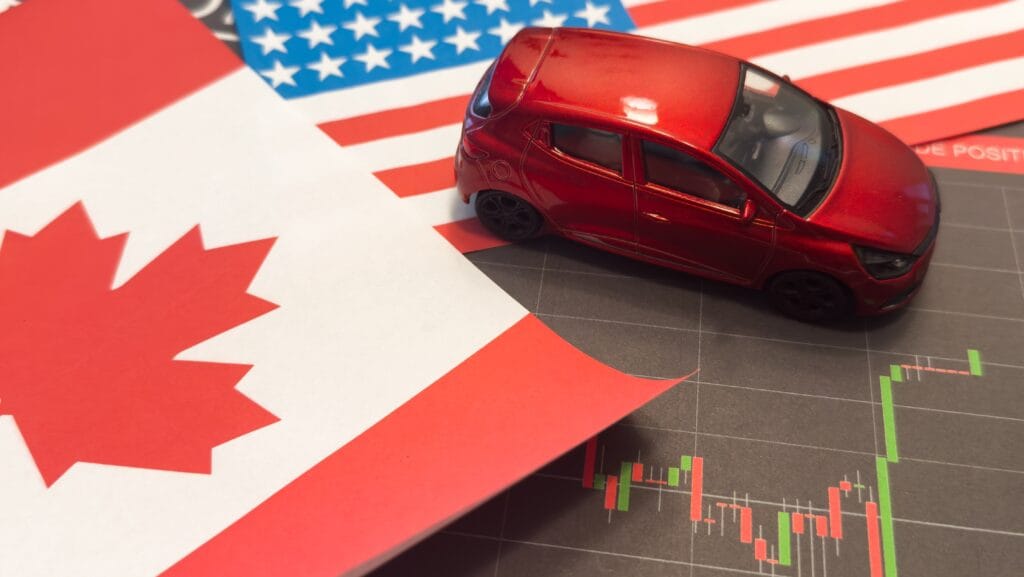
A new tariff push from Washington is turning the trade fight from showroom prices toward the hidden machinery inside modern vehicles. While imported cars have already been a political target, the next pressure point may be the engines, batteries, electrical components, brake parts, sensors, tires, and computer systems that make vehicles run.
The risk is not just that a finished car could cost more. It is that the supply chain behind nearly every vehicle is built from parts that move across borders, sometimes more than once, before a driver ever sees a window sticker. Trump’s latest tariff strategy adds fresh uncertainty to an already strained auto sector, raising questions for automakers, repair shops, dealers, and families trying to budget for a new or used vehicle.
The Tariff Fight Is Moving Deeper Into the Vehicle
Trump’s newest trade move is built around a Section 301 investigation into forced-labor import rules across dozens of economies. The proposal would add duties of 10 percent or 12.5 percent on many imports, depending on how U.S. trade officials classify each country’s forced-labor enforcement. On paper, that sounds broader than cars. In practice, it lands in the middle of a supply-chain system where auto manufacturers rely on parts, materials, and electronics from a long list of countries.
The auto sector is especially exposed because the parts inside a car are rarely simple, single-country products. A battery pack may rely on minerals, cells, software, cooling systems, and casings sourced through different channels. A transmission or electronic control unit can include inputs from multiple countries before final assembly. That makes even a tariff aimed at broader trade behaviour feel personal to drivers, because the eventual cost can show up as a higher price on a new vehicle, a pricier repair estimate, or fewer discounts at the dealership.
Auto Parts Were Already in the Crosshairs
The newest tariff proposal does not arrive in a vacuum. In March 2025, Trump announced a 25 percent tariff framework on imported automobiles and certain automobile parts under Section 232, a trade law tied to national security. The vehicle tariff began in early April 2025, while the auto-parts duties took effect in early May 2025. That schedule gave automakers and suppliers only a narrow window to understand which parts were covered and how import paperwork would be handled.
The parts list was not limited to obscure components. It covered major systems such as engines, transmissions, powertrain parts, electrical components, and lithium-ion batteries, along with more everyday pieces like tires, shock absorbers, spark plug wires, and brake hoses. That matters because these are not optional luxury features. They are the guts of modern vehicles. A tariff on a finished imported SUV is easy for shoppers to understand. A tariff on the parts buried under the hood is harder to see, but it can still shape the final price.
The “Made in North America” Label Is More Complicated Than It Looks
A vehicle sold as North American-made may still depend on parts that crossed the U.S., Canadian, and Mexican borders several times before assembly. The North American auto industry was designed around regional integration, not sealed national production lines. A part can be cast in one country, machined in another, tested somewhere else, and then shipped to a final assembly plant. That system worked because the trade rules made repeated border crossings manageable.
Tariffs complicate that rhythm. If duties are applied at the wrong point, or if companies cannot easily prove which content qualifies for preferential treatment, the cost of a part can rise before it ever reaches the assembly line. The impact can be especially awkward for Detroit automakers, because many U.S.-built vehicles still depend on imported parts. A pickup assembled in Michigan can include components from Mexico, Canada, Asia, Europe, or all of the above. The badge on the hood tells only part of the story.
Canada and Mexico Have Some Protection, But Not a Free Pass
Under the current auto-parts guidance, parts that qualify under the Canada-United States-Mexico Agreement can receive special treatment, including a 0 percent additional duty in certain cases. That protection is significant for Canadian and Mexican suppliers, because the North American auto sector depends heavily on regional sourcing. It also gives automakers a reason to document content carefully and preserve CUSMA compliance wherever possible.
Still, the protection has limits. U.S. rules have left room for tariffs to apply to the non-U.S. value of qualifying vehicles, and U.S. officials have said compliant auto parts are protected only until a process is established to apply duties to the non-U.S. content of those parts. Knock-down kits and parts compilations are treated differently. In plain English, CUSMA reduces the danger, but it does not eliminate uncertainty. That is why automakers, suppliers, and governments keep watching the fine print as closely as the headline tariff rate.
The Repair Counter Could Feel It Too
Most drivers do not buy engines or transmissions directly, but they do pay for parts when something breaks. A family replacing tires, a commuter dealing with worn suspension, or a parent facing a brake repair may never think about tariff codes. Yet some of the parts covered by the tariff framework overlap with common repair and maintenance categories. If import costs rise and suppliers pass them down the chain, repair shops may have less room to absorb the difference.
The impact would not be identical for every vehicle. A domestic model with widely available aftermarket parts may be less exposed than an imported luxury SUV with specialized electronics or a hybrid system. Older cars could also feel pressure if replacement parts become harder to source or more expensive to stock. For drivers already stretching vehicle life because new-car prices are high, even a modest increase in repair costs can be frustrating. A tariff fight that begins in Washington can end with a bigger invoice at a local garage.
EVs and High-Tech Vehicles May Be Especially Sensitive
Modern vehicles increasingly behave like computers on wheels. Electric vehicles, hybrids, advanced driver-assistance systems, infotainment screens, battery-management systems, and sensors all rely on complex electronic supply chains. The tariff list has already included lithium-ion batteries and electrical components, and reporting on the federal notice flagged automotive computers as a difficult category because the relevant tariff code can also cover broader computer products.
That creates a problem for an industry trying to make cleaner and more advanced vehicles more affordable. EVs are already cost-sensitive because batteries remain one of the most expensive parts of the vehicle. Hybrids also depend on specialized electronics and battery systems, even when the car still has a gasoline engine. If tariffs raise the cost of those inputs, manufacturers may delay price cuts, reduce incentives, or focus production on higher-margin trims. Consumers may not see the tariff line item, but they may notice fewer affordable options.
Automakers Got Relief, But It Does Not Remove the Cost
The Trump administration has offered some relief for U.S.-assembled vehicles and domestic production, including mechanisms designed to offset part-tariff costs for automakers. That helps explain why the policy is more complicated than a simple 25 percent tax on every component. The administration wants to pressure companies to build more in the United States while softening the immediate blow to manufacturers that already assemble vehicles there.
But relief does not make the costs disappear. A Center for Automotive Research analysis estimated that a uniform 25 percent tariff on imported parts and vehicles could add more than $100 billion in costs for U.S. automakers. Another estimate found average tariff costs of more than $4,000 per U.S.-produced vehicle tied to imported parts, with even higher costs for the Detroit Three. Automakers can try to absorb costs, renegotiate contracts, shift suppliers, or raise prices. None of those choices is painless.
The Bigger Risk Is Uncertainty
Tariffs do not only affect prices. They affect planning. Automakers make decisions years in advance about factories, suppliers, tooling, batteries, engines, and model launches. A sudden change in tariff rules can interrupt those plans, especially when companies do not know whether an exemption will remain, whether another parts category will be added, or whether Canada, Mexico, Europe, Japan, South Korea, or China will face a new layer of duties.
That uncertainty can shape what drivers see in the market. Companies may delay launches, reduce trim choices, shift production to vehicles with higher profit margins, or keep inventories tighter to avoid being caught with the wrong mix of tariff-exposed models. Dealers may become more cautious with discounts. Buyers may see confusing price changes from one month to the next. In the end, the biggest impact of the plan may not be one dramatic price jump, but a slower squeeze that makes cars, parts, and repairs feel more expensive and less predictable.
What Drivers Should Watch Next
The most important dates are not only on the campaign trail. U.S. trade officials opened a comment process for the forced-labor tariff proposal, with written comments due in July 2026 and hearings scheduled after that. Those steps matter because tariff proposals can change before they take effect. Exemptions can be added, rates can shift, countries can negotiate, and industries can lobby for carve-outs.
For drivers, the practical signs will be easier to spot than the legal filings. Watch for automakers warning about higher input costs, dealers reducing incentives, repair shops flagging parts shortages, or insurers reacting to more expensive replacement components. A tariff on a finished car makes headlines immediately. A tariff on the parts inside the car moves more quietly. But over time, that quiet pressure can still reach the driveway.

Alanna Rosen is an experienced content writer that focuses on many EV and educational content. Her articles are regularly published on Get CyberTrucked and syndicated on large publications.