China’s auto industry has become one of the world’s most formidable manufacturing machines, but its home market is suddenly refusing to absorb cars at the pace factories can produce them. Retail passenger-vehicle sales fell 22.1% year over year in May 2026, even as exports accelerated at a striking rate. The contrast is reshaping where Chinese automakers look for growth, how they price vehicles and where they build factories.
The downturn does not mean Chinese consumers have abandoned cars or electric vehicles. Instead, it reflects a difficult mix of weaker demand, reduced tax support, high fuel prices and a market crowded with competing brands. For automakers, the immediate answer has been to send more vehicles abroad. That strategy is delivering volume, but it is also intensifying trade tensions from Europe to emerging markets.
The 22% Drop Is Bigger Than a One-Month Miss
The headline figure comes from the China Passenger Car Association, which reported 1.51 million retail passenger-vehicle sales in May. That was 22.1% below May 2025, although sales improved 9.2% from April. The monthly rebound offered some relief, but it did not erase the scale of the year-over-year contraction. A dealership that delivered 100 cars in the comparable month last year would, on average, have moved only about 78 this May.
Through the first five months of 2026, retail sales reached about 7.1 million vehicles, down 19.5% from the same period a year earlier. May also marked the eighth consecutive month of annual declines. For dealerships, that means slower showroom traffic and more pressure to move inventory. For manufacturers, it means production plans built around years of rapid expansion are colliding with a domestic market that has become much harder to predict, even when monthly sales appear to stabilize at all.
China’s Car Market Has Been Losing Momentum for Months
May’s decline followed a 21.5% drop in April and a 15% fall in March, showing that the weakness was not caused by a single holiday calendar or temporary disruption. Industry officials have warned that domestic demand deteriorated more sharply than expected during the opening months of 2026 and could remain under pressure. The pattern matters because several consecutive declines can alter everything from factory shifts to supplier orders.
The slowdown is especially striking because China remains the world’s largest auto market and the centre of global electric-vehicle production. Its scale once allowed automakers to launch new models, cut prices and recover development costs quickly. That cycle becomes less forgiving when sales contract. A model that misses expectations can leave thousands of vehicles sitting at factories or dealerships, while another round of discounts may train consumers to delay purchases in anticipation of an even better deal. In that environment, waiting can feel rational to buyers but punishing to manufacturers.
Gasoline Cars Are Taking the Hardest Hit
The market is not shrinking evenly. Retail sales of conventional internal-combustion passenger vehicles fell 39% in May to roughly 560,000 units. New-energy vehicles, which include battery-electric cars and plug-in hybrids, declined a much smaller 7.5% to about 950,000. As a result, NEVs captured a record 62.9% of China’s retail passenger-car market, making electrified vehicles the clear majority despite the overall slump.
Even within the electric category, the picture was mixed. Battery-electric sales rose 3.9% to 637,000 vehicles, while plug-in hybrids fell 23% and extended-range models dropped even more sharply. High oil prices made gasoline vehicles less attractive, but they did not automatically lift every electrified segment. Chinese buyers increasingly appear to be choosing between fully electric cars and postponing a purchase, leaving traditional gasoline models and some hybrid formats squeezed in the middle. The shift is less a simple EV boom than a rapid reordering of consumer priorities this year.
Reduced Tax Support Changed the Buying Calculation
Policy has long played a major role in China’s electric-car boom. New-energy vehicles purchased in 2024 and 2025 qualified for a full purchase-tax exemption worth up to 30,000 yuan per passenger vehicle. Beginning in 2026, the incentive was cut in half, with the maximum tax reduction falling to 15,000 yuan for vehicles purchased in 2026 and 2027. For a family comparing two similarly priced cars, that change can materially alter the monthly payment.
China renewed its vehicle trade-in program for 2026, but the smaller tax benefit still raised the effective cost of many EVs. The shift matters most for price-sensitive households shopping at the lower end of the market. It also created a strong reason to buy before the end of 2025, pulling some demand forward. When support changes after years of generous incentives, even interested buyers may pause, compare prices more carefully or keep an older vehicle longer. Policy did not create the entire downturn, but it changed the timing and psychology of purchases.
Exports Have Become the Industry’s Release Valve
While Chinese showrooms struggled, overseas shipments surged. One widely cited passenger-car dataset put May exports at about 809,000 vehicles, up 73% from a year earlier. Another CPCA measure, covering domestically produced passenger vehicles under a different definition, recorded 784,000 exports, up 75.1%. The totals differ because industry groups count categories and channels differently, but both show the same dramatic direction: foreign demand is absorbing a growing share of China’s output.
New-energy passenger-car exports more than doubled, reaching roughly 424,000 to 435,000 units depending on the dataset. That means electric and plug-in hybrid vehicles accounted for more than half of passenger-car exports. Instead of slowing factories to match domestic demand, automakers are increasingly redirecting production toward Europe, Latin America, Southeast Asia and other markets where affordable electric vehicles remain scarce. A car that cannot find a buyer in Shanghai may now be headed to São Paulo, Bangkok or Berlin at scale.
BYD Shows How Quickly the Strategy Is Changing
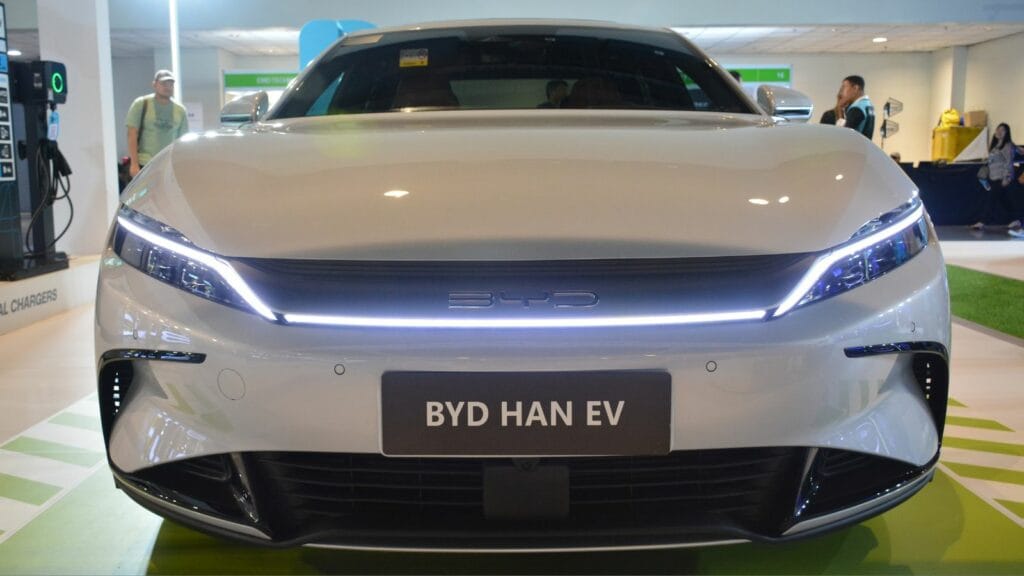
BYD’s May results captured the industry’s new dependence on foreign buyers. The automaker sold a record 160,644 vehicles overseas during the month, an increase of about 80% from a year earlier. Overseas volume represented roughly 42% of its monthly new-energy vehicle sales and helped BYD end its longest run of year-over-year sales declines. Without that international surge, the company’s headline performance would have looked considerably weaker.
The company is targeting about 1.5 million overseas sales in 2026, compared with approximately 1.05 million in 2025. That expansion is no longer a side project. BYD has said it wants to become the world’s largest automaker within five years, and international growth is central to that ambition. A customer choosing a Dolphin Surf in Europe or an Atto 3 in Latin America now matters more to BYD’s growth story than another round of discounts in an overcrowded Chinese showroom. The brand’s future is increasingly being decided outside China.
Selling Abroad Can Protect Thin Profit Margins
China’s price war produced impressive sales volumes but damaged earnings across the industry. The average automotive profit margin fell to a record-low 4.1% in 2025 and reportedly slipped to 2.9% during the first two months of 2026. Automakers faced rising development costs while repeatedly cutting prices or adding expensive driver-assistance features at little extra charge. Selling more vehicles did not always translate into healthier businesses.
Exports can provide better pricing and reduce dependence on China’s relentless discount cycle. The International Energy Agency found that Chinese electric-car exports doubled to more than 2.5 million units in 2025 as production exceeded domestic demand and manufacturers pursued higher profits overseas. The opportunity is not guaranteed: shipping, distribution, warranty networks and local marketing all add costs. Still, a vehicle that earns little in China may generate a healthier return in a market where comparable EVs remain more expensive. Foreign sales are therefore becoming a financial strategy, not merely a volume strategy.
Tariffs Are Pushing Automakers to Build Cars Overseas
Export growth is provoking a policy response. The European Union imposed additional countervailing duties of 17% on BYD electric vehicles made in China, 18.8% on Geely and 35.3% on SAIC, on top of the EU’s standard vehicle import tariff. Those measures make direct exports less attractive and encourage Chinese companies to manufacture closer to their customers. Tariffs designed to slow imports may therefore accelerate Chinese investment inside Europe.
BYD plans to begin production at its Szeged, Hungary, plant in late 2026 and is considering an existing factory in southern Europe for a second regional site. Its European sales nearly reached 188,000 vehicles in 2025 and exceeded 100,000 through May 2026. Building locally can reduce tariff exposure, shorten supply chains and create European jobs, but it also transforms a trade dispute into a long-term industrial challenge for established automakers. Instead of competing only with imported Chinese cars, they may soon compete with Chinese brands built by European workers.
The Impact Will Reach Far Beyond China
The export wave is arriving as global EV demand continues to grow. The International Energy Agency expects about 23 million electric cars to be sold worldwide in 2026, equal to 28% of all new-car sales. Chinese automakers supplied roughly 60% of global electric-car sales in 2025, while China produced nearly three-quarters of the world’s electric cars. Few manufacturing shifts have reached this scale so quickly.
For consumers, that scale can mean more models, faster technology adoption and lower prices. For governments and rival automakers, it raises concerns about subsidies, factory closures and dependence on Chinese batteries and supply chains. Exports may keep Chinese plants busy, but they cannot remove every risk created by weak demand at home. The more heavily automakers rely on foreign markets, the more exposed they become to tariffs, local-content rules and political resistance. China’s domestic slump is therefore becoming a global auto-industry story, with consequences for car prices, factory jobs and trade policy far beyond its borders.

Alanna Rosen is an experienced content writer that focuses on many EV and educational content. Her articles are regularly published on Get CyberTrucked and syndicated on large publications.