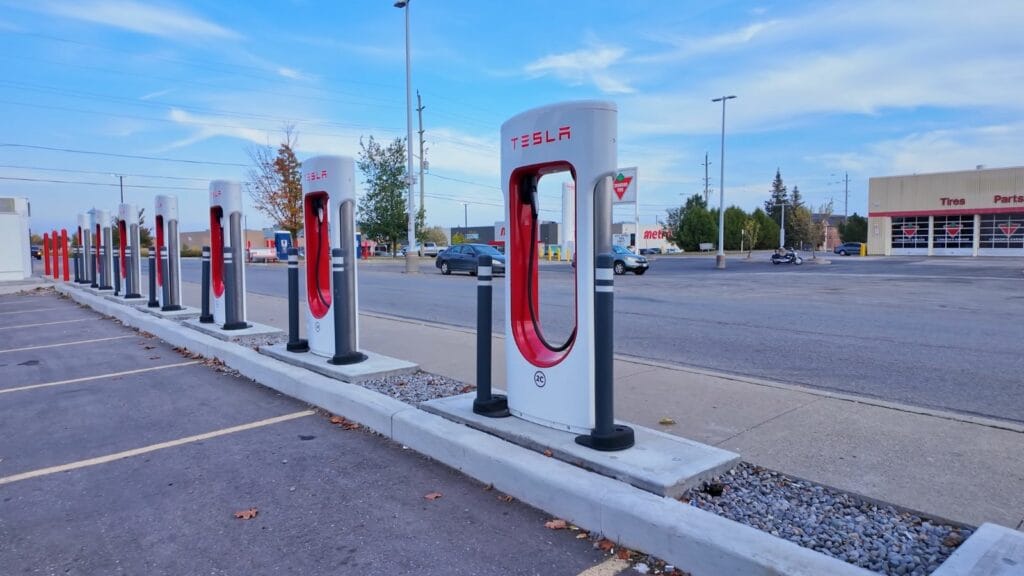
For months, the rows of red-and-white charging posts at an Ajax shopping centre stood ready but unusable, a highly visible reminder that building an electric-vehicle station is only part of the job. On June 17, 2026, that wait ended when Tesla activated its 44-stall Supercharger at RioCan Durham Centre, making it the company’s largest charging site in Canada by stall count.
Located at 40 Kingston Road East, just north of Highway 401, the new hub can deliver up to 325 kilowatts and is available around the clock. It also accepts compatible non-Tesla vehicles with North American Charging System access. The opening adds substantial fast-charging capacity to the eastern Greater Toronto Area and offers a practical test of what high-volume public charging can look like as more Canadian drivers move toward electric vehicles.
A New Canadian Record Is Set in Ajax
The Ajax station takes the national title from Tesla’s 40-stall Supercharger in Richmond, British Columbia. It also moves well beyond Ontario’s previous high-water mark, the 32-stall site in Mississauga. Four extra stalls may sound like a modest difference from Richmond, but the scale becomes clearer when compared with the smaller eight-, 12- or 16-port charging stops commonly encountered on Canadian road trips. At full availability, 44 drivers can be connected at the same location rather than forming a queue around a much smaller bank of chargers.
The milestone is important because charging capacity is measured not only by how many dots appear on a map, but by how many vehicles a site can serve during busy periods. A station may look adequate on an ordinary weekday and become overwhelmed before a holiday weekend. Ajax gives Tesla a larger buffer for those demand spikes. It also creates redundancy: if a few stalls are occupied or temporarily unavailable, dozens of other charging positions remain.
The Opening Followed Months of Frustrating Delays
Construction began in May 2025, and the physical station was largely completed months before drivers were allowed to use it. An opening had been expected for January 23, 2026, but the date passed while the site remained fenced off. Reporting on the project traced the delay to utility connections and final energization rather than a lack of installed charging hardware. For nearby owners, the result was especially frustrating because the finished equipment could be seen from the surrounding parking lot.
The final steps accelerated in June. Local officials confirmed that the site had been energized, crews completed commissioning work, and Tesla then activated the station in its network on Wednesday evening, June 17. The episode illustrates a less visible obstacle facing charging expansion. Installing posts and pouring concrete can happen relatively quickly; obtaining sufficient electrical service, completing inspections and coordinating final activation can take much longer. Ajax’s delayed launch therefore became both a success story and a case study in the grid and permitting work behind public fast charging.
A Highway Location Designed for More Than a Quick Plug-In
The Supercharger sits at RioCan Durham Centre, a large open-air retail complex near Kingston Road, Salem Road and Highway 401. RioCan describes the property as a roughly 1.09-million-square-foot centre with 86 units and major retailers including Walmart, Home Depot, Canadian Tire, Costco, Winners, HomeSense, SportChek and Chapters. That mix gives drivers practical ways to use a charging stop: groceries can be picked up, a meal can be ordered, or a family can stretch its legs without leaving the property.
Its placement near Highway 401 is equally significant. The corridor is the main east-west route through southern Ontario and links the Greater Toronto Area with communities such as Oshawa, Cobourg, Belleville and Kingston. A driver heading east from Toronto can now stop before leaving the densest part of Durham Region, while westbound travellers gain another option before entering GTA traffic. The Town of Ajax has also framed the project as an economic opportunity, arguing that charging visitors may stay, shop and eat locally rather than simply passing through.
What a 325-Kilowatt Maximum Means in Practice
Tesla lists the Ajax stalls as capable of delivering up to 325 kW, matching the maximum rate promoted for its current Supercharger network. That figure describes peak power, not a guarantee that every vehicle will receive 325 kW throughout a session. Actual speed depends on the vehicle’s charging limit, battery temperature, state of charge and the station’s operating conditions. A car that can accept only 150 kW will not charge at 325 kW simply because the post has a higher rating.
Charging also slows as a battery fills, particularly at higher states of charge. Tesla says its Superchargers can add as much as 322 kilometres of range in about 15 minutes under suitable conditions and notes that battery preconditioning can improve charging performance. For drivers, the practical advantage of Ajax is therefore a combination of speed and capacity. The power can shorten a well-planned stop, while the unusually large stall count reduces the chance that time saved at the plug will be lost waiting for one to become available.
Pricing Rewards Drivers Who Can Avoid Peak Hours
At the time of opening, Tesla’s app showed rates for Tesla vehicles as low as $0.29 per kilowatt-hour during off-peak periods and as high as $0.51 per kilowatt-hour during peak daytime hours. Compatible non-Tesla vehicles could face rates reaching $0.72 per kilowatt-hour at the busiest times. Tesla says Supercharger prices are pay-per-use, may vary by site and time, and can change. The rate that applies is determined when the vehicle is plugged in.
That gap can meaningfully change the cost of a stop. Adding 50 kWh would cost about $14.50 at the lowest listed Tesla rate, compared with $25.50 at the top Tesla rate. At $0.72 per kWh, the same amount of energy would cost $36 for a non-Tesla vehicle without a lower-rate membership. Those examples do not represent every charging session, since vehicles take different amounts of energy and prices may be updated. They do show why drivers who have flexible schedules may favour early-morning, evening or other off-peak visits.
The Hub Is Not Reserved Exclusively for Tesla Drivers
The Ajax station is open to compatible non-Tesla EVs that have a native NACS port or an approved NACS DC adapter supplied by the vehicle manufacturer. Tesla’s Canadian support information lists brands with access that include Ford, General Motors, Rivian, Hyundai, Kia, Mercedes-Benz, Volvo, Polestar, Nissan, Audi, Porsche, Volkswagen, BMW, Toyota, Honda and several others. Drivers must still confirm that their specific vehicle and the individual station are supported through the Tesla app.
This broader access changes the meaning of a large Tesla-branded site. NACS was originally developed by Tesla, but SAE International has standardized the connector as J3400, helping turn it into a wider North American charging format. At Ajax, that transition is visible in a practical way: a row of chargers built by one automaker can serve vehicles sold by many competitors. There are still limitations, including adapter requirements, different charging-port locations and potentially higher prices for non-Tesla users. Even so, the station adds capacity to the public charging system rather than functioning only as a private benefit for one brand.
The Opening Comes as Canadian EV Demand Begins to Recover
The Ajax hub arrived during a renewed rise in zero-emission vehicle registrations. Statistics Canada reported 43,113 new ZEV registrations in the first quarter of 2026, equal to 10.8 per cent of all new motor-vehicle registrations. That was a 15.8 per cent increase from the first quarter of 2025 and the first year-over-year gain since late 2024. Battery-electric registrations rose 12.9 per cent, while plug-in hybrid registrations increased 22.9 per cent.
Charging infrastructure has also continued to expand. An Electric Autonomy tally using Natural Resources Canada data counted 8,431 public DC fast-charging ports at 2,706 stations in early 2026, up from 6,309 ports a year earlier. Tesla alone was listed with 2,892 DC fast-charging ports at 274 Canadian stations, while the company said its network had already surpassed 3,000 ports across more than 300 locations. Ajax adds only 44 ports to those national totals, but concentrating them beside a major highway and retail destination gives the project an influence larger than its raw share of the network.
Ajax Offers a Glimpse of the Next Phase of Public Charging
Canada’s charging buildout is moving from basic geographic coverage toward larger, faster and more flexible hubs. Tesla has said more than 90 per cent of its Canadian Superchargers are open to compatible vehicles from other brands and that all new sites will follow that approach. The network was targeting more than 400 additional Canadian fast-charging ports in 2026, while Ottawa has announced funding and financing programs intended to support thousands of chargers from multiple operators.
The Ajax station shows what that next phase may look like in everyday life: dozens of plugs, variable pricing, retail amenities and access for a growing range of vehicles. It will not eliminate every queue or solve charging gaps in rural and northern communities. It does, however, raise expectations for high-demand urban and highway sites. For drivers, success will be measured less by the record itself than by whether the hub remains dependable on cold mornings, summer travel weekends and busy evenings. After a long delay, Canada’s largest Supercharger is finally ready for that real-world test.

Alanna Rosen is an experienced content writer that focuses on many EV and educational content. Her articles are regularly published on Get CyberTrucked and syndicated on large publications.