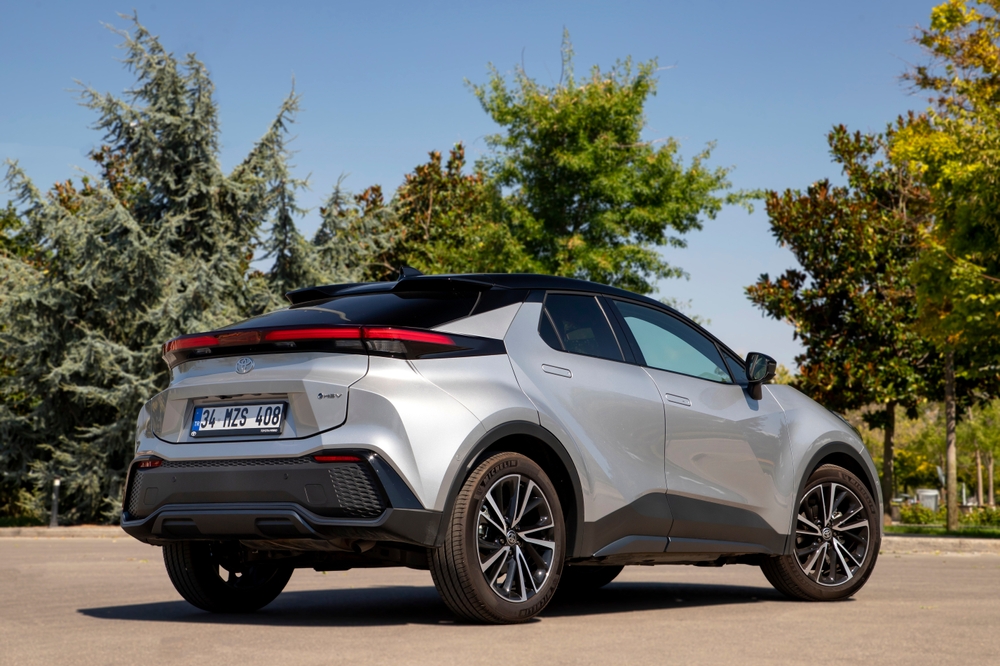
Toyota is returning the C-HR name to Canada, but almost everything beneath the badge has changed. The 2026 model is now a fully electric compact crossover, and its headline combination is unusually direct: a starting MSRP of $44,900 and an NRCan-estimated driving range of up to 496 kilometres.
That pairing gives Toyota a stronger answer for Canadians who have liked the idea of an EV but found the price, range or charging compromises difficult to accept. The new C-HR is smaller and less rugged than Toyota’s other electric SUVs, yet it arrives with a 77-kWh battery, standard fast-charging hardware and a well-equipped cabin. More importantly, it enters the market as federal incentives return and Canadian zero-emission vehicle registrations begin growing again.
A Price Engineered to Matter
Toyota’s advertised $44,900 figure applies to the front-wheel-drive C-HR SE and represents the manufacturer’s suggested retail price, not the final amount on a purchase contract. Toyota estimates the vehicle price at $48,300 once freight, pre-delivery inspection, air-conditioning charges and maximum dealer or other fees are included. Sales tax, licensing, registration and insurance remain extra. That distinction matters because a price that looks comfortably below $45,000 can move close to $50,000 before a buyer selects paint, accessories or protection packages.
The base C-HR may also fit within Canada’s Electric Vehicle Affordability Program. In 2026, an eligible battery-electric purchase or lease of at least 48 months can receive up to $5,000 at the point of sale. Approval is not automatic: the dealership must confirm the buyer and transaction qualify, and the program generally limits the final transaction value to $50,000. Options, accessories and dealer fees count toward that threshold, while freight, taxes and government incentives do not.
The 496-Kilometre Figure Belongs to One Specific Trim
The 496-kilometre rating belongs specifically to the C-HR SE with front-wheel drive and 18-inch wheels. Choosing the dual-motor XSE AWD lowers the NRCan estimate to 452 kilometres, while the XSE Premium AWD—with 20-inch wheels and more luxury equipment—is rated at 438 kilometres. All three versions use a 77-kWh lithium-ion battery, so the official figures make the trade-off easy to see: the longest-range model is also the lightest and simplest configuration, while the more powerful trims surrender distance for added traction, performance and equipment.
Those numbers should still be treated as comparison tools rather than promises. Toyota states that the ratings assume a full battery and ideal outside temperatures of roughly 20 to 30 degrees Celsius. Speed, cold weather, cabin heating, terrain, cargo, road conditions and driving habits can all reduce real-world range. Even so, a driver covering a 60-kilometre round-trip commute would have substantial breathing room between charges in mild conditions, rather than needing to plug in every evening.
Front-Wheel Drive for Distance, AWD for Speed
Toyota has created two noticeably different personalities within the same crossover. The SE sends 221 horsepower to the front wheels, prioritizing efficiency and the maximum 496-kilometre rating. The XSE models add a second electric motor at the rear, producing a combined 338 horsepower through electronic all-wheel drive. Toyota estimates the AWD version can accelerate from zero to 100 km/h in 5.2 seconds—quick enough to give a compact commuter the straight-line pace once associated with performance cars.
The C-HR is built on Toyota’s dedicated e-TNGA electric platform, with its battery mounted beneath the floor. That layout lowers the centre of gravity, while cross-framing around the pack contributes to body rigidity. Toyota also says the springs, dampers and anti-roll bars were tuned specifically for this model. Drivers can select four levels of regenerative braking with steering-wheel paddles, making it possible to increase deceleration in traffic or reduce it when coasting feels more natural. The result is not simply a gasoline crossover converted to run on electricity.
Charging Finally Feels Less Complicated
Every Canadian C-HR receives a North American Charging System port, an 11-kW onboard AC charger and a dual-voltage cable that can connect to 120- or 240-volt power. On a compatible DC fast charger, Toyota estimates the battery can move from 10% to 80% in about 30 minutes under ideal conditions. That is the difference between a brief highway stop and a much longer interruption, although actual charging time will vary with battery temperature, charger output, weather and the vehicle’s starting charge level.
Battery preconditioning is standard and can warm or cool the pack toward a more useful temperature before fast charging. It can be activated manually, or automatically when a compatible charging station is entered into the navigation system; the automatic function depends on an active Drive Connect trial or subscription. Plug & Charge can also identify the vehicle and handle authorization at selected networks, though it likewise depends on connected services. These details matter in Canada, where winter preparation can be as important as the charger’s advertised maximum speed.
Compact Outside, More Useful Than the Roofline Suggests
The C-HR’s coupe-like roofline suggests style first, but its measurements reveal a genuinely usable compact crossover. It is 4,520 millimetres long, 1,870 millimetres wide and 1,620 millimetres tall, with a 2,750-millimetre wheelbase. Cargo capacity is rated at up to 720 litres behind the second row and 1,685 litres with the 60/40 split rear seatbacks folded. That gives the vehicle enough flexibility for grocery runs, luggage, sports equipment or a larger purchase without moving into a heavier, more expensive electric SUV.
Toyota also avoids making the least expensive version feel purely urban. The SE includes a power liftgate, low-profile roof rails, rain-sensing wipers and 18-inch alloy wheels. Heated front seats and a heated steering wheel address cold-weather comfort, while a 1,500-watt AC outlet can power small equipment or electronics. The sloping body still asks buyers to decide whether style and compact dimensions matter more than the boxier cargo shape of a conventional SUV, but the published capacity is stronger than the silhouette initially suggests.
The Base Model Does Not Feel Stripped
The standard-equipment list is one of the C-HR’s more persuasive features. Even the SE includes a 14-inch Toyota Multimedia touchscreen, wireless Apple CarPlay and Android Auto, a digital gauge cluster, two wireless phone chargers and four USB-C ports. It also brings an eight-way power driver’s seat, fabric and SofTex upholstery, ambient lighting and a six-speaker audio system. For a base model positioned as Toyota’s entry electric vehicle, the cabin does not appear designed merely to advertise a low starting price.
Moving to the XSE AWD adds SofTex and synthetic-suede trim, an eight-way power passenger seat, driver-seat memory and a panoramic-view monitor. The Premium package brings a fixed panoramic roof, heated rear seats and a nine-speaker JBL system with an 800-watt amplifier. Some connected features deserve a closer look during a purchase decision: Drive Connect and Remote Connect include three-year trials, while Safety Connect and Service Connect include longer trial periods. Once those trials end, continued access to certain cloud, remote and driver-assistance functions may require a paid subscription.
Safety and Warranty Address First-Time EV Nerves
Toyota Safety Sense 3.0 is standard across the C-HR range. Its core functions include a pre-collision system with pedestrian detection, full-speed adaptive cruise control, lane-departure alert with steering assist, lane-tracing assistance, road-sign recognition, automatic high beams and Proactive Driving Assist. Blind-spot monitoring, rear cross-traffic alert, Safe Exit Alert and front-and-rear parking assistance with automatic braking are also standard. These systems can reduce workload and warn of hazards, but Toyota stresses that they do not replace attentive driving.
Coverage for the electric hardware is equally important for buyers moving away from gasoline for the first time. Toyota Canada lists an eight-year or 160,000-kilometre warranty for battery-electric-specific components, the high-voltage battery and battery-capacity coverage. The broader vehicle receives a three-year or 60,000-kilometre basic warranty and a five-year or 100,000-kilometre powertrain warranty. Roadside assistance runs for three years with unlimited kilometres. The terms do not eliminate every ownership risk, but they place the most expensive EV components under coverage well beyond the basic warranty period.
Why the Timing Matters in Canada
The timing of the C-HR’s arrival is notable because Canada’s EV market is showing signs of recovery after a difficult 2025. Statistics Canada recorded 43,113 new zero-emission vehicle registrations in the first quarter of 2026, equal to 10.8% of all new registrations. That was a 15.8% increase from a year earlier, while battery-electric registrations alone rose 12.9%. The federal affordability program began on February 16, giving lower-priced models a clearer advantage than vehicles that sit well beyond the program’s transaction-value limit.
Within Toyota’s own range, the C-HR now serves as the entry point below the $45,990 bZ and the more rugged $59,900 bZ Woodland. It also joins a Canadian market in which several of the ten least-expensive EVs now carry MSRPs below $50,000. That competition means Toyota cannot rely on its badge alone. The C-HR’s case rests on a specific formula: nearly 500 kilometres of rated range in the base trim, useful standard equipment, familiar dealer support and the option of genuinely quick all-wheel-drive performance.

Alanna Rosen is an experienced content writer that focuses on many EV and educational content. Her articles are regularly published on Get CyberTrucked and syndicated on large publications.