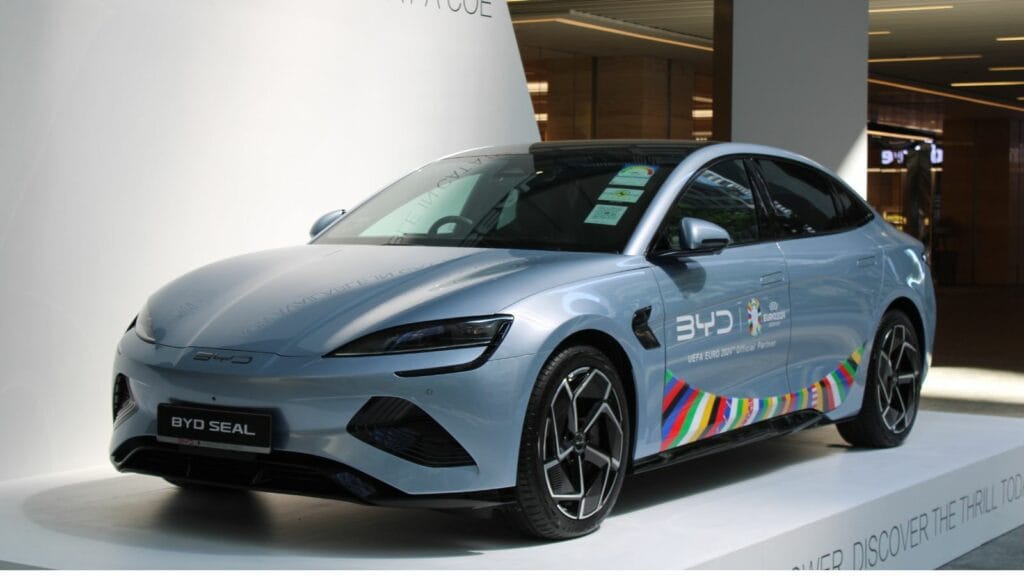
A brief conversation at the G7 summit revealed how quickly the temperature around Canada’s controversial Chinese electric-vehicle deal can change. Months after senior Trump administration officials predicted that Ottawa would regret opening its market to Chinese-made EVs, President Donald Trump sounded surprisingly receptive when Prime Minister Mark Carney explained that imports would be controlled by a firm quota.
The exchange did not erase Washington’s concerns about Chinese technology, auto-sector competition or North American supply chains. It did, however, give Carney something politically valuable: evidence that Canada’s decision may not be the deal-breaking confrontation some critics predicted. Behind the friendly words remains a much larger struggle over affordable vehicles, manufacturing jobs, agricultural exports and Canada’s room to make independent trade decisions.
A G7 Conversation Changed the Tone
The shift emerged during an informal conversation between Carney and Trump at the June G7 summit in Évian-les-Bains, France. Carney told the president that Chinese EV imports would represent less than 3% of the Canadian market, with a maximum of 49,000 vehicles permitted during the first year. He emphasized that Ottawa had established a hard cap rather than opening the market without limits.
Trump responded positively, saying he liked the structure. Carney later said the two leaders discussed the arrangement more than once and that Trump appeared comfortable once the quota mechanism was explained. The exchange mattered because it contrasted sharply with the language coming from other members of the administration. It also showed Carney adapting his argument to Trump’s preference for controlled, transactional trade deals. Instead of defending closer relations with China in broad diplomatic terms, he presented the policy as a tightly managed agreement that delivered measurable benefits while limiting Chinese access.
What Canada’s “Hard Cap” Actually Means
Canada’s arrangement allows an initial 49,000 electric vehicles originating in China to enter each year at the regular most-favoured-nation tariff of 6.1%. That replaced the additional 100% surtax Ottawa had imposed in October 2024. The quota took effect on March 1, 2026, with the first 24,500 vehicles available through a six-month, first-come, first-served import period ending August 31.
The cap will not remain fixed. It is scheduled to increase by 6.5% annually, bringing the total close to 70,000 vehicles after five years. Ottawa has also attached an affordability requirement, although it begins gradually. Ten per cent of the second-year quota must have a free-on-board import value of C$35,000 or less, rising to 50% by the fifth year. That figure represents the vehicle’s value before dealership expenses, shipping and other retail costs, so it does not guarantee a C$35,000 showroom price. Importers must obtain shipment-specific permits, and vehicles arriving outside the quota can be prohibited.
Trump’s Officials Had Delivered a Much Harsher Warning
The friendlier G7 exchange followed months of criticism from Washington. When Canada announced the arrangement in January, U.S. Transportation Secretary Sean Duffy said Ottawa would eventually regret bringing Chinese vehicles into its market. U.S. Trade Representative Jamieson Greer also called the decision problematic and questioned whether Canada would be satisfied with the bargain over the longer term.
Even then, Greer acknowledged that 49,000 vehicles were unlikely to disrupt American exports to Canada. His stronger concern was that Chinese automakers could gain a strategic foothold in North America, particularly as Washington was working to keep Chinese-connected vehicles and technology out of the United States. Officials stressed that cars admitted to Canada would not automatically be allowed across the U.S. border. That distinction remains important. Canada’s tariff decision governs its own consumer market; it does not give Chinese vehicles preferential access under CUSMA or override American import, cybersecurity and country-of-origin rules. Trump’s warmer language softened the politics, but it did not dismantle those regulatory barriers.
Canola Was the Bargaining Chip Behind the Cars
The EV quota was not negotiated in isolation. Canada offered limited access to Chinese-made vehicles as part of a wider arrangement designed to restore market access for Canadian agriculture. China had imposed combined tariffs of roughly 84% on Canadian canola seed after Ottawa introduced its original EV surtax. Under the new understanding, Beijing agreed to reduce the combined canola rate to about 15%.
That concession carries particular weight across the Prairies. Canadian canola seed exports to China have historically represented a multibillion-dollar market, affecting farmers, grain handlers, railways and processors far beyond the farm gate. China also agreed to remove or suspend discriminatory tariffs affecting products such as canola meal, peas, lobsters and crabs, while working on access for beef, pet food and animal genetics. Ottawa estimated that the broader package could unlock nearly C$3 billion in export orders. For a Saskatchewan producer facing a suddenly restricted market, the deal can look less like a concession to Beijing and more like an attempt to recover customers lost during a tariff dispute.
Carney Is Testing a More Independent Trade Strategy
Carney has framed the agreement as an example of pragmatic diversification at a time when Canada’s traditional economic relationship with the United States has become less predictable. His government wants to expand non-U.S. exports and reduce the risk created by relying too heavily on one customer. Allowing a controlled number of Chinese vehicles offered Ottawa a bargaining asset that Beijing valued without granting unlimited access to Canada’s auto market.
The government also argues that competition and potential joint ventures could strengthen Canada’s EV supply chain. Officials hope Chinese automakers may eventually invest in Canadian assembly, battery production or technology partnerships with trusted domestic companies. That outcome is not guaranteed, and the current arrangement does not force manufacturers to build plants in Canada. However, the strategy reflects a clear calculation: Canada may gain more from negotiating conditions for Chinese participation than from attempting to block the world’s largest EV industry indefinitely. Trump’s reaction gives Carney room to argue that diversification does not automatically mean abandoning North American economic integration.
Ontario’s Auto Sector Sees a Much Bigger Risk
The quota may be small compared with Canada’s total vehicle market, but its critics argue that market share is not the only relevant measurement. Ontario Premier Doug Ford warned that allowing lower-cost Chinese vehicles without guaranteed Canadian investment could undermine companies already producing vehicles and parts domestically. Unions and traditional automakers have raised similar concerns about competing against firms benefiting from China’s enormous industrial scale and state-supported supply chains.
The stakes are substantial. Canada’s auto industry supports roughly 125,000 direct jobs, about 80% of them in Ontario. In 2024, Canadian plants produced approximately 1.3 million light-duty vehicles, with roughly 1.1 million exported to the United States. For an assembly worker in Windsor or a parts supplier in southwestern Ontario, even a limited quota can feel like the beginning of a larger shift rather than an isolated trade concession. Critics also note that Chinese brands could use early imports to establish dealerships, service networks and brand recognition before the quota expands. Ottawa’s challenge will be proving that new competition can produce Canadian investment instead of simply replacing Canadian-made vehicles.
Affordability Gives the Deal Its Strongest Consumer Argument
The government’s most politically effective defence may be the price of a new vehicle. Statistics Canada reported that dealerships received an average of C$55,827 for each vehicle sold in 2025, compared with C$43,567 in 2019. At the same time, the share of new vehicles classified as zero-emission fell from 13.8% in 2024 to 8.7% in 2025, following changes to incentives and a period of economic uncertainty.
That creates an opening for manufacturers capable of selling smaller, lower-priced EVs. Chinese companies have built a global reputation for offering extensive technology and electric range at prices that challenge North American, Japanese and European competitors. Canada had comparatively few EV choices below C$40,000 before incentives, which limited adoption among households unable to spend luxury-vehicle money. The market has recently shown signs of recovery—battery-electric registrations rose 12.9% year over year in the first quarter of 2026—but affordability remains central. For a family replacing an aging commuter car, the debate may ultimately be less about geopolitics than whether a dependable EV fits the monthly budget.
Cybersecurity Concerns Have Not Disappeared
Washington’s resistance to Chinese vehicles is about more than factory jobs. Modern cars collect location information, connect to phones, receive remote software updates and rely on cameras and sensors. American officials argue that vehicles using Chinese-controlled software or communications equipment could expose sensitive data or create opportunities for remote interference. U.S. restrictions generally begin with Chinese-linked connected-vehicle software in 2027 model-year vehicles, followed by hardware restrictions scheduled for later years.
Those rules help explain why American officials insist that Chinese-made vehicles sold in Canada will not simply flow south. Even established companies have had to seek special authorization when Chinese ownership or production intersects with connected-car regulations. Canada has said imported vehicles must meet Canadian motor-vehicle safety standards, but crashworthiness and road safety do not settle every question involving data storage, software control and foreign access. Ottawa will therefore face pressure to establish clear privacy and cybersecurity requirements before unfamiliar brands become widely available. Trump may accept the numerical cap while his administration continues enforcing a much harder technological barrier.
The Real Test Will Come During the CUSMA Review
The timing makes Trump’s softer response especially significant. Canada, the United States and Mexico are approaching the first six-year joint review of CUSMA on July 1, 2026. The review does not automatically terminate or renegotiate the agreement, but each country must decide whether it supports extending the pact’s term. A failure to agree would create recurring reviews and prolonged uncertainty for businesses that depend on predictable North American rules.
Canada sends roughly three-quarters of its exports to the United States, making the relationship too large to treat casually. Washington could still use Chinese EV access as leverage when discussing automotive content requirements, technology rules or trade with non-market economies. Trump has also questioned whether the United States benefits from maintaining the agreement in its current form. His approving comments therefore represent reassurance, not a binding guarantee. They suggest the quota itself may be negotiable within the wider relationship, but they do not ensure that U.S. officials will stop challenging Canada’s China policy. Carney has won a friendlier hearing; the harder task is keeping the dispute from becoming bargaining ammunition.
Softer Words Do Not Yet Amount to a Policy Reversal
Trump’s reaction fits a broader tension within his own approach to China. He has supported high tariffs and strict controls on Chinese technology, yet he has also said Chinese automakers could be welcomed if they built factories and created jobs in the United States. That leaves room for him to appreciate Canada’s quota as a controlled deal even while senior officials remain deeply skeptical of Chinese industrial expansion.
For Ottawa, the moment is useful but should not be mistaken for a final settlement. Trump’s positions can shift with the negotiating context, and agencies responsible for trade, transportation and national security will continue applying existing American rules. The durability of Canada’s strategy will depend on what happens next: whether affordable vehicles actually reach consumers, whether Chinese companies make meaningful Canadian investments, whether agricultural access remains open and whether domestic auto employment is protected. The G7 exchange lowered the political temperature. It did not resolve the central question of whether Canada can deepen selected trade ties with China without paying a price in Washington.

Alanna Rosen is an experienced content writer that focuses on many EV and educational content. Her articles are regularly published on Get CyberTrucked and syndicated on large publications.